


How Startups Can Claim Tax Holidays and Benefits During Incometax Efiling
How Startups Can Claim Tax Holidays and Benefits During Incometax Efiling
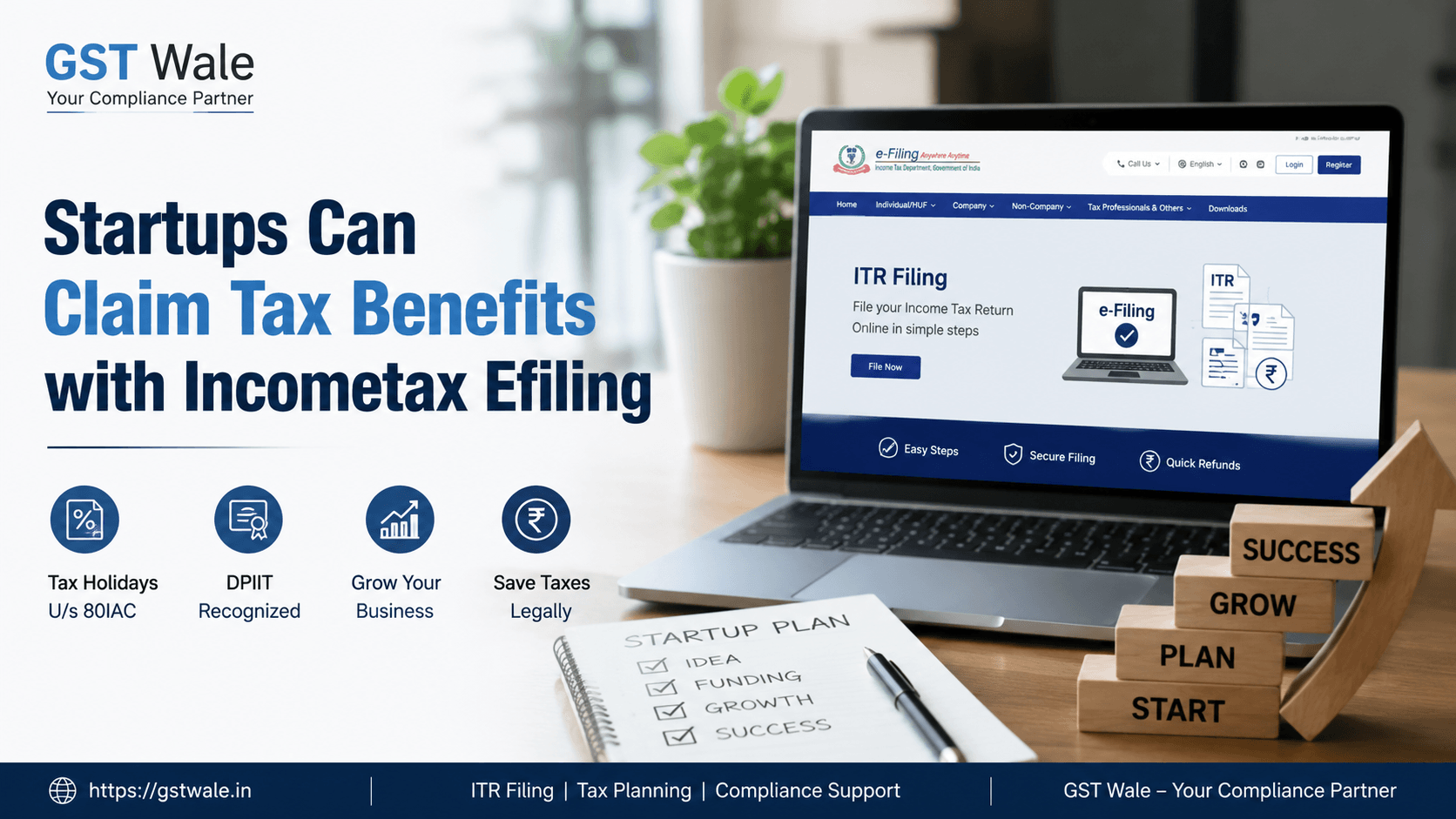
How Startups Can Claim Tax Holidays and Benefits During Incometax Efiling
Starting a business in India comes with plenty of challenges, but the government also provides several tax benefits to encourage innovation, investment and employment. One of the most important benefits available to an eligible startup is the tax deduction under Section 80IAC. However, simply calling your business a startup does not automatically give you a tax holiday. Proper eligibility, DPIIT recognition, documentation and accurate incometax efiling are all important.
For founders, getting the tax return right is just as important as maintaining books of accounts. If you are looking for professional support with your ITR Filing, GST Wale can help you understand the applicable provisions and prepare your return correctly.
In this article, we explain how the startup tax holiday works, who can claim it, what the turnover criteria mean, and how other tax benefits can be considered while completing incometax efiling.
Understanding the Startup Tax Holiday Under Section 80IAC
Section 80IAC provides a 100% deduction of eligible business profits for three consecutive assessment years, selected out of the prescribed period beginning from the year of incorporation. The Income Tax Department currently describes the benefit as 100% of profits for three consecutive assessment years out of the first ten years from incorporation.
This is commonly referred to as a startup tax holiday. It is important to understand that it is a deduction from eligible business profits, not simply a blanket exemption from every type of tax or every source of income.
For example, suppose a qualifying startup has eligible business profits of ₹30 lakh in a particular year. If that year falls within its approved three-year tax exemption window and all conditions are satisfied, the startup may claim a deduction of the eligible profit under Section 80IAC.
This can significantly improve cash flow during the early years when founders generally need more money for hiring, technology, marketing and expansion.
Who Is an Eligible Startup for Section 80IAC?
Before claiming the benefit during incometax efiling, founders should first determine whether the business qualifies.
The basic requirements include:
- The entity should generally be a DPIIT-recognized startup.
- For Section 80IAC, the eligible entity is a private limited company or LLP.
- The startup must satisfy the applicable incorporation-date requirements.
- The business should be engaged in innovation, development or improvement of products, processes or services, or have a scalable business model with significant potential for employment or wealth creation.
- The business should not have been formed by splitting up or reconstructing an existing business.
- The applicable turnover criteria must be satisfied.
Startup India's current recognition framework has also been updated following the February 2026 notification, with the turnover threshold for general DPIIT startup recognition revised to ₹200 crore. However, founders should distinguish this recognition criterion from the separate conditions applicable to the Section 80IAC tax deduction.
That distinction is important because DPIIT recognition and eligibility for the actual income-tax deduction are related but are not exactly the same thing.
Why DPIIT Recognition Matters Before Incometax Efiling
DPIIT recognition is an important starting point for startups planning to access government benefits. A recognized startup can apply for various benefits under the Startup India framework, including tax-related incentives.
However, recognition alone should not be treated as automatic approval for the tax holiday.
For Section 80IAC, the startup needs to satisfy the applicable conditions and obtain the necessary eligibility approval. Startup India states that recognized startups can apply for the Section 80IAC exemption, while the Inter-Ministerial Board validates eligibility for the income-tax benefit.
Therefore, founders should ideally complete the recognition and exemption process well before the incometax efiling deadline rather than waiting until the last moment.
How to Claim Section 80IAC Benefit During Incometax Efiling
The process should be approached systematically.
Step 1: Check Your Startup Eligibility
First, verify the legal structure, incorporation date, business activity, recognition status and applicable turnover criteria.
Do not assume that every newly incorporated company qualifies. The nature of the business and other statutory conditions also matter.
Step 2: Obtain DPIIT Recognition
If your startup meets the applicable conditions, apply for DPIIT recognition through the prescribed government process.
Keep the recognition certificate and supporting documents safely because they may be required while applying for further benefits.
Step 3: Apply for the Section 80IAC Benefit
After obtaining the required recognition, apply for the Section 80IAC tax exemption through the applicable Startup India process.
Financial statements, incorporation details, shareholding information, income-tax records and other supporting documents may be required depending on the application stage. Startup India's 80IAC application process specifically refers to documents such as audited financial statements, income-tax return acknowledgements and shareholding details.
Step 4: Identify the Correct Three Years
The tax holiday does not necessarily mean that the first three years must always be selected.
The law provides a window within which the startup can claim the deduction for three consecutive assessment years. A founder should therefore evaluate profitability and business projections before deciding when the tax exemption window will be most useful.
Step 5: Report the Deduction Correctly
During incometax efiling, the eligible profit and deduction should be reported under the appropriate provisions and schedules of the applicable income-tax return.
The figures in the return should agree with the books of accounts and financial statements. A mismatch between financial statements, tax computation and the return can create unnecessary compliance issues.
What About the Turnover Criteria?
Turnover is one area where startup founders should be particularly careful.
There are different thresholds for different startup-related benefits and these thresholds have changed over time. The current DPIIT recognition framework provides for a ₹200 crore turnover ceiling for non-DeepTech startups and ₹300 crore for DeepTech startups.
For Section 80IAC, however, the applicable tax-law conditions should be checked separately. Startup India's current 80IAC application material continues to state a ₹100 crore turnover condition for that specific tax exemption.
This is a good example of why founders should not copy a turnover limit from a general startup article and use it directly while preparing incometax efiling. The relevant provision, assessment year and applicable rules should always be checked.
Capital Gain Benefits Available to Startup Investors
Startup-related tax benefits are not limited to the company's business profits.
Certain capital-gain provisions can also provide relief in appropriate circumstances. For example, Section 54EE can provide exemption from tax on qualifying long-term capital gains when the gains are invested in a specified long-term asset notified by the government, subject to the statutory conditions and investment limit. Startup India records the maximum investment under this provision as ₹50 lakh.
There is also a provision under Section 54GB relating to investment of proceeds from certain residential property transfers into eligible startup equity, subject to the conditions prescribed by law.
So, when founders or investors discuss a "capital gain waiver", they should understand that these are conditional exemptions or deductions, not an unconditional waiver of capital-gains tax.
Professional review is especially useful because the conditions can involve the type of asset sold, timing of investment, holding requirements and the manner in which the funds are used.
Common Mistakes Startups Should Avoid During Incometax Efiling
A tax holiday can be valuable, but incorrect reporting can create problems. Some common mistakes include:
- Assuming DPIIT recognition automatically provides the Section 80IAC deduction.
- Using an outdated turnover threshold.
- Claiming the deduction without satisfying the applicable approval requirements.
- Selecting tax-holiday years without considering profitability.
- Reporting figures that do not match audited financial statements.
- Ignoring documentation requirements.
- Treating capital-gain provisions as unconditional exemptions.
- Filing the return without reviewing the relevant schedules and tax computation.
A founder may save considerable tax through a legitimate benefit, but only when the underlying conditions are properly satisfied.
Practical Example: How a Startup Can Plan Its Tax Holiday
Consider a technology startup that becomes eligible for the Section 80IAC benefit and starts generating substantial profits after several years of operation.
Instead of automatically claiming the deduction in an early low-profit year, the management may evaluate whether a later three-year period would provide greater tax savings, provided the legal conditions and available window permit such selection.
For instance, if profits are ₹8 lakh in one year and ₹60 lakh in a later eligible year, the timing of the deduction can materially affect the overall tax benefit.
This is why incometax efiling should not be treated merely as a form-filling exercise. Tax planning should ideally happen before the financial year closes.
Documents Startups Should Keep Ready
Before completing incometax efiling, maintain a proper file containing:
- Certificate of incorporation
- DPIIT recognition certificate
- Section 80IAC eligibility or approval documents, where applicable
- Audited financial statements
- Profit and loss account
- Balance sheet
- Books of accounts
- Previous income-tax return acknowledgements
- Shareholding details
- Details supporting business eligibility
- Computation of income and deduction
Keeping these records organised makes the return preparation process considerably smoother.
FAQs About Incometax Efiling for Startups
Can every DPIIT-recognized startup claim Section 80IAC?
No. DPIIT recognition is an important eligibility step, but the Section 80IAC deduction has its own conditions. The startup must satisfy the applicable requirements for the tax benefit and obtain the necessary eligibility approval before claiming the deduction.
How many years can an eligible startup claim the tax holiday?
Section 80IAC provides a 100% deduction of eligible profits for three consecutive assessment years within the applicable ten-year period from incorporation. The exact year selection should be planned carefully based on eligibility and profitability.
Is DPIIT recognition enough to reduce income tax?
No. DPIIT recognition provides access to various startup benefits, but individual tax incentives can have additional requirements. Section 80IAC, for example, has separate conditions for claiming the profit deduction.
Can a startup claim capital gain benefits as well?
Certain capital-gain provisions may apply in qualifying circumstances. Sections such as 54EE and 54GB have specific conditions, investment requirements and limitations. They should therefore be evaluated separately rather than treated as an automatic benefit.
Should startups take professional help for incometax efiling?
For a startup claiming significant tax deductions, professional review can be worthwhile. A CA can check eligibility, documentation, computation, disclosures and consistency between the books and the income-tax return before filing.
Plan Your Incometax Efiling Before the Deadline
For a growing startup, tax planning can make a meaningful difference to cash flow and long-term growth. Section 80IAC can provide a substantial tax benefit to an eligible startup, while DPIIT recognition and certain capital-gain provisions can offer additional advantages when their respective conditions are satisfied.
The key is not simply to claim a deduction, but to establish eligibility, maintain proper records and report the benefit correctly during incometax efiling. The turnover criteria, tax exemption window and other conditions should also be checked against the rules applicable to the relevant year.
At GST Wale, we believe that good tax compliance starts with good planning. If you are a startup founder and want to understand your tax benefits, deductions or return filing requirements, connect with GST Wale for professional guidance and accurate incometax efiling support.
 Previous