


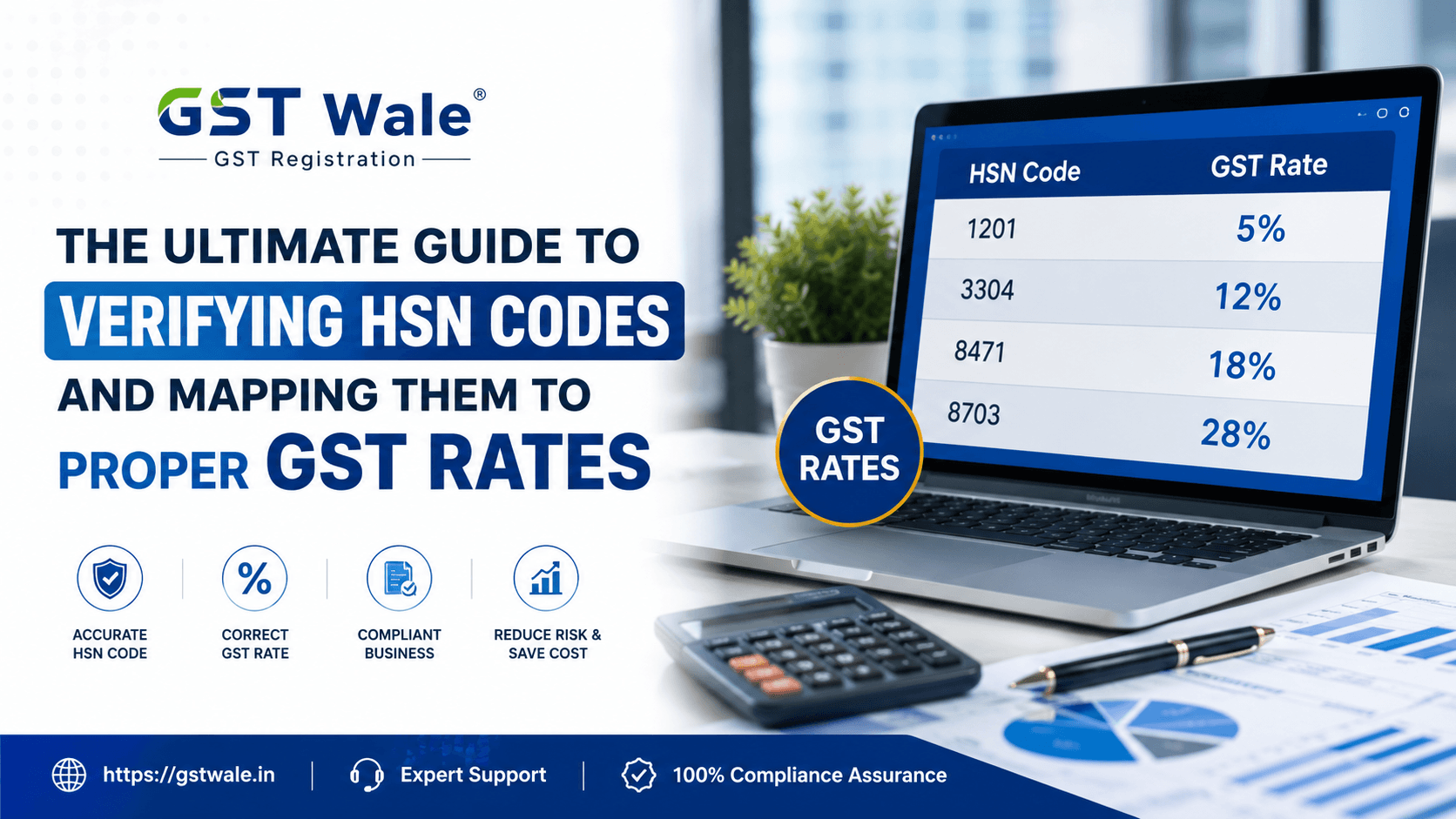
The Ultimate Guide to Verifying HSN Codes and Mapping Them to Proper GST Rates
The Ultimate Guide to Verifying HSN Codes and Mapping Them to Proper GST Rates
As a business owner in India, running your daily operations keeps you on your toes. Between managing supply chains, handling customers, and tracking cash flow, the last thing you want is a legal notice from the tax department. Yet, thousands of entrepreneurs find themselves in hot water every year for one simple, avoidable mistake: choosing the wrong Harmonized System Nomenclature (HSN) code.
When you misclassify your product, you inevitably apply the wrong gst rates on your invoices. This doesn't just mess up your books; it invites heavy penalties and scrutiny. If you are just starting your business journey, securing your GST Registration is only the first step. The real work lies in compliance, and today, we at GST Wale are going to break down exactly how to verify HSN codes and map them perfectly to the correct gst rates.
Understanding HSN Codes and Why They Matter
Before we dive into the mapping process, let’s understand what we are dealing with. The Harmonized System Nomenclature, universally known as HSN, is an internationally accepted 6-digit multipurpose goods nomenclature developed by the World Customs Organization (WCO). India has adopted this system and extended it to an 8-digit code for even greater specificity.
Think of an HSN code as a universal barcode for your products. Whether you sell handmade leather shoes from Agra or premium tea leaves from Darjeeling, the tax department identifies your product through this specific code.
Why is Accurate HSN Mapping Crucial?
Determines Tax Liability: Your HSN code directly dictates which of the gst rates applies to your product. A single digit error can push your product from a 12% bracket to an 18% bracket.
Legal Compliance: Incorrect mapping leads to misclassification disputes with tax authorities, which can freeze your input tax credit (ITC) and result in costly litigation.
Smooth ITC Flow: If your HSN codes don’t match what your supplier has uploaded, your buyers won’t get their Input Tax Credit, which can severely damage your business relationships.
Step-by-Step Guide to Verifying HSN Codes
Finding and verifying the right code shouldn't feel like searching for a needle in a haystack. Here is the exact process we use at GST Wale to help our clients verify their codes.
Step 1: Analyze Your Product Components
Don’t just look at what the product is; look at what it is made of and how it is used. For example, if you sell a gift hamper containing chocolates (18% GST) and dry fruits (12% GST), the classification rules change based on whether it is a mixed supply or a composite supply.
Step 2: Use the Official HSN Finder Tool
The government provides an official hsn finder tool on the GST Portal.
Log into the GST portal or visit the CBIC website.
Navigate to the 'Services' tab, select 'User Services', and click on 'Search HSN Code'.
Enter keywords related to your product or type the initial digits if you know them.
Step 3: Check the Structure of the Code
Ensure you are using the right length of the code based on your business turnover:
Turnover up to ₹5 Crores: Minimum 4-digit HSN code required for B2B invoices.
Turnover above ₹5 Crores: Mandatory 6-digit HSN code for all B2B and B2C invoices.
Import/Export: 8-digit HSN codes are mandatory, regardless of turnover.
Mapping HSN Codes to the Correct GST Rates
Once you have verified your HSN code, the next critical step is cross-referencing it with the current gst rates structure. The Indian government frequently updates these slabs during GST Council meetings, meaning you need to keep an eye out for any gst new rate announcements.
Navigating the GST Rate Slabs
Currently, goods and services are broadly categorized under five major tax brackets. When mapping, you must match your HSN code against the latest official gst new rate list:
0% (Exempt): Essential items like fresh milk, unbranded food grains, and curd.
5%: Items of mass consumption like tea, coffee, edible oils, and life-saving drugs.
12%: Processed foods, business class air travel, and specific machinery.
18%: The most common gst new slab for capital goods, electronic items, and various professional services.
28%: Luxury and demerit goods like automobiles, aerated drinks, and tobacco products.
Avoid Common Mapping Pitfalls
A frequent mistake we see at GST Wale involves tax invoice formatting. Business owners often select a general HSN code to save time, accidentally charging a lower tax rate. If the department catches this during an audit, you will have to pay the differential tax amount out of your own pocket, along with 18% interest per annum.
Real-World Example: The Confectionery Confusion
Let’s look at a practical scenario. Suppose you manufacture chocolate-coated biscuits.
Plain biscuits fall under HSN Chapter 19 and generally attract lower gst rates.
Chocolates fall under HSN Chapter 18 and attract a higher gst new rate of 18%.
If you mistakenly classify your chocolate-coated biscuits purely as plain biscuits to enjoy a lower rate, you are inviting misclassification disputes. The department looks at the essential character of the product. Because it is marketed and consumed as a chocolate treat, it must be mapped to the higher tax bracket.
Frequently Asked Questions (FAQs)
Q1: What happens if I mention the wrong HSN code on a tax invoice?
If you put an incorrect HSN code but charged the correct tax rate, it is considered a clerical error, attracting a minor penalty. However, if the wrong HSN code led to you charging lower gst rates, you will be liable to pay the short tax amount, plus interest and penalties for tax evasion.
Q2: How often does the government release a gst new rate list?
The GST Council meets periodically (usually every few months) to review economic conditions. If they decide to rationalize taxes, a gst new slab or rate revision is notified immediately via CBIC circulars.
Q3: Is HSN mandatory for small retailers selling directly to consumers?
If your annual aggregate turnover is under ₹5 Crores and you are issuing a B2C (Business to Consumer) invoice, mentioning the HSN code is optional. However, for B2B invoices, it remains mandatory.
Q4: Can two different products have the same HSN code?
Yes, broader categories (like 4-digit codes) cover a wide range of similar items. However, as you go deeper into the 6-digit and 8-digit codes, the descriptions become highly specific to individual product types.
Let GST Wale Handhold Your Compliance
Accurate classification is the backbone of a healthy tax profile. While tools like the online hsn finder tool make the process easier, interpreting complex legal definitions can still be tricky. A single misinterpretation can lead to uncalled-for disputes and disrupt your business peace of mind.
Don't leave your tax compliance to guesswork. At GST Wale, we stay on top of every gst new rate update and structural shift so you don't have to. Whether you are struggling to find the right HSN code, fixing your tax invoice formatting, or trying to resolve past misclassification disputes, our team of expert Chartered Accountants is here to guide you every step of the way. Reach out to GST Wale today, and let’s keep your business legally sound and financially thriving!
 Previous