


How the Automobiles Sector is Adapting to the Simplified GST New Rate Framework
How the Automobiles Sector is Adapting to the Simplified GST New Rate Framework
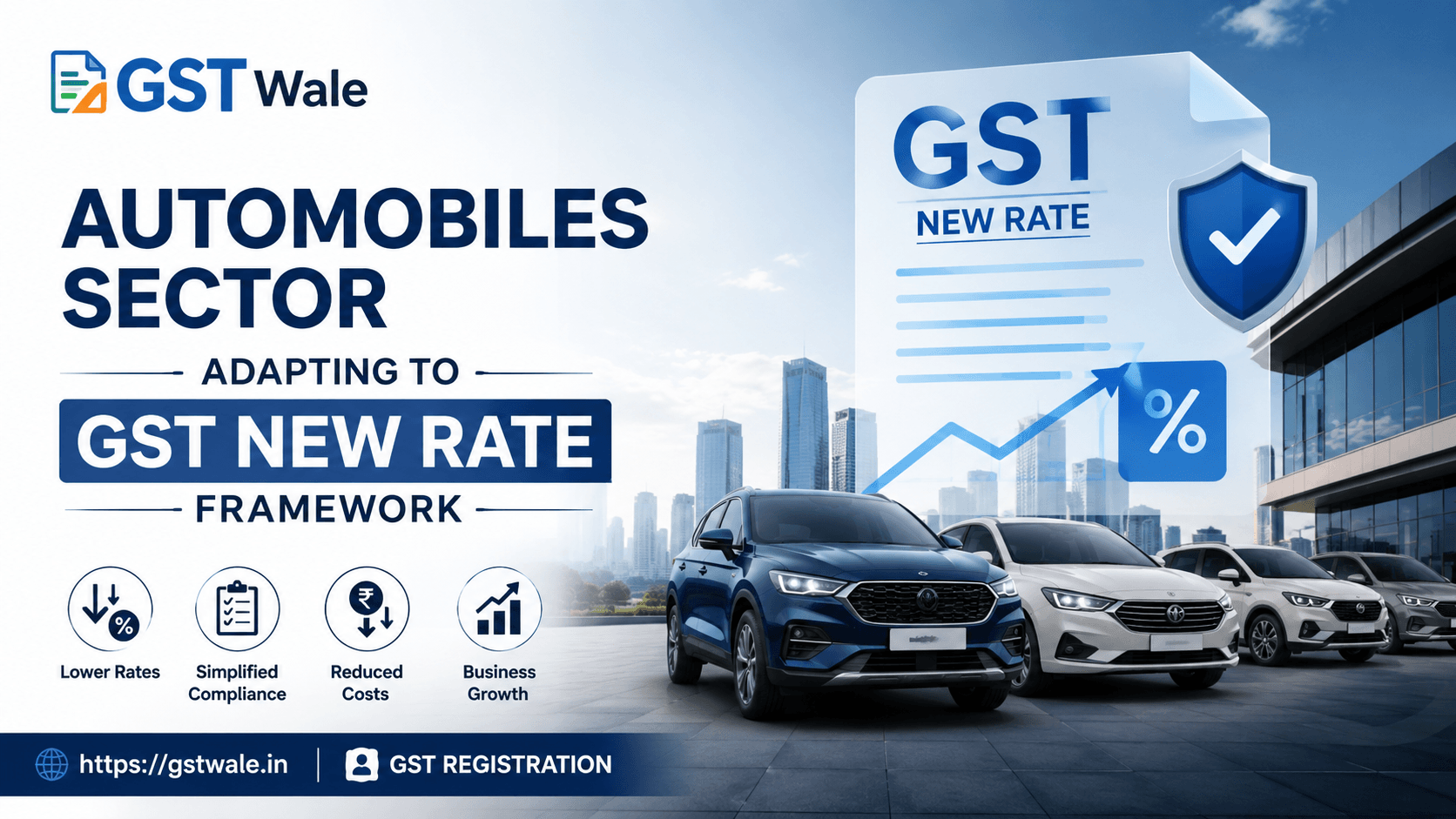
The Indian automobile landscape is undergoing one of its most critical tax transformations. For years, auto manufacturers, dealers, and everyday car buyers struggled with a complex tax matrix—a standard 28% base rate bundled with unpredictable, varying slabs of Compensation Cess. Following the implementation of the historic GST 2.0 reforms, the landscape has completely shifted. The complex structure has collapsed into a highly predictable, streamlined tax model.
At GST Wale, we interact daily with automobile dealerships, spare parts manufacturers, and logistics firms trying to make sense of these sweeping updates. The primary objective behind the gst new rate framework is unambiguous: to eliminate complex definitions, improve affordability for mass-market buyers, and fast-track structural compliance. If you are a business operating in the automotive supply chain or planning to launch an auto-venture, securing a valid GST Registration is your immediate first step to access the input tax credits unlocked by this massive overhaul.
The Core Philosophy Behind the GST New Rate Structure
Before diving into how different vehicle segments are adapting, let us look at the structural shift. Previously, an automobile’s final price tag depended on highly precise engineering specifications: exact millimeter measurements of length, microscopic variations in engine displacement, and ground clearance dimensions.
Under the revised gst new rate framework, the multi-layered system has been simplified into major, consolidated tax brackets. By removing the old Compensation Cess on key passenger segments, the government has moved away from hyper-specific classification rules to two dominant pillars: 18% for mass market and public utility vehicles, and 40% for larger premium vehicles.
Segment-by-Segment Impact of the New Tax Framework
The implementation of the gst new rate has modified pricing strategies across different automotive verticals. Here is a clear breakdown of how major categories are transitioning under the revised gst new slab structure:
1. Mass Market Vehicles and the Small Car Tax Cut
The entry-level passenger segment has received a major boost. Previously, sub-4-meter hatchbacks and compact sedans were taxed at a 28% base rate plus an additional 1% to 3% compensation cess, driving the effective tax burden to around 29% to 31%.
The updated gst new rate list introduces a flat 18% tax slab for small cars:
Petrol, LPG, and CNG vehicles (Engine $\le$ 1200cc and Length $\le$ 4000mm): Flat 18% GST (No Cess).
Diesel vehicles (Engine $\le$ 1500cc and Length $\le$ 4000mm): Flat 18% GST (No Cess).
This specific small car tax cut represents a direct tax reduction of 11 to 13 percentage points. For a mass-market hatchback priced at an ex-showroom value of ₹6,00,000, this structural correction yields immediate savings of over ₹60,000, immediately lowering the baseline entry cost for Indian families.
2. Mid-Size Sedans and the Premium SUV Segment
For larger vehicles, the calculation has shifted away from layered cess schedules. Previously, large sedans and premium SUVs faced a steep combined tax rate of up to 50% (28% GST + up to 22% cess).
The new framework establishes a flat 40% GST rate for this entire luxury tier, eliminating the separate luxury automobile cess component completely. This 40% threshold applies uniformly to:
Mid size suv tax brackets and premium utility platforms (Length $> 4000\text{mm}$ or Engine $> 1500\text{cc}$).
High-capacity hybrid models exceeding small-car dimensions.
While a 40% tax rate remains high, the elimination of a variable luxury cess simplifies the final billing process, resolves long-standing classification disputes regarding ground clearance, and slightly reduces the overall tax incidence on larger family utility vehicles.
Green Mobility and Commercial Vehicles Under the New Regimes
The government continues to use gst rates strategically to encourage sustainable technology and strengthen industrial supply chains.
Accelerating Electric Vehicle Subsidies
To maintain clear long-term direction for alternative energy investment, the concessional tax bracket for the electric vehicle ecosystem remains protected. All electric cars, two-wheelers, and commercial electric vehicles continue to attract a concessional 5% GST rate. By preserving this low rate alongside separate electric vehicle subsidies, the government maintains a clear price advantage for clean-energy options over conventional internal combustion engines.
Support for Commercial Logistics and Infrastructure
The broader transportation industry has also seen significant tax reductions. Heavy-duty freight trucks, public transit buses designed to carry 10 or more passengers, and three-wheeler auto-rickshaws have all dropped from the 28% luxury bracket to a standard 18% rate. This structural change helps lower capital expenditure requirements for domestic logistics businesses and fleet operators.
Practical Action Plan for Auto Dealerships and Ancillary Businesses
As a business owner navigating this transition, you must update your business operations to stay aligned with the gst new rate changes.
Audit and Update ERP Systems: Ensure your billing software reflects the new flat rates (18% or 40%) based on exact HSN codes, removing the calculation fields for the old compensation cess.
Optimize Input Tax Credit (ITC): With standard components and spare parts stabilizing around the 18% marker, match your outward tax liabilities with your supplier invoices to maximize cash flow efficiency.
Revise Anti-Profiteering Guardrails: Ensure that the benefits from the small car tax cut and lower commercial vehicle rates are passed down to consumers transparently via adjusted ex-showroom pricing.
Frequently Asked Questions (FAQs)
Q1. How has the gst new rate changed the tax calculation on mid-size SUVs?
Previously, a premium SUV faced a combined tax rate of roughly 50%, consisting of a 28% base rate plus a 22% compensation cess. Under the current simplified system, the separate luxury automobile cess has been removed, and the vehicle is taxed at a single, flat 40% GST rate.
Q2. Do vehicle spare parts and accessories benefit from the 18% small car tax cut?
No. The small car tax cut to 18% applies strictly to the sale of complete vehicles matching the specific engine and length criteria. High-end aesthetic components, alloy wheels, and advanced entertainment systems continue to attract separate rates under their respective component HSN categories.
Q3. Does the lower GST rate on vehicles reduce the cost of car insurance?
Yes, it does. Vehicle insurance premiums are calculated based on the car's Insured Declared Value (IDV), which directly relies on the vehicle's ex-showroom price. Because the new, lower tax rates reduce the base ex-showroom cost, the associated insurance premiums drop accordingly.
Q4. Is a business required to modify its existing GST registration due to these rate changes?
No, you do not need a new registration if you already hold one. However, you must update your invoicing software and accounting matrices to ensure that the correct tax liabilities are calculated, reported, and settled in your monthly filing returns.
Need Expert Guidance? Partner with GST Wale
Transitioning your business operations to align with major regulatory updates requires meticulous planning and execution. Whether you need to update your invoicing workflows, optimize your input tax credit structures, or secure a fresh commercial registration, GST Wale is here to support you at every stage.
 Previous