


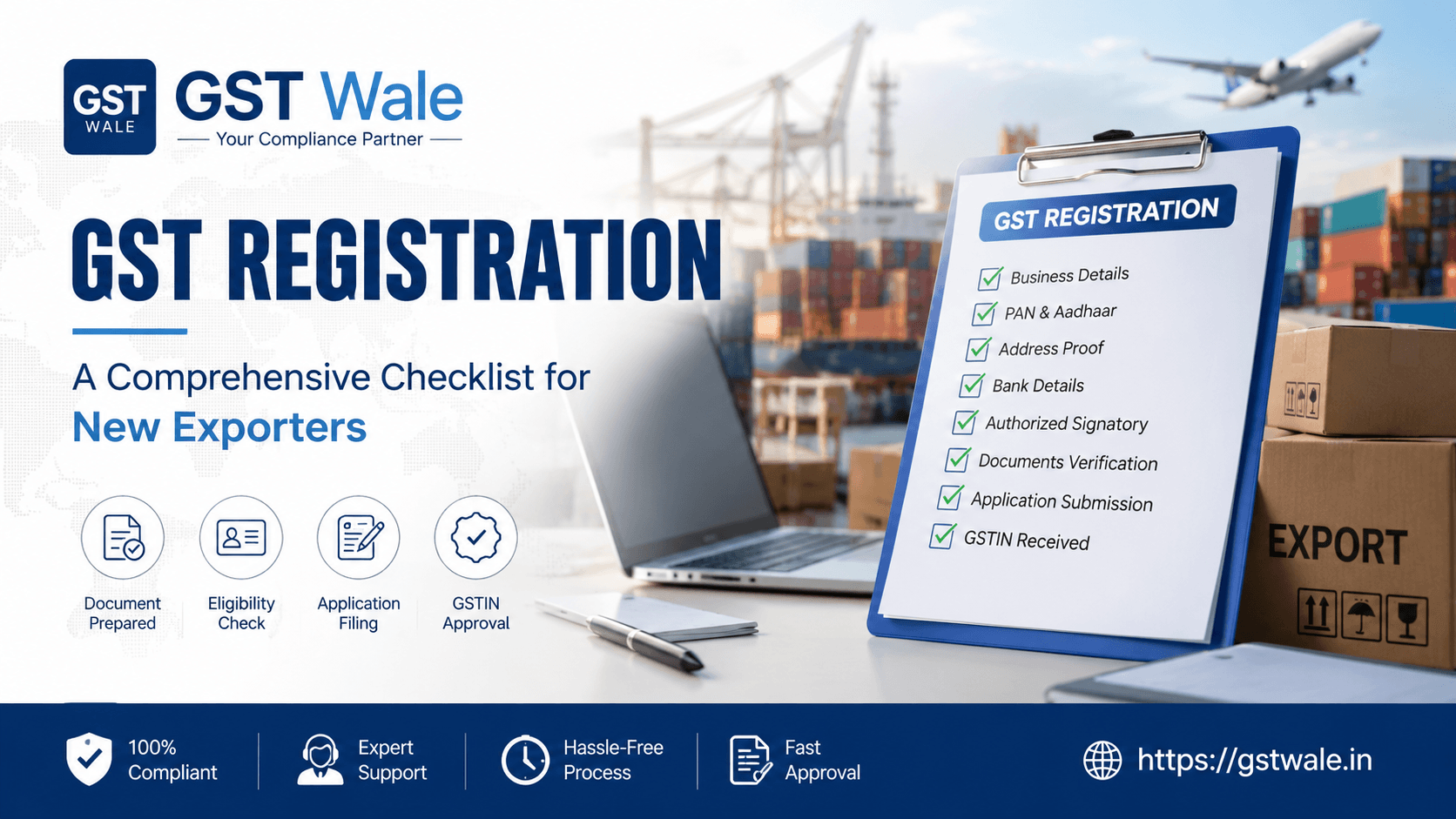
A Comprehensive Checklist for New Exporters Applying for GST Registration
A Comprehensive Checklist for New Exporters Applying for GST Registration
Namaste! Starting an export business from India is an exhilarating journey. Venturing into the global market allows your products and services to reach international horizons while bringing home valuable foreign currency. However, before you load your first cargo or send out your first international service invoice, you need a robust compliance foundation. At the heart of this foundation lies the mandatory passport for your business entity: your goods and services tax registration.
Many budding entrepreneurs approach us at GST Wale with a common dilemma: "Namaste CA Saab, I am only going to sell goods outside India, so why do I need to register for local taxes" Here is the expert insight: under Section 16 of the Integrated Goods and Services Tax (IGST) Act, exports are classified as zero rated exports. This means you do not pass on the burden of domestic taxes to your international clients. However, to claim the incredible benefits of this tax structure, tracking your transactions through a valid compliance portal is legally non-negotiable. Legally securing your business through an official portal like GST Registration is the very first step toward operating a legitimate, globally recognized Indian export house.
Why GST Registration is Crucial for Exporters
In the cross-border trade framework, registering under the GST regime opens doors to immense financial advantages. Without it, your international trade setup faces operational gridlock.
Unlocking Zero Rated Exports Benefits
When you engage in exporting, your sales are labeled as zero-rated. This does not mean the goods themselves are exempt from tax; rather, it means the entire supply chain is kept tax-free. You can execute this through two primary compliance routes:
Export under a Letter of Undertaking (LUT): This pathway allows you to ship your products or deliver services abroad without paying any upfront output IGST.
Export with payment of IGST: Under this alternative, you pay the integrated tax at the time of export and claim a complete reimbursement later.
Reclaiming Your Cash Flow via Refund of Input Tax Credit
As an exporter, you buy raw materials, pay for packaging, hire logistics providers, and procure various services within India. All these domestic purchases attract standard GST. If you utilize the LUT pathway for your outward shipments, you accumulate a significant balance in your Electronic Credit Ledger.
A formal registration empowers you to file for a refund of input tax credit seamlessly. This ensures that your hard-earned working capital does not remain blocked in government accounts, giving you the liquid cash required to scale your cross-border operations.
The Essential Pre-Registration Checklist
Before logging onto the common portal, a wise exporter gathers all required documentation. Misaligned details are the most frequent cause of application rejections and delayed approvals.
1. Primary Identity and Business Constitution Proofs
The documentation requirements fluctuate depending on how you choose to legally structure your business venture:
Sole Proprietorship: Permanent Account Number (PAN) card, Aadhaar card, and a recent photograph of the proprietor.
Partnership Firm / LLP: Partnership deed or LLP agreement, PAN card of the firm, along with identity proofs and photographs of all active partners and authorized signatories.
Private Limited Company: Certificate of Incorporation issued by the Ministry of Corporate Affairs (MCA), Memorandum of Association (MoA), Articles of Association (AoA), Company PAN card, and a formal Board Resolution appointing the authorized signatory.
2. Verified Principal Place of Business Proof
The tax department scrutinizes business addresses closely to combat fraudulent billings. Ensure your documents match these standards:
Owned Premises: The latest electricity bill, municipal khata copy, or property tax receipt (ensure the document is less than 2 months old).
Rented or Leased Premises: A legally valid rent/lease agreement accompanied by a No Objection Certificate (NOC) from the actual property owner, plus the owner’s utility bill.
Expert Advice from GST Wale: Ensure the legal name spelled on your business PAN card matches the name on your utility bills and property deeds down to the exact character. Even a minor typo can prompt a system rejection or trigger an unannounced physical verification by a tax officer.
Crucial Post-Registration Steps for Seamless Global Trade
Obtaining your basic registration code is only the initial part of the sequence. To move goods across borders smoothly, you must integrate your tax credentials with international customs portals.
Step 1: Furnish the Letter of Undertaking (LUT)
Once your business profile is active, navigate to the User Services section and submit Form GST RFD-11 to furnish your letter of undertaking lut. Filing this form allows you to export without paying any output tax upfront. This filing must be renewed at the start of every new financial year to ensure uninterrupted compliance coverage.
Step 2: Establish Your ICEGATE Integration
For goods exporters, your shipping declarations must seamlessly interact with the central customs systems. This requires a robust icegate integration setup. By linking your business profile with the Indian Customs Electronic Gateway (ICEGATE), your digital declarations, automated clearances, and financial statements interact without manual intervention.
Step 3: Ensure Flawless Shipping Bill Verification
When exporting physical goods, you do not need to file a separate refund form (RFD-01) for your output tax payouts. The custom department treats your standard shipping documents as an eligible refund claim.
However, a successful shipping bill verification requires that the specific invoice numbers, values, and shipping port codes reported in your monthly GSTR-1 returns mirror the data uploaded by customs authorities onto the electronic ledger exactly. Any variation blocks your automatic payout.
Common Mistakes New Exporters Must Avoid
Classifying Exports as Exempt Supplies: Never mark export turnover as "Exempt" in your monthly return filings. Exempt items block you from claiming internal input tax credits, whereas zero-rated classifications fully preserve your right to claim tax reimbursements.
Delaying Bank Account Updates: Current tax regulations permit you to register your business using temporary details. However, you must update your active commercial bank account on the portal within 30 days of receiving your registration certificate.
Ignoring Aadhaar Authentication: Always opt for online Aadhaar authentication during your application. Skipping this step often triggers mandatory physical office inspections, which can delay your operational launch by several weeks.
Frequently Asked Questions (FAQs)
Q1. Is GST registration mandatory for a 100% export-oriented unit?
Yes. While normal domestic businesses enjoy threshold exemptions up to an annual turnover of ₹20 Lakhs or ₹40 Lakhs, exporters engage in inter-state supplies. Under Section 24 of the CGST Act, anyone executing cross-border or inter-state taxable supplies must obtain compulsory registration, regardless of total annual turnover.
Q2. Can I claim a refund on input services like freight and marketing?
Absolutely. The law permits a full refund of input tax credit accumulated on both physical input materials and inward business services (such as international freight forwarding, cloud storage, and global marketing fees) directly utilized to enable your outbound shipments.
Q3. What happens if I fail to export goods within the specified LUT timelines?
When you file an LUT, you pledge to export the designated goods within 3 months from the date of raising your commercial export invoice. If you miss this deadline, you must pay the applicable IGST along with interest penalties within 15 days, or your LUT privileges may be suspended.
Q4. How does the ICEGATE system track my GST data?
Your customs declaration documents directly capture your business GSTIN. The portal handles an automated data exchange with the central tax servers, running an electronic verification check on your shipping details before authorizing automatic customs payouts.
Let GST Wale Handle Your Compliance Journey
Stepping into global trade requires your complete, undivided focus on product quality, international supply chains, and client relations. Don't let intricate tax procedures and documentation delays slow down your cross-border ambitions.
At GST Wale, our team of experienced tax professionals manages your entire setup journey—from initial document drafting and seamless port integrations to filing timely LUTs and unlocking stuck input tax refunds. Connect with our export compliance desk today, and let's take your business global with complete peace of mind!
 Previous