


How Intimation Notices Under Section 143(1) Work After You Efile ITR
How Intimation Notices Under Section 143(1) Work After You Efile ITR
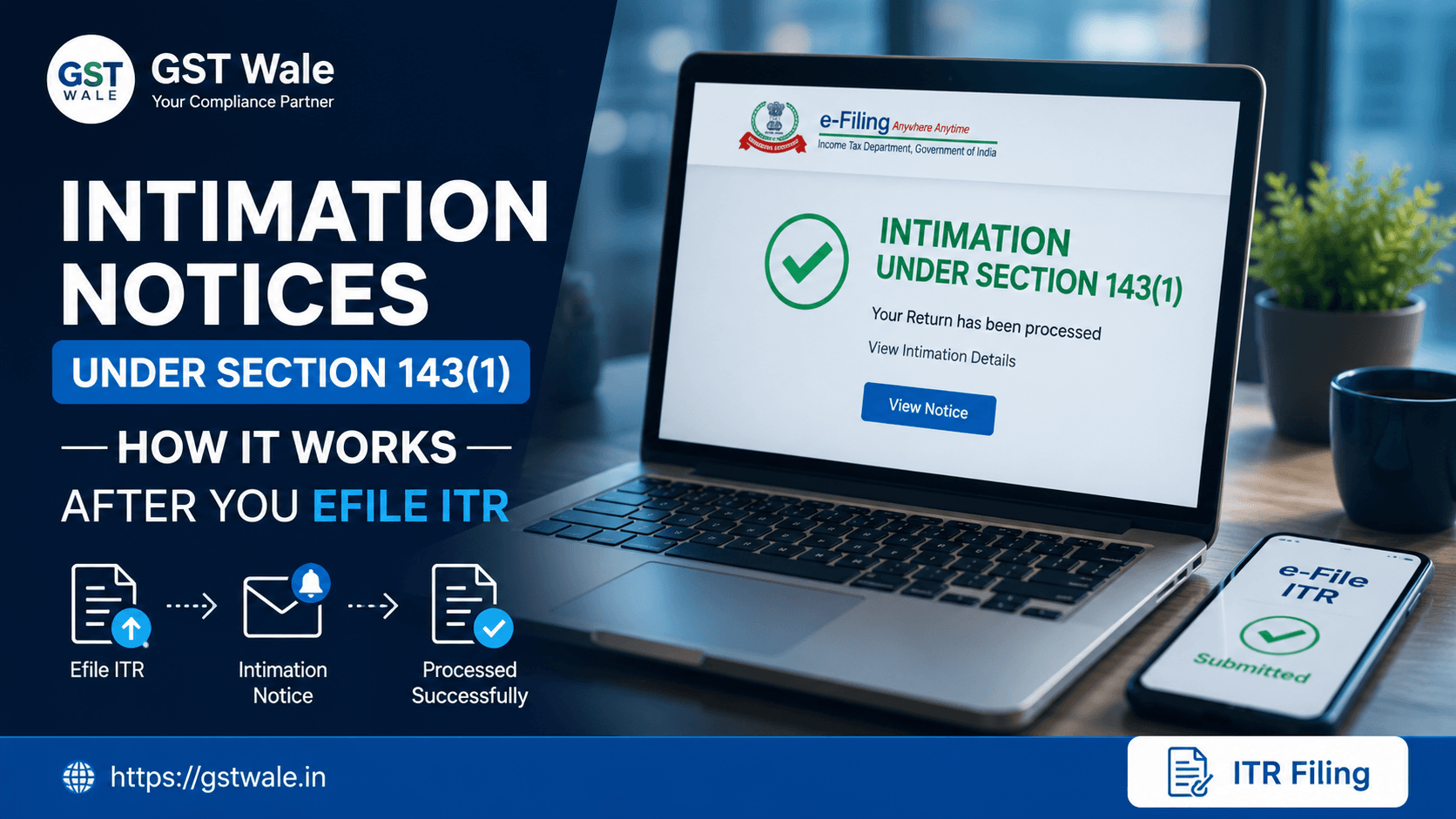
Most taxpayers heave a sigh of relief the moment they click the submission button. You’ve done your part, gathered your documents, and managed to efile itr successfully. However, a few weeks or months later, an email notification pops up from the Income Tax Department regarding an intimation under Section 143(1). For many, this triggers unnecessary panic.
At GST Wale, we handle hundreds of such cases every season. If you are struggling with your paperwork, our ITR Filing services are designed to take the stress out of your compliance journey. Let’s break down what this notice actually means and why it shouldn’t be a cause for alarm.
What is an Intimation Notice Under Section 143(1)?
When you efile itr, the Income Tax Department doesn’t just store your data in a digital folder. The department’s centralized system performs a preliminary assessment of your return. This process is known as e-filed return processing.
Under Section 143(1), the department checks your return for basic arithmetic errors, incorrect tax calculations, or discrepancies between your declared income and the data available in their systems, such as your Form 26AS or AIS (Annual Information Statement). Think of this as an automated audit. The intimation you receive is essentially a report card of this electronic verification.
Why Did You Receive This Notice?
Receiving a notice doesn’t always mean you are in trouble. In fact, most intimations are purely administrative. Here are the most common reasons:
Mathematical Errors: You might have made a simple calculation mistake when adding your interest income or claiming deductions.
Income Tax Mismatch: This is the most common trigger. If the income you reported doesn't match the details in your Form 26AS, AIS, or TIS, the system will automatically flag it.
Claiming Incorrect Credits: Sometimes, taxpayers claim TDS or TCS credits that haven't been deposited by the deductor yet, leading to a discrepancy.
Excessive Deductions: Claiming a deduction under a section you aren't eligible for or exceeding the prescribed limit can also trigger a review.
Decoding the Tax Demand Notice
If your intimation shows a tax demand notice, it means the department believes you owe more tax than you calculated. Conversely, it might also show a refund amount that differs from what you expected.
If you disagree with the findings, you have the right to respond. You must respond to tax notice within 30 days of receiving the intimation. Do not ignore these notifications. If you fail to respond, the department may treat the intimation as final, and you might face recovery proceedings for the unpaid tax demand.
Steps to Handle an Intimation Notice
If you find yourself staring at an intimation, follow this step-by-step approach:
Log in to the Portal: Access your account on the official e-filing website.
Download the Intimation: Navigate to the "e-File" menu, select "Income Tax Returns," and click on "View Filed Returns." Download the intimation order.
Cross-Verify: Compare your original data with the findings mentioned in the notice. Use your Form 26AS and AIS as your source of truth.
Identify the Mismatch: Pinpoint exactly where the income tax mismatch occurred. Is it a missed entry? A clerical error? Or an incorrect TDS claim?
Submit a Rectification: If you find an error in your original submission, you can file a rectification request under Section 154 through the portal to correct the data.
Frequently Asked Questions
Is an intimation notice the same as an assessment notice?
No. An intimation under 143(1) is an automated preliminary check. An assessment notice usually involves a deeper scrutiny of your financial records by an officer.
What happens if I ignore the notice?
Ignoring it is never an option. If there is a tax demand, interest will continue to accrue. Additionally, the department may adjust any future refunds against the outstanding demand.
Can I file a response if I agree with the demand?
Yes. If the demand is correct, simply pay the outstanding tax through the "e-Pay Tax" facility on the portal to avoid penalties and further interest.
Is it common to get a notice after I efile itr?
Yes, it is very common. As the department moves toward fully automated processing, these digital intimations are the new standard for ensuring compliance.
The process to efile itr is becoming more transparent, but it also leaves less room for error. An intimation under Section 143(1) is simply the department's way of reconciling your self-assessment with their records. If you are diligent, most issues can be resolved with a simple rectification.
However, tax laws are complex, and even a small slip in data entry can lead to avoidable notices. If you want to ensure your returns are accurate from the very start, reach out to us at GST Wale. Our team is here to handle your compliance, ensure you efile itr correctly, and keep your financial records clean and audit-ready. Don't wait for a notice—let us handle the paperwork while you focus on growing your business.
 Previous