


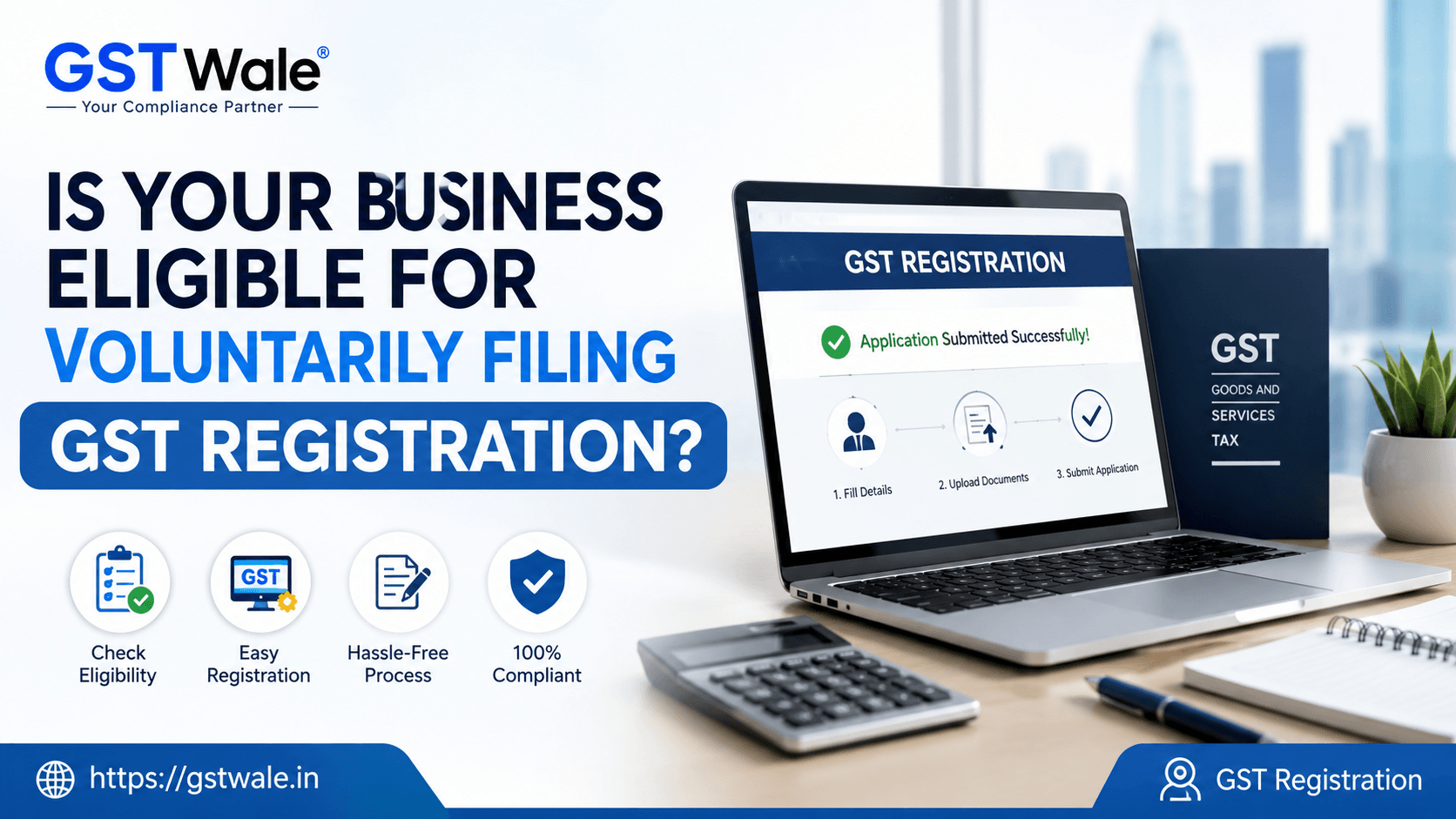
Is Your Business Eligible for Voluntarily Filing a GST Registration Application?
Is Your Business Eligible for Voluntarily Filing a GST Registration Application?
Starting a new business venture in India brings a long list of decisions, and one of the most common questions we encounter at GST Wale is whether a business should get a goods and services tax registration even if its turnover is well below the legally mandated threshold. Many small business owners, freelancers, and budding entrepreneurs believe that unless their annual turnover crosses ₹20 Lakhs or ₹40 Lakhs, they cannot or should not enter the indirect tax ecosystem. However, the Indian tax framework allows you to opt for a voluntary gst registration from day one. Deciding to apply for a gst registration voluntarily is a strategic business move that can completely transform how your company operates, competes, and grows in the modern Indian market.
If you are looking to formalize your business structure and want to leverage legal compliance as a competitive advantage, getting your online GST Registration is the most definitive first step you can take. While the compliance framework might seem demanding at first glance, the commercial advantages often significantly outweigh the administrative responsibilities. In this comprehensive guide, we will break down the exact tax registration criteria, evaluate who is eligible for voluntary enrollment, and weigh the pros and cons so you can make an informed decision for your business survival and expansion.
Understanding the Baseline Tax Registration Criteria in India
Before exploring the voluntary route, let us establish what the standard legal mandates are. Under the current Indirect Tax laws, a business is legally required to obtain a gst registration if its aggregate annual turnover exceeds specified thresholds. For pure service providers, this threshold is generally ₹20 Lakhs (and ₹10 Lakhs for special category states). For businesses exclusively engaged in the supply of goods, the threshold limit was extended to ₹40 Lakhs (subject to certain state-wise variations and exceptions).
Additionally, mandatory gst registration registration is triggered regardless of turnover in specific scenarios, such as making inter-state taxable supplies, operating as an e-commerce operator, or acting as a casual taxable person. But what if you do not fall into any of these mandatory brackets? This is exactly where Section 25(3) of the Central Goods and Services Tax (CGST) Act comes into play. It explicitly states that a person or entity, though not liable to be registered under mandatory provisions, may get themselves registered voluntarily. Once registered, all provisions of the Act apply to them just as they do to a regularly mandated taxpayer.
Who is Eligible for Voluntary GST Registration?
The short answer is: Almost any legitimate business entity in India is eligible. The law does not put a minimum floor limit on your turnover to apply for a voluntary gst registration. Whether your annual revenue is ₹50,000 or absolute zero because you are still in the setup phase, you can legally file an application for registration.
To successfully apply, your business needs to meet the basic operational criteria rather than financial ones. You must possess:
A valid Permanent Account Number (PAN) linked with Aadhaar.
A defined place of business (even a home office or shared workspace with appropriate documentation like electricity bills, rent agreements, or NOCs works perfectly).
Valid identity and address proofs for the promoters, partners, or proprietors.
As long as you have a bona fide intention to carry out business and supply goods or services, your application for voluntary gst registration will be processed and approved by the tax authorities.
Real-World Example: Rahul operates a boutique software development firm from Noida. His first-year projected revenue is only ₹8 Lakhs, well below the ₹20 Lakhs threshold. However, he wants to secure software development projects from large corporate clients based in Mumbai and Bangalore. Because corporate vendor onboarding requires a valid GSTIN, Rahul applies for a gst registration voluntarily. This simple compliance move immediately makes him eligible to pitch to large enterprises.
The Hidden Business Growth: Input Tax Credit Benefits
One of the most compelling reasons to go for a voluntary gst registration is the seamless flow of input tax credit benefits. When you run an unregistered business, you still pay GST on all your business purchases—such as laptops, office furniture, internet bills, raw materials, or professional consulting services. For an unregistered entity, this tax paid becomes a direct expense, directly hitting your profit margins.
Once you secure your gst registration, you enter the formal credit chain. The tax you pay on your business inputs can be fully offset against the tax you collect on your sales output. If your output tax liability is lower than your input credit, the balance accumulates in your electronic credit ledger for future use. This effective cost reduction is one of the primary drivers behind smart startups choosing to register early.
Unlocking Corporate Vendor Onboarding and Market Expansion
In the modern corporate ecosystem, large enterprises are highly risk-averse when it comes to tax compliance. Most established corporations completely avoid purchasing from unregistered dealers. Why? Because buying from an unregistered dealer introduces compliance tracking complications and deprives the corporate buyer of input tax credits, or subjects them to Reverse Charge Mechanism (RCM) liabilities in specific situations.
Therefore, having a valid GSTIN is an absolute prerequisite for successful corporate vendor onboarding. If your growth plan involves bidding for corporate contracts, listing your items on premium B2B platforms, or supplying to top-tier brands, an early gst registration acts as your corporate passport. It tells your prospective clients that you are a structured, compliant, and serious player in the industry.
Evaluating the Two Sides of the Coin: Pros vs Cons
While the business advantages are substantial, as experienced Chartered Accountants, we believe in presenting a transparent view. Let us evaluate the explicit advantages and the corresponding responsibilities that come with a voluntary gst registration.
The Key Advantages
Inter-State Sales Freedom: You can legally sell your products or services across state borders without worrying about local threshold restrictions.
E-commerce Readily Available: Major e-commerce portals require a mandatory GSTIN to register as a seller. A voluntary registration opens up the global digital marketplace for your products.
Enhanced Credibility: A business with a valid government tax registration registration naturally commands more trust from banks, financial institutions, vendors, and customers.
The Accompanying Responsibilities
Mandatory Continuous Compliance: Once registered, you must regularly file your GST returns (such as GSTR-1 and GSTR-3B) according to your chosen schedule (monthly or quarterly via the QRMP scheme), even if there is zero business activity during a particular tax period. Failing to file triggers late fees and penalties.
Strict Tax Collection: You are legally bound to collect GST from your customers on every taxable supply and remit it to the government. This might make your pricing look 5%, 12%, or 18% higher to unregistered end-consumers who cannot claim input credit.
Step-by-Step Outline of the GST Registration Application
If you have weighed the options and decided to move forward, the application process for goods and services tax registration is completely digitalized. Here is a high-level summary of how the process unfolds:
Generation of TRN: You visit the official GST Portal and submit your PAN, mobile number, and email ID to generate a Temporary Reference Number (TRN).
Submission of Form: Using the TRN, you log in and fill out the detailed gst registration application form, uploading business details, stakeholder information, and principal place of business proof.
Aadhaar Authentication: Opting for instant Aadhaar authentication significantly speeds up the verification process and minimizes the chances of physical spot verifications.
ARN Generation & Review: Once submitted, an Application Reference Number (ARN) is generated. The jurisdictional tax officer reviews your documents. If everything is clear, your GST Certificate (Form REG-06) containing your unique GSTIN is issued within a few working days.
Frequently Asked Questions (FAQs)
Q1: Can I cancel my voluntary gst registration later if compliance becomes difficult?
Answer: Yes, absolutely. The tax laws provide a smooth mechanism to apply for the cancellation of your registration voluntarily if you shut down your business or find the compliance burden unsustainable, provided there are no outstanding tax liabilities or pending returns.
Q2: Will I be penalized if I file a "Nil" return for consecutive months?
Answer: No, there is no penalty for having zero business transactions. However, you must file a "Nil" return within the due date. The penalty or late fee is levied for not filing the return, not for having zero business turnover.
Q3: Do I need a separate commercial office space to apply for a voluntary gst registration?
Answer: No, a separate commercial space is not mandatory under the tax registration criteria. You can legally use your residential address as your principal place of business, provided you supply a valid electricity bill and a No Objection Certificate (NOC) from the property owner.
Taking the Smart Step Forward with GST Wale
Deciding to proceed with a voluntary gst registration is not just a question of legal tax eligibility—it is a strategic decision about your business's future trajectory. If your business model involves dealing with corporate clients, utilizing e-commerce channels, expanding across state borders, or investing heavily in taxable business inputs, opting for an early gst registration is undoubtedly the right choice. It lays down a robust foundation for building market trust, optimizing your cost structures through input tax credit benefits, and preparing your enterprise for rapid scale.
However, entering the indirect tax landscape means committing to precise timelines, accurate invoicing, and flawless monthly or quarterly filings. This is where professional expertise makes all the difference. At GST Wale, we eliminate all the complexity from your compliance journey. Our dedicated team of chartered accountants and corporate tax consultants handles your end-to-end gst registration registration process seamlessly, ensuring that your applications are processed quickly without errors or unwanted tax officer queries. Let us manage the legal intricacies while you focus entirely on growing your core business venture. Get in touch with GST Wale today to start your journey into a fully compliant, highly credible, and highly competitive corporate player!
 Previous