


The Impact of the 18% Standard GST New Rate on Electronic Appliances
The Impact of the 18% Standard GST New Rate on Electronic Appliances
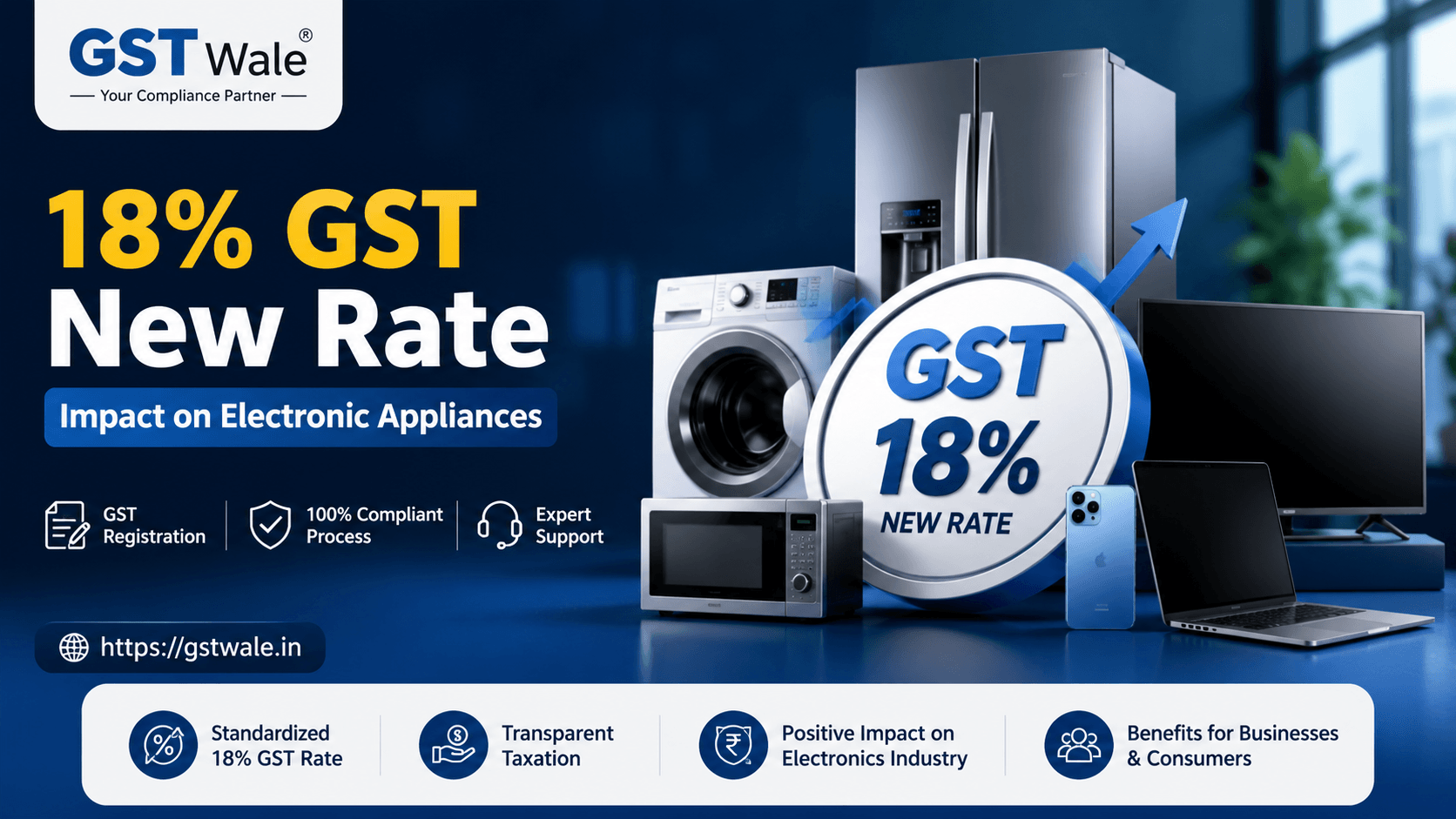
As the festive seasons approach and businesses gear up for higher sales volume, the Indian consumer market experiences massive shifts based on tax restructuring. For the longest time, both home buyers and retail businesses have kept a very close eye on the decisions made by the GST Council. In recent high-level discussions, the talk of implementing a uniform 18% standard gst new rate on a wider spectrum of electronic appliances has triggered a significant buzz across industries. If you are a manufacturing unit, a retail outlet owner, or simply an end consumer looking to upgrade your household comfort, understanding how this tax rationalization redefines retail dynamics is absolutely critical.
At GST Wale, we constantly interact with thousands of business owners who struggle to navigate the compliance maze whenever a new notification drops. For startup founders or expanding traders, ensuring your business is correctly aligned with the latest tax updates starts with securing a valid GST Registration. Getting registered not only legalizes your market operations but allows you to seamlessly claim Input Tax Credit (ITC), directly softening the financial blow that any major tax restructuring might bring to your supply chain margins.
Deconstructing the Shift: Moving to the 18% GST New Rate
Historically, India’s indirect tax ecosystem placed premium comfort goods under the highest tax brackets. When GST was introduced in 2017, several luxury and electronic items were anchored inside the steep 28% slab to keep tax revenues robust. Over the years, the Council systematically brought down rates for items like mid-sized TVs and washing machines. However, a standardized 18% gst new rate creates an interesting equilibrium across multiple product lines.
The core objective behind introducing this unified structure is simple: revenue neutrality combined with simplified compliance. Rather than categorizing goods arbitrarily based on screen dimensions or engine capacity, a standard flat levy provides a predictable fiscal landscape. For manufacturers, this eliminates legal disputes with the department regarding product classification, a common headache that CAs have had to litigate for decades.
Decoding the GST New Slab and Rate Lists for Electronic Items
When analyzing the gst new slab distribution, we must recognize that electronic appliances are no longer viewed as elite luxuries. Air conditioners, large refrigerators, and high-end entertainment systems are essential utilities in modern Indian homes due to shifting climate patterns and remote work lifestyles. Let us break down how specific segments behave under the latest gst new rate list directives.
Smart TV Tax Restructuring
Previously, television screens were divided cleanly by size: screens up to 32 inches enjoyed a lower tax structure, whereas premium displays above 32 inches faced heavier burdens. Under the unified guidelines, the smart tv tax is streamlined, removing size-based discrepancies. Whether a consumer buys a modest 43-inch family screen or an ultra-large 65-inch home theater display, the calculation remains uniform, eliminating artificial pricing cliffs created purely by tax brackets.
Refrigerator GST and Air Conditioner Tax Rate Adjustments
Summers in India are becoming increasingly severe, driving up the baseline demand for cooling appliances. The refrigerator gst structure now ensures that large double-door and side-by-side models become significantly more accessible to middle-class households. Concurrently, the air conditioner tax rate stabilization at 18% marks a permanent departure from the prohibitive 28% luxury bracket. This ensures that cooling systems can be priced more competitively, giving tremendous relief to urban families.
Impact on Gadget Affordability and Consumer Behavior
The most immediate and visible outcome of this regulatory adjustment is its profound impact on overall gadget affordability. When a product drops from a higher tier to a stabilized 18% gst new rate, the mathematical benefit translates into a direct price reduction, provided manufacturers choose to pass on the anti-profiteering benefits to end consumers.
Real-World Mathematical Example: Imagine a premium inverter air conditioner with a base manufacturing price of ₹40,000.
Under the old premium luxury rate of 28%, the tax component amounted to ₹11,200, pushing the final retail price to ₹51,200.
Under the streamlined 18% gst new rate, the tax on the exact same base price drops to ₹7,200, bringing the final cost down to ₹47,200.
This represents an immediate, crisp saving of ₹4,000 for the household buyer!
This visible reduction in acquisition costs acts as a major catalyst for consumer demand. Instead of delaying their electronics purchases until deep discount festive clearance windows, middle-class consumers feel empowered to upgrade their gadgets year-round, stabilizing factory outputs and ensuring consistent cash flows for local micro-retailers.
How Businesses Can Navigate the GST New Rate Transition
While consumers celebrate lower retail tags, businesses must systematically recalibrate their back-end accounting systems to stay compliant with the gst rates adjustments. Failing to do so can lead to faulty invoicing, mismatched returns, and unnecessary audit red flags. Here is a brief, step-by-step transition checklist curated by our team at GST Wale:
Update HSN Master Data: Ensure your Enterprise Resource Planning (ERP) or billing software accurately maps the revised 18% rate to the corresponding HSN codes for all electrical appliances.
Recalculate Input Tax Credit (ITC): Carefully reconcile your purchase invoices through your GSTR-2B statement to claim exact credits under the updated gst new rate, avoiding any excess or short claims.
Revise Price Lists and Outward Invoices: Work with your distribution network to issue updated Maximum Retail Price (MRP) stickers and generate fresh product catalogs reflecting the tax reductions.
Audit Existing Warehouse Inventory: For stock purchased under older tax structures, apply correct transitional provisions to ensure compliance with anti-profiteering regulations defined under the GST Act.
Frequently Asked Questions (FAQs)
1. What is the standard GST new rate for major household electronic appliances now? The current standard rate is stabilized at 18% for most primary electronic appliances including smart televisions, consumer refrigerators, and residential air conditioning units, shifting away from older legacy luxury brackets.
2. Does the smart tv tax vary based on the physical size of the display? Under the updated tax harmonization structure, the size-based distinction has been systematically minimized, subjecting modern smart TVs to a consistent rate structure regardless of display dimensions.
3. How does this specific adjustment affect overall gadget affordability for ordinary buyers? By dropping the tax ceiling on premium appliances down to a uniform 18%, consumer acquisition costs drop by several thousand rupees per item, significantly boosting consumer spending power and product accessibility.
4. Can retail business owners claim full Input Tax Credit under the gst new slab? Yes, as long as the business holds a valid registration, receives goods for business furtherance, and reconciles purchases via GSTR-2B, they can claim 100% legitimate Input Tax Credit against outward liabilities.
The Way Forward with GST Wale
The introduction of the 18% standard gst new rate for electronic appliances is a progressive macro-economic move that strikes an excellent balance between consumer satisfaction and systematic tax collection. By reducing the cost burden on modern necessities, the government has given a clear boost to retail sectors while simultaneously simplifying the entire compliance architecture for corporate entities and small traders alike.
However, running a retail chain or an e-commerce platform smoothly requires deep technical expertise to stay on top of rapidly evolving gst rates and structural revisions. Miscalculating tax fields or delaying mandatory statutory filings can lead to hefty fines and frozen credits that stifle your business growth. Let our seasoned experts manage your financial backend while you focus entirely on scaling your core market operations. Reach out to the professional team at GST Wale today to secure seamless compliance, maximize your monthly input tax credits, and future-proof your enterprise against any upcoming fiscal policy shifts!
 Previous