


Is Apple Care or Mobile Insurance Subject to GST on Mobile Phone Rates?
Is Apple Care or Mobile Insurance Subject to GST on Mobile Phone Rates?
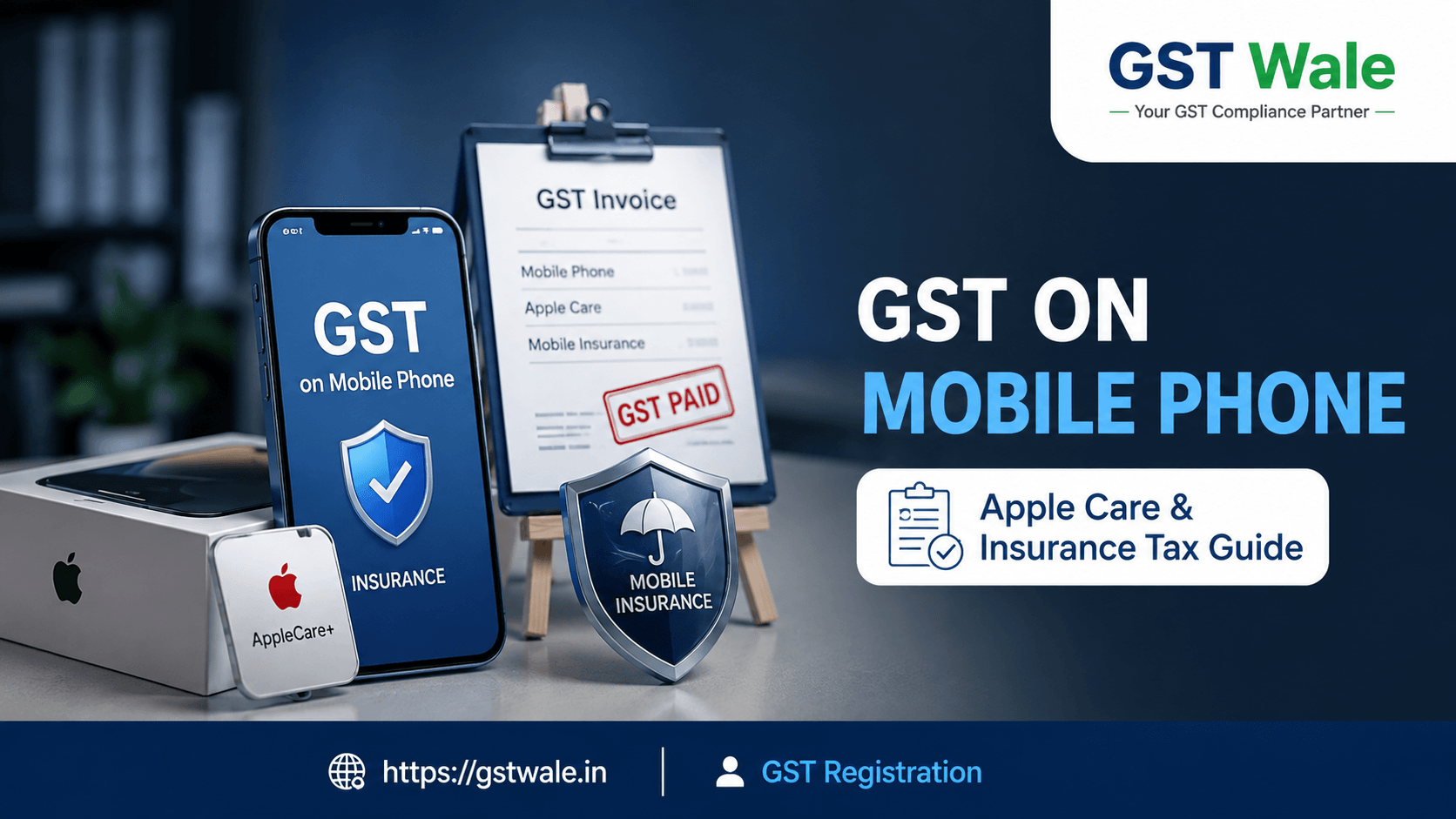
Buying a new smartphone often comes with optional add-ons such as AppleCare, extended warranty plans, or mobile insurance. Many buyers focus only on the purchase price and overlook the tax implications of these additional services. Understanding gst on mobile phone purchases becomes even more important when these extra protection plans are added to your bill.
If you are a business owner, retailer, or an individual purchasing a premium smartphone, knowing how GST is charged on AppleCare and mobile insurance can help you make informed decisions. If you're starting a business that sells electronic products, obtaining GST Registration is one of the first compliance requirements you should complete. In this article, GST Wale explains how GST applies to mobile phones, insurance, extended warranties, and repair services under Indian GST law.
Understanding GST on Mobile Phone Purchases
Before discussing AppleCare and insurance, it is important to understand the basic gst on mobile phone structure in India.
Mobile phones are generally taxed at 18% GST. This tax is applicable whether you purchase a phone from an offline retailer or an online marketplace. The GST charged becomes part of the invoice, and businesses registered under GST may claim eligible Input Tax Credit (ITC), subject to applicable conditions.
However, confusion often begins when customers purchase additional protection plans along with the mobile phone.
Is AppleCare Subject to GST on Mobile Phone?
Yes. AppleCare plans are generally taxable under GST because they are considered a supply of service. AppleCare provides extended warranty coverage, technical support, and repair benefits beyond the standard manufacturer warranty.
When purchasing AppleCare along with your device, GST is applicable on the value of the AppleCare plan separately unless the transaction falls under specific composite supply rules. In most practical situations, the mobile phone and AppleCare are billed as separate taxable items.
Why AppleCare Attracts GST
- It provides additional service after the original warranty period.
- It offers repair and replacement support.
- It is considered a taxable service under GST law.
- GST is charged on the service value mentioned in the invoice.
Therefore, while calculating the overall gst on mobile phone purchase cost, buyers should also include GST paid on AppleCare.
Is Mobile Insurance Taxable Under GST?
Yes. Mobile insurance is also subject to GST because insurance is treated as a taxable financial service.
Whether you buy insurance from the mobile retailer, an insurance company, or an online marketplace, GST is applicable on the insurance premium. The GST on the insurance plan is separate from the GST charged on the mobile handset.
For example, if you purchase a smartphone worth ₹60,000 and a mobile insurance plan worth ₹3,000, GST is calculated independently on both taxable supplies as applicable.
Composite Supply Rules and Mobile Phone Add-ons
Many customers ask whether AppleCare, insurance, and the mobile phone together should be taxed as one product.
This depends upon the composite supply rules under GST.
What Is Composite Supply?
A composite supply occurs when two or more supplies are naturally bundled and supplied together in the ordinary course of business. The tax rate applicable to the principal supply generally applies to the entire bundle.
For example, if installation is naturally bundled with the sale of a product, both may be treated as a composite supply.
Are AppleCare and Mobile Insurance Composite Supplies?
In most retail transactions, AppleCare and mobile insurance are optional services. Since customers can purchase the mobile phone without buying these services, they are generally treated as separate taxable supplies rather than a composite supply.
This is why separate GST calculations are commonly seen on invoices.
Understanding the Mixed Supply Definition
The mixed supply definition is another important GST concept.
A mixed supply refers to two or more individual supplies offered together for a single price, where each item can also be sold separately and the package is not naturally bundled.
If a retailer offers a promotional package containing:
- Mobile phone
- Insurance
- Power bank
- Bluetooth speaker
for one consolidated price, GST treatment may depend on whether the package qualifies as a mixed supply under GST law.
The tax implications can differ from a normal individual purchase, making proper invoice structuring important.
GST on Mobile Servicing Charges
After purchasing a smartphone, many users incur repair expenses. These mobile servicing charges also attract GST.
Common taxable servicing activities include:
- Display replacement
- Battery replacement
- Software repair
- Motherboard repair
- Charging port replacement
- Camera repair
The service centre charges GST on the labour component as well as on eligible parts supplied during the repair process.
Therefore, gst on mobile phone expenses is not limited to the initial purchase. Future servicing costs may also include GST.
GST on Repair Parts
Another frequently asked question relates to repair parts tax.
When components like screens, batteries, speakers, charging ports, cameras, or motherboards are replaced, GST is applicable on the spare parts supplied.
The invoice usually contains:
- Cost of spare parts
- GST on spare parts
- Labour charges
- GST on labour services
Businesses should preserve these invoices for accounting purposes and, where eligible, claim Input Tax Credit according to GST provisions.
Extended Warranty Tax Rate Under GST
The extended warranty tax rate generally follows GST provisions applicable to warranty-related service contracts.
An extended warranty is different from the standard manufacturer's warranty because it provides additional protection after the original warranty period expires.
Since it is supplied as a separate service, GST is generally charged on the warranty amount mentioned in the invoice.
Whether you purchase AppleCare or another brand's extended warranty, buyers should always verify the GST charged before making payment.
Practical Example
Suppose Rahul purchases:
- Mobile Phone – ₹70,000
- AppleCare Plan – ₹12,000
- Mobile Insurance – ₹2,500
Each item is billed separately.
In this situation:
- GST applies to the mobile phone.
- GST applies separately to AppleCare.
- GST also applies to the insurance premium.
This demonstrates why understanding gst on mobile phone purchases requires looking beyond only the handset price.
Tips for Buyers
- Always request a proper GST invoice.
- Check whether AppleCare and insurance are billed separately.
- Understand the warranty terms before purchasing.
- Verify GST charged on repair invoices.
- Businesses should maintain invoices for ITC wherever eligible.
Frequently Asked Questions
Is GST applicable on AppleCare plans?
Yes. AppleCare is generally treated as a taxable service, and GST is charged separately on the value of the plan.
Does mobile insurance attract GST?
Yes. Mobile insurance is a taxable insurance service, and GST is charged on the insurance premium.
Can businesses claim Input Tax Credit on mobile phone purchases?
Eligible registered businesses may claim Input Tax Credit subject to GST law, business use, and documentation requirements.
Are repair charges taxable?
Yes. Both labour charges and eligible spare parts supplied during repairs usually attract GST.
Does an extended warranty have GST?
Yes. Since an extended warranty is generally considered a separate service, GST is normally applicable on the warranty amount.
Understanding gst on mobile phone purchases involves much more than knowing the GST rate on the handset itself. AppleCare, mobile insurance, extended warranties, servicing charges, and repair parts all have separate GST implications depending on the nature of the supply. Concepts such as composite supply rules and the mixed supply definition can also influence the tax treatment in specific situations.
If you are unsure about GST compliance, Input Tax Credit eligibility, invoicing, or taxation of mobile-related products and services, GST Wale is here to help. Our experienced professionals provide practical GST guidance, registration support, return filing assistance, and compliance solutions so you can stay fully compliant while focusing on your business with confidence.
 Previous