


Top Mistakes to Avoid in GST R 1 When Categorizing Inter-State vs Intra-State Sales
Top Mistakes to Avoid in GST R 1 When Categorizing Inter-State vs Intra-State Sales
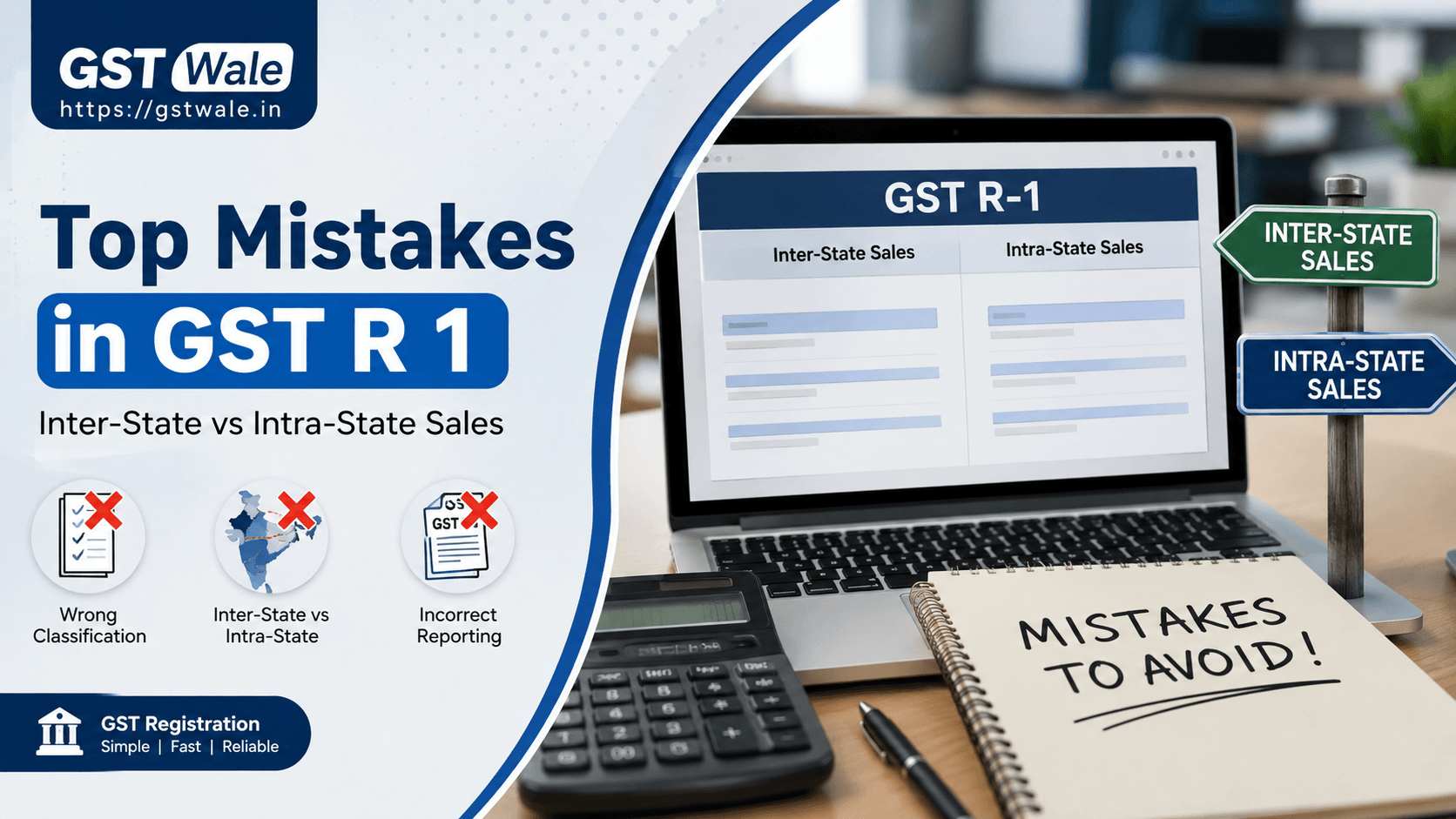
Filing gst r 1 correctly is not just about entering sales figures and submitting the return on time. One of the most common mistakes businesses make is incorrectly classifying a transaction as inter-state or intra-state. This can affect whether IGST or CGST and SGST applies, and even a small classification error can create reconciliation problems later.
If your business is newly registered or expanding into different states, understanding GST classification becomes even more important. Proper GST Registration is the starting point, but correct invoicing and reporting are equally important for smooth GST compliance.
At GST Wale, we regularly come across businesses that have the right sales figures but report them under the wrong tax category. The good news is that most of these errors can be avoided by understanding the place of supply rules, checking the location of supplier rules, and reviewing invoices before filing gst r 1.
Understanding Inter-State and Intra-State Sales
Before discussing common gst r 1 mistakes, let us understand the basic difference.
An intra-state supply generally occurs when the location of the supplier and the place of supply are in the same state or Union Territory. In such cases, CGST and SGST or UTGST generally apply.
An inter-state supply generally occurs when the supplier and place of supply are in different states or Union Territories. In such cases, IGST is generally applicable.
For example, suppose a business located in Uttar Pradesh sells goods to a registered customer in Delhi. The supplier is in Uttar Pradesh, while the place of supply is Delhi. This is an inter-state transaction and IGST would generally apply.
Now suppose the same Uttar Pradesh business sells goods to a customer where both the supplier location and applicable place of supply are in Uttar Pradesh. This would generally be an intra-state supply, subject to the specific rules applicable to that transaction.
Correct classification is therefore essential when preparing gst r 1.
Top gst r 1 Mistakes Businesses Should Avoid
Mistake 1: Assuming the Customer's Billing Address Is Always the Place of Supply
A common misconception is that the customer's billing address automatically determines the place of supply. This is not always correct.
GST law contains specific place of supply rules depending on the nature of the transaction. Goods, services, transportation, imports, exports, and certain special transactions can have different rules.
For ordinary movement of goods, businesses should examine where the movement ends for delivery to the recipient and consider the applicable GST provisions rather than relying only on the address printed on the invoice.
Before entering a transaction into gst r 1, review the actual transaction and not merely the billing address.
Mistake 2: Ignoring the Location of Supplier Rules
The location of supplier rules are equally important. Businesses sometimes have multiple branches, warehouses, offices, or additional places of business and assume that all sales originate from the head office.
This can create incorrect tax classification.
For example, if a company has registrations in several states, each GST registration is generally treated separately for GST purposes. The state from which the supply is actually made and the applicable place of supply must be examined carefully.
A proper review before filing gst r 1 can prevent unnecessary amendments later.
Mistake 3: Using the Wrong State Code
State codes play an important role in GST invoicing and return reporting. Entering the wrong state code can result in an intra-state transaction being reported as inter-state, or vice versa.
This is one of the most frequent gst r 1 data-entry mistakes.
Businesses should verify:
- Supplier GSTIN and state code
- Customer GSTIN and state code
- Place of supply
- Whether IGST or CGST and SGST applies
- Invoice type and applicable tax rate
Automated accounting software can reduce manual errors, but the underlying master data must still be correct.
Mistake 4: Confusing IGST With CGST and SGST
The difference between IGST and CGST plus SGST may appear straightforward, but mistakes occur when businesses process large volumes of invoices.
For example, a supplier may have a customer whose registered office is in the same state, while the actual transaction circumstances result in a different place of supply. Simply matching two state names without checking the applicable rule can produce an incorrect result.
These igst vs cgst sgst mistakes can affect gst r 1 reporting, tax liability, input tax credit reconciliation, and the recipient's records.
Mistake 5: Treating Every Sale From a Warehouse as Intra-State
Another practical mistake is assuming that a sale is intra-state because goods are stored in a warehouse.
The warehouse location, supplier's GST registration, movement of goods, and applicable place of supply provisions all need to be considered.
For example, a business may maintain a warehouse in Maharashtra while its GST registration and supply structure involve another state. The correct GST treatment cannot be decided merely because the physical stock was stored in Maharashtra.
This is why businesses should review the transaction structure before finalizing gst r 1.
Mistake 6: Not Checking B2B Invoices Before Filing
A wrong GSTIN or place-of-supply code can cause problems for both the supplier and recipient.
Before filing gst r 1, businesses should perform an invoice-level review. Pay special attention to high-value transactions and invoices involving customers from other states.
A simple pre-filing checklist can identify errors before they become part of the filed return.
Mistake 7: Making Changes Without Maintaining Documentation
When an error is discovered, some businesses simply change the figures in their accounting software without keeping a proper record of what was changed and why.
This is risky.
Keep supporting documents such as:
- Original invoice details
- Corrected invoice information
- Reason for classification change
- Customer communication, where relevant
- Accounting adjustment records
- Relevant return amendment details
Good documentation makes tax return corrections much easier to explain during reconciliation or an enquiry.
How to Correct a Wrong Inter-State or Intra-State Classification
Step 1: Identify the Original Error
First determine whether the problem relates to the GSTIN, state code, place of supply, tax type, taxable value, or another invoice field.
Do not immediately change the tax amount without identifying the root cause.
Step 2: Recheck the Applicable GST Rules
Review the transaction under the relevant place of supply provisions and determine whether the supply is actually inter-state or intra-state.
If the transaction is unusual, professional tax advice can help prevent a second mistake.
Step 3: Review the Impact on GST R 1
Check whether the incorrect transaction has already been reported in gst r 1. If it has, determine the appropriate mechanism for correcting the reported information under the rules applicable to that tax period.
This is particularly important where the recipient has already claimed input tax credit based on the original invoice.
Step 4: Reconcile With the Customer
For B2B transactions, communicate with the customer where the correction affects their GST records or input tax credit.
Both parties should ideally have consistent invoice information.
Step 5: Maintain an Amendment Record
Document all amendment of wrong location codes and related changes. A clear audit trail helps during future reconciliations.
A Practical gst r 1 Pre-Filing Checklist
Before submitting gst r 1, businesses can use this simple review process:
- Download or review the sales register for the relevant period.
- Separate transactions by GST registration.
- Verify customer GSTINs and state codes.
- Check the applicable place of supply.
- Separate inter-state and intra-state supplies.
- Confirm IGST versus CGST and SGST.
- Review credit notes and debit notes.
- Reconcile the return figures with the accounting system.
- Investigate unusual or high-value transactions.
- Keep supporting records for amendments and corrections.
This process may take some additional time, but it is far less expensive than resolving repeated discrepancies after filing.
Why Correct Classification Matters
Incorrect classification does not always mean that tax has been completely avoided. Sometimes the total tax amount may appear correct while the tax has been reported under the wrong category.
However, such errors can still create compliance issues.
They may lead to differences between the supplier's and recipient's records, reconciliation challenges, incorrect input tax credit reporting, additional correspondence, and unnecessary tax return corrections.
For businesses with significant inter-state sales, these issues can multiply quickly because hundreds or thousands of invoices may be involved.
Expert Advice From GST Wale
The best approach is to treat GST classification as an accounting control rather than a filing-day activity.
Do not wait until the gst r 1 filing deadline to identify whether transactions are inter-state or intra-state. Configure your accounting system properly, maintain accurate customer and supplier master data, and review unusual transactions periodically.
Businesses should also train their invoicing and accounts teams to understand the difference between customer location, supplier location, and place of supply. These three concepts should not be treated as interchangeable.
Where an error is discovered, act promptly and maintain proper records instead of repeatedly carrying the issue forward.
FAQs
What is the most common gst r 1 mistake in inter-state sales?
One common mistake is reporting an inter-state transaction as intra-state because the business relies only on the customer's billing address or fails to verify the applicable place of supply. Businesses should examine the complete transaction and applicable GST provisions before deciding whether IGST or CGST and SGST applies.
Can a wrong place of supply affect gst r 1?
Yes. A wrong place of supply can affect whether a transaction is classified as inter-state or intra-state. Consequently, the tax type and return reporting may also be affected. Businesses should review the transaction carefully and follow the applicable correction mechanism when an error has already been reported.
What are igst vs cgst sgst mistakes?
These are errors where a business applies IGST when CGST and SGST should apply, or applies CGST and SGST when IGST should apply. Such mistakes can happen because of incorrect state codes, customer master data, or misunderstanding of place of supply provisions.
How can businesses prevent GST classification errors?
Businesses should maintain accurate GSTIN and state-code records, configure their accounting software correctly, review the place of supply for unusual transactions, and reconcile sales data before filing gst r 1. A periodic internal review can identify recurring errors before they affect multiple tax periods.
Should a business take professional help for complex GST transactions?
Yes. Transactions involving multiple registrations, branches, warehouses, special supplies, exports, imports, or unusual place of supply situations can require detailed analysis. Professional guidance can help businesses reduce compliance risks and avoid repeated tax return corrections.
Correct classification of inter-state and intra-state sales is an important part of accurate gst r 1 compliance. A wrong state code, incorrect place of supply, or confusion between IGST and CGST plus SGST can create unnecessary reconciliation and correction work.
The safest approach is simple: verify the supplier location, understand the applicable place of supply rules, check invoice details, and reconcile everything before filing.
At GST Wale, we help businesses understand GST requirements and manage compliance with practical, business-focused guidance. If you want to reduce GST errors and keep your filings accurate, connect with GST Wale for reliable GST support and professional assistance.
 Previous