


Why Your Form 26AS is the Most Important Document for Your ITR Form
Why Your Form 26AS is the Most Important Document for Your ITR Form
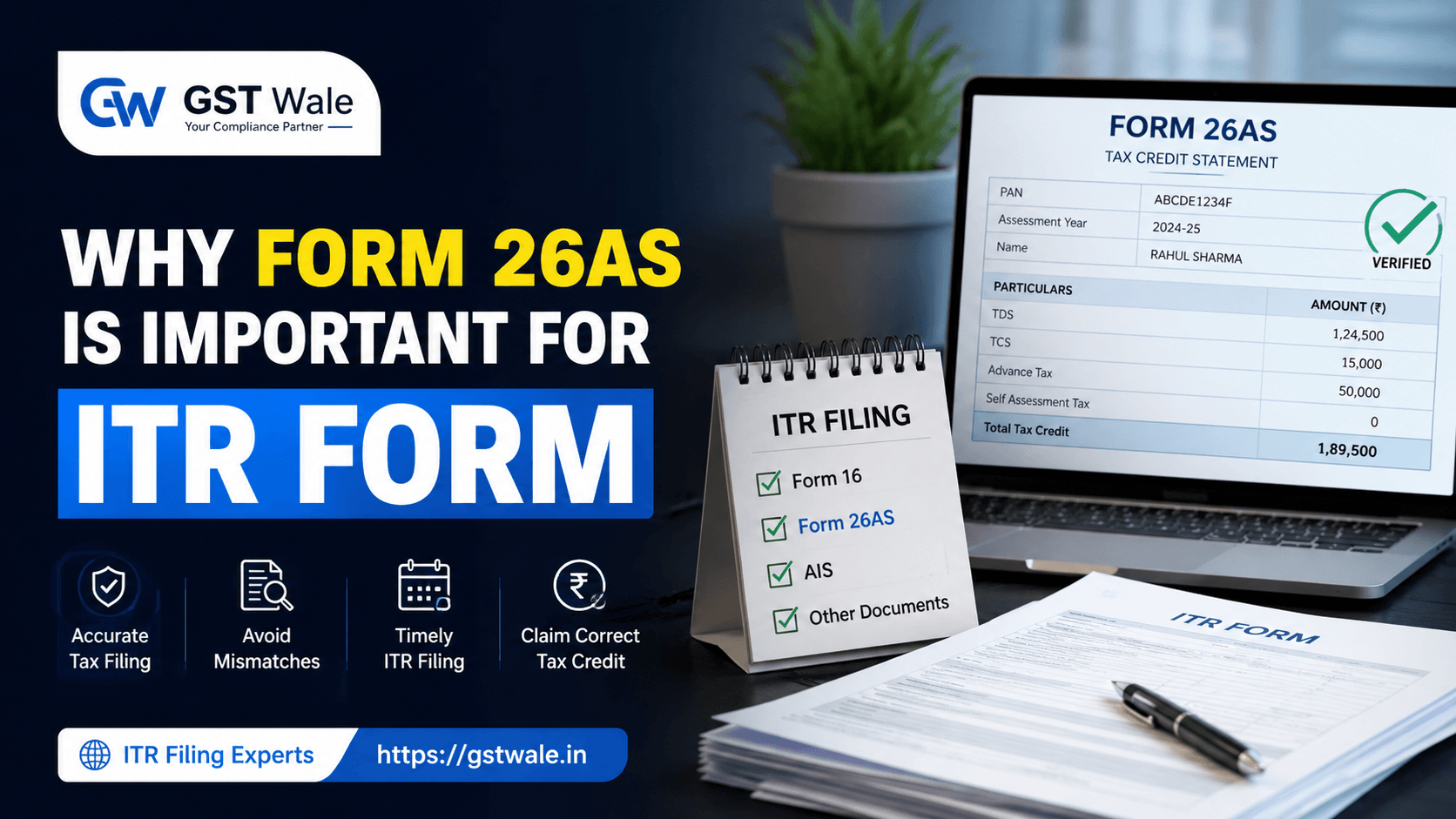
As a Chartered Accountant here at GST Wale, I’ve seen countless taxpayers panic when they receive a notice from the Income Tax Department. Most of the time, the root cause isn't tax evasion, but a simple mismatch between what they declared and what the taxman already knows. If you are preparing to handle your ITR Filing this season, the first place you must look is your Form 26AS. It is essentially the foundation upon which your entire itr form is built. Understanding this document is the single most important step before you even think about hitting the 'submit' button on your return.
What Exactly is Form 26AS and Why Should You Care?
Think of Form 26AS as your personal financial report card issued by the Income Tax Department. It is a consolidated statement that reflects all the taxes deducted, collected, or paid against your Permanent Account Number (PAN). When you sit down to fill out your itr form, you are essentially telling the government, "Here is what I earned and here is what I have already paid." Form 26AS is the source of truth that the department uses to cross-verify those claims.
Many taxpayers make the mistake of relying solely on their own records—like bank statements or salary slips. While those are important, if a bank or an employer reports a different TDS amount in their own filing, your itr form will flag a mismatch. This is where the trouble begins, often leading to scrutiny or a dreaded notice under section 143(1).
Connecting the Dots: Form 26AS and Your itr form
When you decide to file your income tax return online, the system automatically pulls data from your 26AS. However, just because the data is there doesn't mean it’s complete or accurate. As a professional, I always advise our clients at GST Wale to manually reconcile their 26AS with their actual income statements.
For example, if you are a freelancer or a consultant, your clients might have deducted TDS on your professional fees. If you forget to include any of those specific TDS entries in your itr form, you are essentially overpaying tax because you aren't claiming the credit for the tax already deducted. Conversely, if you report less income than what is reflected in your 26AS under 'Higher Value Transactions', you are inviting an automated system notice. Your itr form must be an exact reflection of the data verified through 26AS.
Practical Insights for a Seamless Experience
To ensure your process is error-free, follow these steps:
Download Regularly: Don't wait until the last minute. Check your Form 26AS quarterly to see if your TDS is being deposited on time.
Reconcile TDS: Compare the TDS shown in your 26AS with the certificates (Form 16/16A) provided by your employer or banks.
Check Annual Information Statement (AIS): While 26AS is vital for your itr form, the AIS is the new expanded version. Use both together for 100% accuracy.
Verify 'Advance Tax' and 'Self-Assessment Tax': If you paid taxes manually, ensure they reflect in the tax payments section of your 26AS before you finalize your itr form.
When you choose to file it returns online, the biggest hurdle is usually a mismatch of data. By keeping these documents synchronized, you save yourself hours of revision and potential penalties.
Common Pitfalls When Filing Your itr form
Many people try to rush the process of it filing, skipping the verification stage entirely. This is where mistakes creep in. Here are the most common errors I encounter:
1. Discrepancy in Salary Income
Employers often report total income and TDS in their returns. If your itr form shows a slightly different figure, the system flags it instantly. Always use the salary details exactly as they appear in the TDS certificate, which in turn should match your 26AS.
2. Missing Interest Income
Banks report interest earned on savings and FDs. If you fail to include this in your itr form, the mismatch is flagged. The 26AS acts as a checklist to ensure you haven't missed any source of income.
3. Incorrect Tax Credits
If you have multiple bank accounts, you might have multiple TDS entries. Forgetting to claim even one small entry can change your total tax liability, making your itr form technically inaccurate.
Frequently Asked Questions
Is Form 26AS the same as the Annual Information Statement (AIS)?
Not exactly. Form 26AS focuses on tax deducted and paid. The AIS is more comprehensive and includes high-value transactions, savings account interest, and more. Both are critical for your itr form.
What happens if there is a mistake in my Form 26AS?
If the TDS reflected is incorrect, you must contact the person or entity who deducted the tax (the deductor) and ask them to file a revised TDS return. You cannot fix the 26AS yourself, but you must ensure it matches your itr form.
Do I need to attach Form 26AS to my itr form?
No, you don't need to upload it. However, the data from your 26AS is used by the department to validate the figures you enter in the itr form.
Why is 26AS so important for itr online?
It acts as the primary validation tool. If your itr online portal data does not align with your 26AS, your processing may be delayed, and you could face tax demands.
Tax compliance doesn't have to be a headache. By treating Form 26AS as the master document for your itr form, you’ve already completed 80% of the hard work. Remember, the Income Tax Department has access to massive amounts of data; transparency is your best defense.
Whether you are filing for the first time or you are a seasoned investor, professional guidance can make all the difference. At GST Wale, we specialize in making the process of filing your itr form as smooth as possible. We don't just file; we reconcile, verify, and ensure you remain compliant year after year. Don't leave your tax health to chance. Reach out to the experts at GST Wale today and get your taxes sorted with precision and peace of mind.
 Previous