


What Happens to Your ITR return If You Leave India Permanently?
What Happens to Your ITR return If You Leave India Permanently?
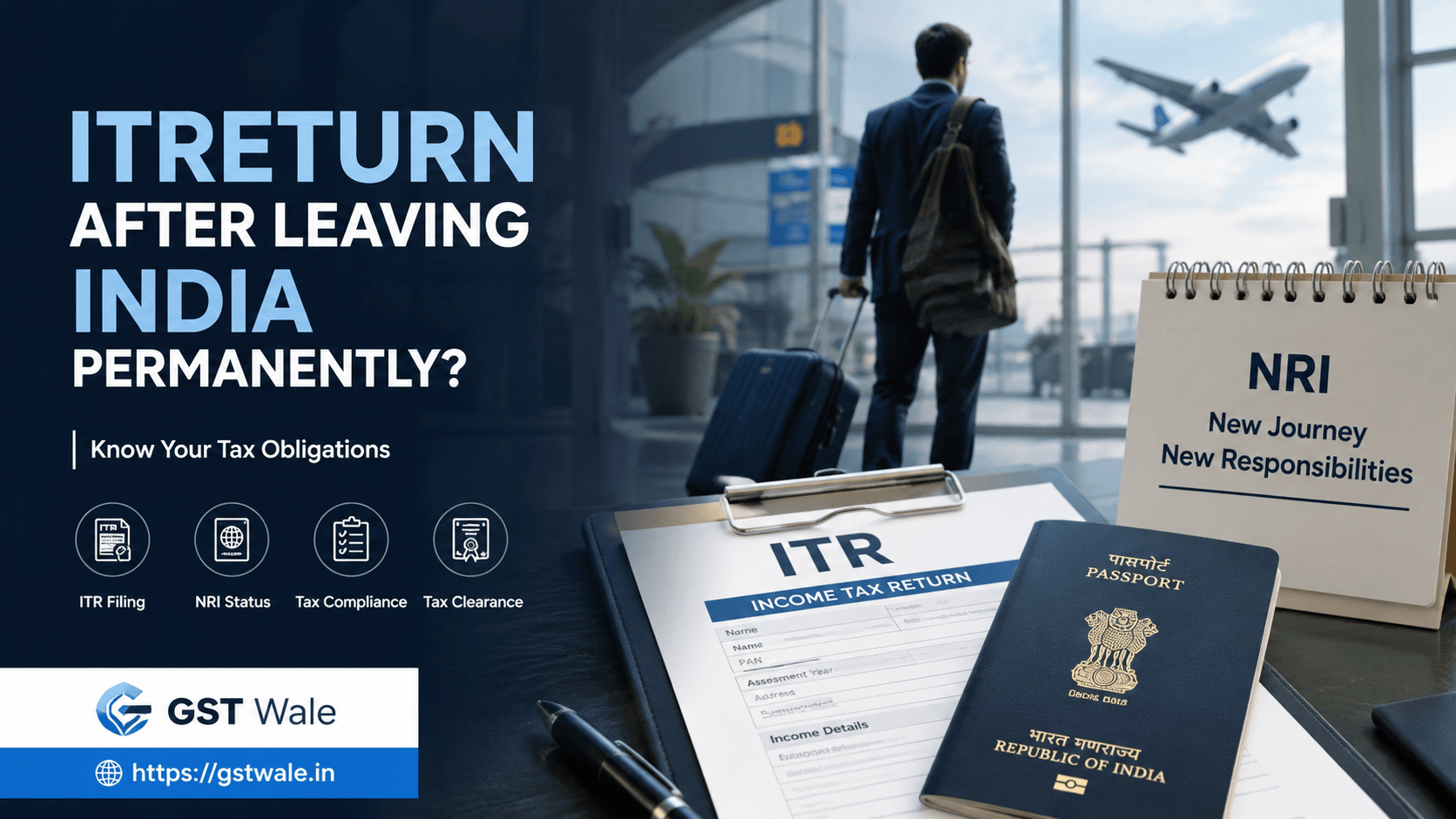
Planning to settle abroad permanently? Whether you are moving for a job, business expansion, higher studies, or family reasons, your tax responsibilities in India do not end overnight. One of the most common questions people ask GST Wale is: “What happens to my ITR return after I leave India permanently?”
The answer depends on your residential status, income sources in India, and compliance with Indian tax laws. Many people assume that once they leave India, they no longer need to file an ITR return. However, that is not always true.
Before relocating, it is important to understand how your ITR return obligations may change and whether you still need to report income earned in India. If you need expert support for ITR Filing, proper planning can save you from future notices and penalties.
In this guide, GST Wale explains everything you need to know about ITR return compliance when leaving India permanently.
Understanding Residential Status for ITR return
Your ITR return requirements mainly depend on your residential status under the Income Tax Act.
Who Is Considered a Resident in India?
You are treated as a resident if:
- You stay in India for 182 days or more during a financial year, or
- You stay in India for 60 days or more in the current year and 365 days or more during the previous 4 years.
If you leave India permanently and do not meet these conditions, you generally become a Non-Resident Indian (NRI).
This process is commonly called breaking tax residency.
Why Residential Status Matters
Your residential status decides:
- Which income is taxable in India
- Whether you need to file an ITR return
- How foreign income is treated
- Which bank accounts and investments you can continue holding
For example:
- Residents pay tax on global income.
- NRIs pay tax only on income earned or received in India.
Do You Still Need to File an ITR return After Leaving India?
Many NRIs believe they are free from Indian tax filing after moving abroad. That is only partially correct.
You may still need to file an ITR return if you have:
- Rental income from property in India
- Capital gains from shares or property sales
- Interest income from Indian bank accounts
- Business income in India
- TDS deductions requiring refunds
Example
Suppose Rahul moved to Canada in September 2025. He still earns rental income from his flat in Pune and receives interest from fixed deposits in India.
Even after becoming an NRI, Rahul must file an ITR return in India because he continues earning taxable income here.
What Happens to Your Existing ITR return Records?
Your previous ITR return history remains with the Income Tax Department even after you leave India permanently.
Important Points to Remember
- Old tax records remain active permanently.
- Notices related to previous years may still come.
- Pending assessments or refunds continue.
- PAN remains valid unless surrendered voluntarily.
This is why notifying the income tax department about your changed residential status is very important.
Steps to Take Before Leaving India Permanently
A proper moving abroad tax checklist can help avoid future tax complications.
Update Your Residential Status
Inform banks, financial institutions, and tax authorities once you become an NRI.
Convert Bank Accounts
One of the most ignored tasks is closing resident bank accounts.
Resident savings accounts should ideally be converted into:
- NRO Accounts
- NRE Accounts
- FCNR Accounts
Operating resident accounts after becoming an NRI may create compliance issues.
Review Investments
Certain investments are not allowed for NRIs. Review:
- PPF accounts
- Mutual funds
- Demat accounts
- Insurance policies
Check Pending Tax Dues
Ensure all pending taxes are cleared before departure.
Is a Tax Clearance Certificate Required?
In some situations, a tax clearance certificate may be required before leaving India permanently.
What Is a Tax Clearance Certificate?
It is a certificate confirming that:
- No tax dues are pending, or
- Adequate arrangements have been made for payment.
When Is It Required?
Generally, most salaried individuals may not require it. However, it can become important in cases involving:
- High-value financial transactions
- Business owners
- Foreign nationals leaving India
- Significant tax liabilities
Consulting a tax expert before departure is always advisable.
Common Mistakes NRIs Make in ITR return Filing
At GST Wale, we frequently see people making avoidable mistakes after relocating abroad.
Ignoring Indian Income
Many NRIs forget that Indian income remains taxable in India.
Using Resident Status Incorrectly
Choosing the wrong residential category in the ITR return can lead to notices.
Not Reporting Foreign Assets Properly
If you qualify as a resident for part of the year, foreign assets may need disclosure.
Missing TDS Refund Claims
A large number of NRIs fail to claim refunds because they stop filing an ITR return.
How Double Taxation Avoidance Agreements (DTAA) Help
India has DTAA agreements with many countries.
These agreements help prevent paying tax twice on the same income.
Example
If tax is deducted in India on rental income and you also pay tax in the UK, DTAA provisions may allow relief.
Proper ITR return filing helps claim these benefits legally.
Important Documents to Keep Safe
Before moving abroad permanently, maintain records of:
- Passport and visa copies
- Employment contracts abroad
- Previous ITR return copies
- Bank statements
- Form 16 and Form 26AS
- Property and investment documents
These records help during future tax assessments.
How Long Should NRIs Continue Filing an ITR return?
There is no fixed timeline.
You should continue filing an ITR return in India as long as:
- Your income exceeds the exemption limit
- TDS has been deducted
- You own taxable assets in India
- You want to carry forward losses
- You need loan or visa documentation
Even if income is below taxable limits, voluntary filing may still be beneficial.
Special Considerations for Business Owners
Business owners relocating abroad must be extra careful.
Things to Review
- GST registrations
- Proprietorship closures
- Director responsibilities
- Company compliance
- Pending assessments
Failing to complete these formalities may create legal complications later.
Role of GST Wale in Managing Your ITR return
Handling taxes after moving abroad can become confusing, especially when multiple income sources are involved.
GST Wale helps individuals and NRIs with:
- Accurate ITR return filing
- Residential status determination
- Tax planning for NRIs
- DTAA guidance
- Compliance support
- Tax notice handling
Our expert team ensures your transition abroad remains smooth and legally compliant.
FAQs on ITR return After Leaving India Permanently
Do I need to file an ITR return if I become an NRI?
Yes, if you earn taxable income in India or wish to claim refunds.
Can I keep my Indian savings account after moving abroad?
No. You should convert it into an NRO or NRE account after becoming an NRI.
What is breaking tax residency?
It refers to changing your tax residency status from resident to non-resident after moving abroad permanently.
Is foreign salary taxable in India for NRIs?
Generally, foreign salary earned abroad is not taxable in India for NRIs.
Should I notify the income tax department after leaving India?
Yes, notifying the income tax department and updating records helps avoid future compliance issues.
Leaving India permanently is a major life decision, but it also brings important tax responsibilities. Your ITR return obligations do not automatically end after relocation. Everything depends on your residential status, Indian income sources, and compliance requirements.
From breaking tax residency to closing resident bank accounts and obtaining a tax clearance certificate where needed, proper planning is essential. Ignoring these aspects may lead to notices, penalties, or unnecessary tax complications later.
At GST Wale, we help individuals, professionals, and business owners manage every aspect of their ITR return smoothly before and after moving abroad. If you are planning an international relocation, our experts can guide you with accurate tax advice and complete compliance support.
 Previous