


Step-by-Step: Reporting Stock Market Intraday Trading and F&O in income tax return itr
Step-by-Step: Reporting Stock Market Intraday Trading and F&O in income tax return itr
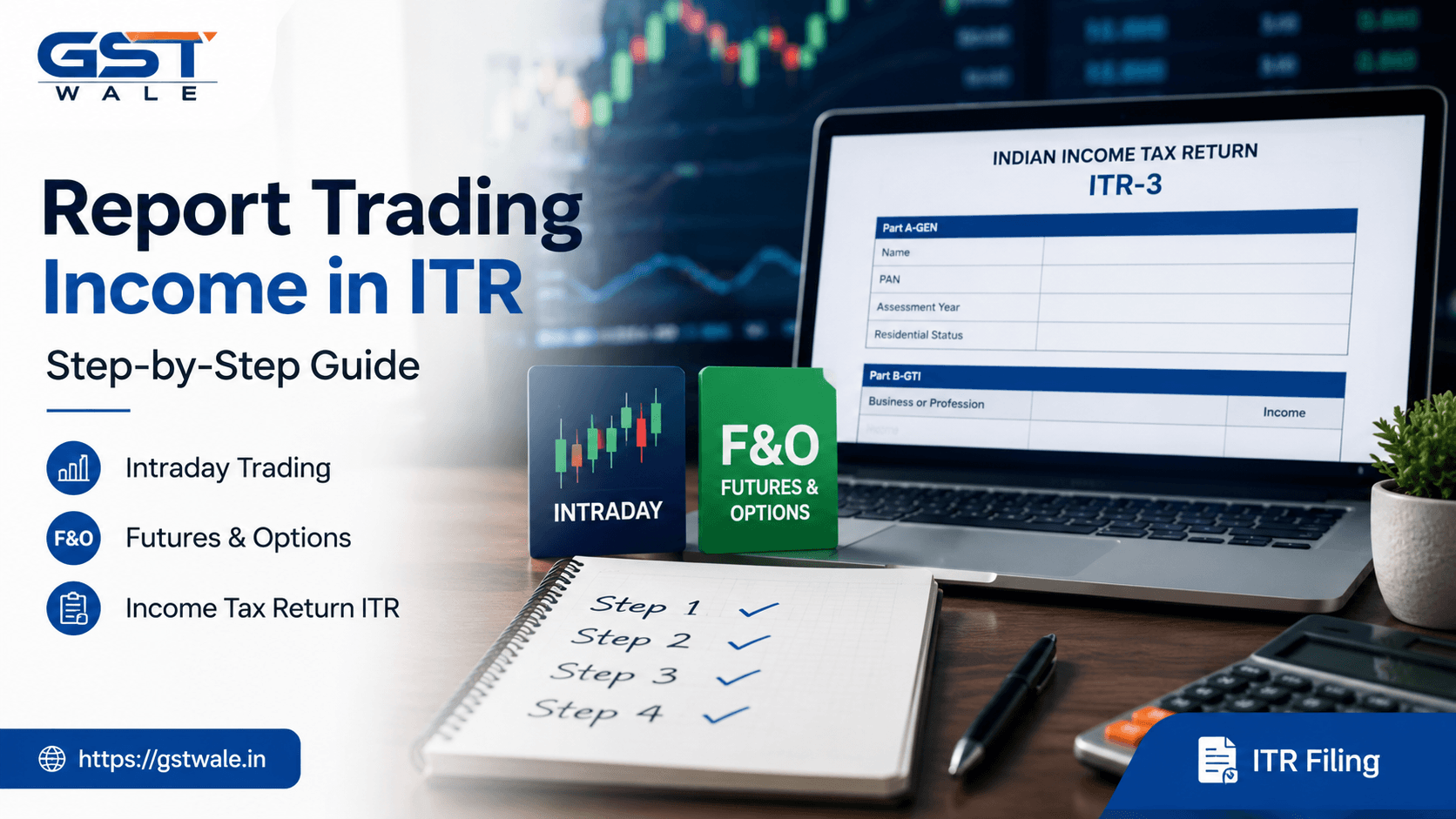
Filing an income tax return itr becomes slightly technical when you are involved in stock market activities like intraday trading or Futures & Options (F&O). Many salaried individuals and retail traders often assume that stock market income is treated like capital gains in every case. However, the Income Tax Department classifies intraday and F&O income differently, and reporting them incorrectly can lead to notices, penalties, or unnecessary scrutiny.
At GST Wale, we regularly assist traders, professionals, and investors with accurate tax filing and compliance. If you actively trade in stocks, derivatives, or options, understanding the correct method of reporting your transactions in your income tax return itr is extremely important. If you are planning professional ITR Filing, proper classification of trading income can help you avoid future tax complications.
In this guide, we will explain the complete process step-by-step in simple language.
Understanding Intraday Trading and F&O Taxation in Income Tax Return ITR
Before filing your income tax return itr, you must first understand how the Income Tax Act treats different types of stock market transactions.
Intraday Trading
Intraday trading means buying and selling shares on the same day without taking delivery. Under income tax laws, intraday trading is treated as speculative business income.
This means:
- Profit is speculative business profit
- Loss is speculative business loss
- Such losses can only be set off against speculative profits
Futures & Options (F&O)
F&O trading is treated differently. Even though it involves speculation in common language, under income tax rules, F&O income is classified as:
- Non speculative business profits
- Business income under Section 43(5)
This distinction is very important while preparing your income tax return itr.
Which ITR Form Should Traders Use?
Selecting the correct form is the first step in filing your income tax return itr correctly.
Use ITR-3 If:
- You have intraday trading income
- You trade in F&O
- You maintain trading books
- You have business income from stock market activities
Use ITR-4 Only If Eligible
ITR-4 can be used under presumptive taxation in certain F&O cases, but it may not suit every trader, especially when turnover is high or losses are involved.
For most active traders, ITR-3 is usually the safer and more appropriate option.
Step-by-Step Process to Report Intraday Trading in Income Tax Return ITR
Step 1: Download Trading Statement
Collect the following documents from your broker:
- Profit & Loss Statement
- Trade Book
- Contract Notes
- Ledger Statement
- Expense Statement
These documents are essential for accurate reporting.
Step 2: Calculate Turnover
In intraday trading, turnover is not simply total sales value.
Turnover is calculated as:
- Absolute profit plus absolute loss
Example:
| Trade | Profit/Loss |
|---|---|
| Trade 1 | ₹20,000 Profit |
| Trade 2 | ₹15,000 Loss |
| Trade 3 | ₹10,000 Profit |
Turnover = 20,000 + 15,000 + 10,000 = ₹45,000
This turnover calculation is important for determining:
- Audit applicability trading turnover
- Tax audit requirements
- Presumptive taxation eligibility
Step 3: Report Speculative Business Income
Intraday profits should be reported under:
- “Profit and Gains from Business or Profession”
Since intraday is speculative in nature, it must be separately disclosed in your income tax return itr.
Step 4: Claim Eligible Expenses
You can claim genuine business expenses such as:
- Internet bills
- Brokerage charges
- Advisory fees
- Laptop depreciation
- Software subscriptions
Proper documentation helps in smooth assessment.
Step-by-Step Process to Report F&O Trading in Income Tax Return ITR
Step 1: Calculate F&O Turnover
F&O turnover rules are different from equity delivery trading.
Turnover includes:
- Absolute profit and loss
- Premium received on options sold
- Reverse trade differences
Example:
| Transaction | Amount |
|---|---|
| Profit | ₹1,20,000 |
| Loss | ₹80,000 |
Turnover = ₹2,00,000
Correct turnover calculation is critical for audit applicability trading turnover analysis.
Step 2: Classify Income Correctly
F&O income must be shown as:
- Non speculative business profits
This is one of the most commonly misunderstood areas while filing an income tax return itr.
Step 3: Maintain Proper Books
The Income Tax Department may ask for records if turnover is substantial.
Good bookkeeping for retail traders should include:
- Broker statements
- Expense invoices
- Bank statements
- P&L summaries
- Demat statements
Even small traders should maintain organized records.
Step 4: Report Business Expenses
You can claim expenses related to trading activity, including:
- Brokerage
- Data subscriptions
- Internet expenses
- Office rent
- Research tools
These deductions help reduce taxable profits legally.
Tax Audit Rules for Traders
Understanding audit provisions business income is essential for traders.
When Is Tax Audit Applicable?
Tax audit may apply if:
- Turnover exceeds prescribed limits
- Declared profit is lower than presumptive taxation norms
- Income exceeds basic exemption limit
Important Audit Considerations
For stock traders, tax audit depends on:
- Turnover calculation
- Profit percentage
- Total income
This is why accurate audit applicability trading turnover computation becomes extremely important.
At GST Wale, we often notice traders receiving notices simply because turnover was calculated incorrectly.
Can You Show F&O Income Under Presumptive Taxation?
Yes, in some cases.
Under Section 44AD:
- Eligible traders may declare 6% or 8% presumptive income
- Books may not be required in certain situations
However, presumptive taxation may not be ideal if:
- You have losses
- You want to carry forward losses
- Your actual profit is low
Professional guidance is recommended before choosing this option in your income tax return itr.
Treatment of Losses in Trading
Intraday Losses
- Treated as speculative losses
- Can only be adjusted against speculative profits
- Carry forward allowed for 4 years
F&O Losses
- Treated as non-speculative business losses
- Can be adjusted against most business income
- Carry forward allowed for 8 years
However, to carry forward losses, filing the income tax return itr before the due date is mandatory.
Common Mistakes Traders Should Avoid
Incorrect ITR Form Selection
Using ITR-1 or ITR-2 despite trading income is a common mistake.
Wrong Turnover Calculation
Improper turnover reporting may trigger tax notices.
Ignoring Expenses
Many traders fail to claim legitimate deductions.
Not Maintaining Records
Weak bookkeeping for retail traders creates compliance issues during assessments.
Late Filing
Late filing may result in:
- Loss carry-forward denial
- Interest and penalties
- Increased scrutiny
FAQs on Income Tax Return ITR for Traders
Is intraday trading treated as capital gains?
No. Intraday trading is treated as speculative business income.
Is F&O income speculative?
No. F&O income is considered non speculative business profits under tax laws.
Which ITR form should traders file?
Most traders should file ITR-3 for accurate reporting.
Is tax audit mandatory for all traders?
No. Audit depends on turnover, profit percentage, and compliance with audit provisions business income rules.
Can trading losses be carried forward?
Yes, but your income tax return itr must be filed within the due date.
Reporting stock market transactions correctly in your income tax return itr is essential for avoiding future tax disputes and ensuring smooth compliance. Intraday trading and F&O transactions have different tax treatments, turnover calculations, and audit implications. Even small errors can create unnecessary complications.
Proper classification of speculative and non speculative business profits, accurate audit applicability trading turnover calculation, and disciplined bookkeeping for retail traders can save significant time and tax stress.
At GST Wale, our experts help traders, investors, and salaried individuals file accurate returns while ensuring full compliance with the latest audit provisions business income requirements. Whether you are a beginner trader or an active F&O participant, our team can simplify your entire income tax return itr filing process with practical and professional support.
 Previous