


Understanding Your Sec 148 notice for FY 21-22: An Expert Guide by GST Wale
Understanding Your Sec 148 notice for FY 21-22: An Expert Guide by GST Wale
Understanding Your Sec 148 notice for FY 21-22: An Expert Guide by GST Wale
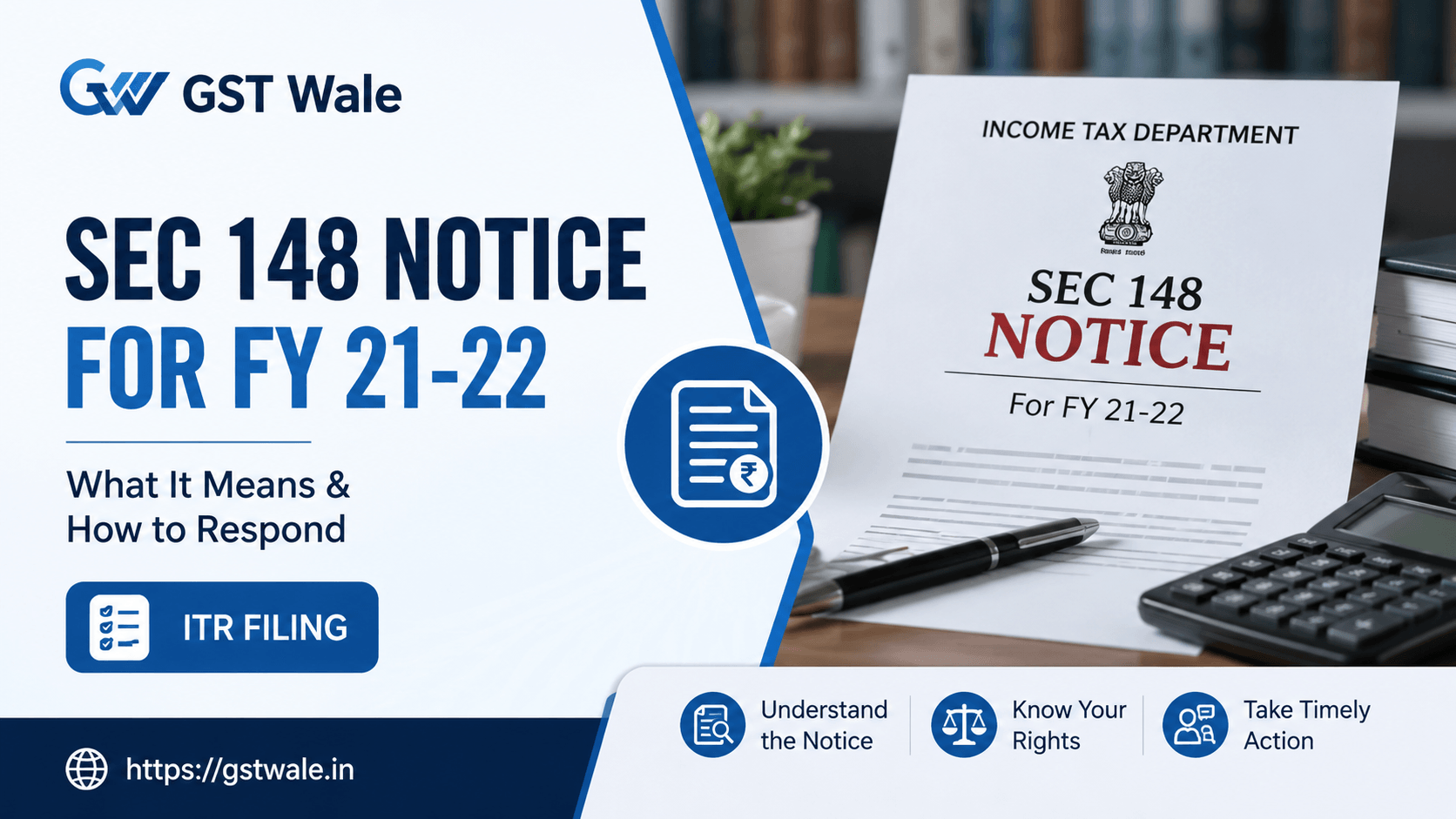
If you have just opened your income tax e-filing portal or checked your email to find a tax notice, you are not alone. Lately, many business owners and individual taxpayers across India have been waking up to a Sec 148 notice for FY 21-22. At GST Wale, we deal with these situations daily, and the very first thing we tell our clients is simple: Do not panic, but do not ignore it either.
A notice issued under Section 148 of the Income Tax Act, 1961, means that the tax department has reason to believe some of your income earned during the Financial Year 2021-22 (corresponding to Assessment Year 2022-23) escaped the initial assessment. Whether you missed reporting a transaction or there was a data mismatch, handling this requires precision. Ensuring accurate and timely ITR Filing in the first place is the best shield against such complications, but if a Sec 148 notice for FY 21-22 has already landed in your inbox, it is time to act methodically.
Why Have You Received a Sec 148 notice for FY 21-22?
The Income Tax Department doesn't issue a reassessment notice out of thin air. With heavy data integration from banks, stock exchanges, and registration authorities, the department relies on concrete information before reopening a case. Here are the most common triggers behind a Sec 148 notice for FY 21-22:
High-Value Cash Deposits or Withdrawals: If you made significant cash transactions in your savings or current accounts during the pandemic-recovery period of FY 21-22 that don't match your declared income.
Unreported Capital Gains: Selling immovable property, shares, or mutual funds without accurately computing or declaring the capital gains in your original tax return.
Mismatches in Form 26AS or AIS: The Annual Information Statement (AIS) records all your financial footprints. If your AIS shows an investment or income stream that you skipped during your tax filing, it can trigger a Sec 148 notice for FY 21-22.
Foreign Assets or Foreign Income: Failing to disclose overseas bank accounts, investments, or income sources during that specific financial year.
The Legal Framework and Timelines for FY 2021-22
Understanding the timelines is a crucial part of your defense when dealing with a Sec 148 notice for FY 21-22. Following recent amendments, the rules regarding how far back the department can go have changed significantly.
The Under-₹50 Lakh Threshold
If the income alleged to have escaped assessment is less than ₹50 lakhs, the department faces a strict time limit. They can only issue a reassessment notice within 3 years and 3 months from the end of the relevant Assessment Year. For FY 2021-22 (AY 2022-23), this window for smaller amounts has generally closed. Therefore, if you receive a fresh notice today for an amount under ₹50 lakhs, it might be legally time-barred, which acts as an excellent initial line of defense.
The Over-₹50 Lakh Threshold
If the tax authorities possess material evidence indicating that the escaped income is ₹50 lakhs or more, the story changes completely. In these high-value cases, the department can reopen assessments up to 5 years and 3 months from the end of the relevant Assessment Year. This means your financial records for that year remain under active scrutiny, and a Sec 148 notice for FY 21-22 for high-value transactions is entirely within their legal rights to issue.
Step-by-Step Response Strategy for a Sec 148 notice for FY 21-22
When GST Wale assists clients with a tax notice, we follow a rigorous, step-by-step protocol to ensure nothing is left to chance. If you are managing this on your own or preparing to speak with an expert, follow this sequence carefully:
1.Verify Authenticity on the Portal:Immediate Action.
Log in to your official income tax e-filing portal. Navigate to the 'e-Proceedings' section to view the actual notice. Check the unique Document Identification Number (DIN) to ensure the notice is authentic and legally valid.
2.Analyze the Section 148A Order:Within 7 Days.
Under the current law, an Assessing Officer cannot issue a Section 148 notice directly without first giving you a chance to explain under Section 148A. Review the attached Section 148A(d) order to see the exact reasons, calculations, and third-party evidence the officer is relying on.
3.Gather Historical Financial Records:Within 15 Days.
Collate all relevant documents for FY 21-22. This includes bank statements for all accounts, property purchase or sale deeds, demat account statements, contract notes, and your original ITR acknowledgment.
4.File the Reassessment Return:Within 30 Days.
The notice will require you to file a fresh return of income for the relevant year. File this return carefully, incorporating the necessary corrections if you agree with the discrepancies, or re-submitting your original figures if you plan to contest the notice.
5.Submit a Detailed Legal Reply:Final Step.
Draft a comprehensive, legal-factual reply addressing every single point raised by the officer. Attach your documentary proof to show that either the income was already taxed, is exempt, or the calculation provided by the department contains factual errors.
Pitfalls to Avoid When Responding
As experienced CAs, we often see taxpayers make critical mistakes out of fear or haste when trying to resolve a Sec 148 notice for FY 21-22.
Expert Warning: Never ignore the deadlines specified in the notice. Failing to respond within the stipulated time allows the Assessing Officer to pass a 'Best Judgment Assessment' under Section 144, calculating your tax liability arbitrarily based on available data, accompanied by heavy penalties and potential prosecution.
Another common blunder is filing a generic, single-sentence response like "I have paid all my taxes." The department expects a point-by-point reconciliation of the specific transaction highlighted in the notice. If they show a ₹60 lakh property sale, you must provide the exact calculation of cost of acquisition, indexation, and capital gains.
Frequently Asked Questions (FAQs)
Can I file an updated return after receiving a Sec 148 notice for FY 21-22?
No. Once a show-cause notice under Section 148A or a formal Sec 148 notice for FY 21-22 is issued to you, the option to file an updated return (ITR-U) for that specific financial year is completely blocked. You must now respond through the ongoing reassessment proceedings.
What is the penalty if income escapement is proven?
If the department proves that income escaped assessment, you will have to pay the regular tax due on that income, along with hefty interest under Sections 234B and 234C. Additionally, a penalty for under-reporting or misreporting of income under Section 270A can range from 50% to 200% of the tax payable.
Is a personal appearance required before the tax officer?
No, the entire reassessment process has been shifted to the Faceless Assessment Scheme. All submissions, explanations, and document uploads are handled electronically through your e-filing account. If a clarification is required, a video-conference hearing can be requested.
How can GST Wale help me clear my Sec 148 notice for FY 21-22?
At GST Wale, our team of seasoned tax professionals and Chartered Accountants reviews the base information behind your notice, prepares a legally sound reconciliation statement, files the mandated returns, and handles all digital representations before the tax authorities on your behalf to protect you from unfair tax demands.
Let GST Wale Secure Your Peace of Mind
Receiving a Sec 148 notice for FY 21-22 can undoubtedly disrupt your peace of mind, but it is entirely manageable when approached with accurate data and sound legal strategy. The Income Tax Department is focused on verifying data anomalies, and presenting a transparent, clean, and professional response is the only way to close the matter cleanly.
Don't leave your hard-earned business revenue or personal savings to chance by submitting incorrect replies. Let the experts at GST Wale take the burden off your shoulders. We will analyze your notice, deep-dive into your financial footprint for FY 2021-22, and draft a robust response that minimizes your tax risk. Reach out to GST Wale today to schedule a professional consultation and put your tax worries to rest!
 Previous