


New ITR Forms & Rules For FY 2025-26: Deadlines, Changes, & Penalty Guide
New ITR Forms & Rules For FY 2025-26: Deadlines, Changes, & Penalty Guide
Tax season in India is no longer just about filling out a few rows of numbers at the last minute and hitting submit. Over the last few years, the Income Tax Department has undergone a massive digital transformation, making tax compliance highly automated and data-driven. As we enter the filing window for the current assessment cycle, staying on top of the FY 2025-26 ITR Filing Changes is absolutely critical for every salaried employee, freelancer, and business owner. Filing blindly based on what you did last year is the easiest way to land a "defective return" notice or face hefty penalties.
At GST Wale, we interact with hundreds of taxpayers daily, and the common consensus we hear is: "Sir, the portal already has all my data, so why do the forms keep changing?" The truth is, while the portal compiles your financial footprint via the Annual Information Statement (AIS), the responsibility to choose the correct form and declare income accurately still rests entirely on you. If you find the entire process overwhelming, you can always rely on our experts for seamless ITR Filing to ensure complete accuracy and peace of mind. Let us deep-dive into what has shifted this year and how you can navigate these changes smoothly.
Understanding the New ITR Forms FY 2025-26
Choosing the wrong ITR form is like trying to fit a square peg into a round hole. If your financial profile doesn't match the legal scope of the form you submit, the tax department's automated systems will flag your return as invalid. To prevent this, let’s break down the updated eligibility criteria for the primary ITR forms for FY 2025-26.
ITR-1 Sahaj Eligibility
The ITR-1, or Sahaj form, is meant for individuals with simple, straightforward income structures. However, its boundaries are strictly enforced. To qualify for ITR-1 Sahaj eligibility, you must meet the following conditions:
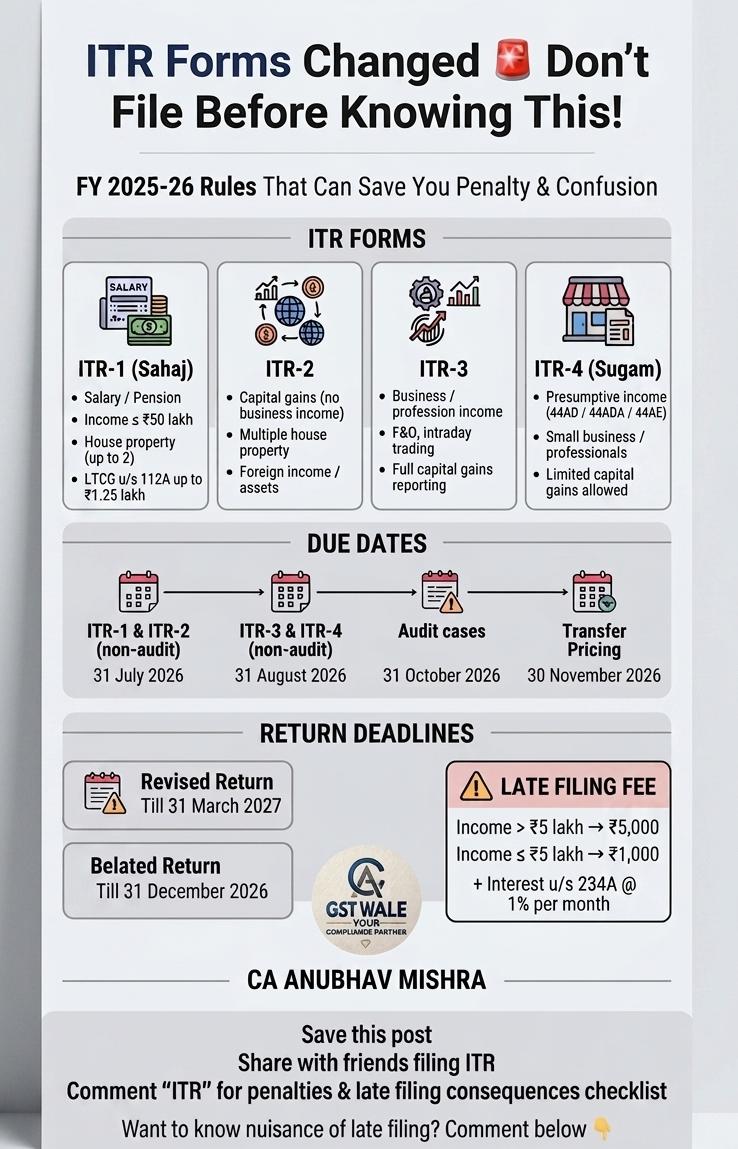
Your total income for the financial year must not exceed ₹50 lakh.
Your income must come only from Salary, Pension, one house property, or "Other Sources" (like bank interest).
New relaxation: Long-Term Capital Gains (LTCG) under Section 112A are permitted up to ₹1.25 lakh (reflecting the updated exemption limits).
Who is excluded? If you own foreign assets, hold unlisted equity shares, are a director in a company, or have brought forward losses from previous years, you cannot use ITR-1.
ITR-2 Capital Gains and Foreign Income
If you are an active retail investor, ITR-1 will not cut it. You will need to move to ITR-2, which is tailored for individuals who do not have business profits but possess diverse investment portfolios.
ITR-2 capital gains reporting requires a highly granular breakdown of your short-term and long-term gains from stocks, mutual funds, and real estate.
This form is mandatory if your total income crosses ₹50 lakh or if you own more than one house property.
It is also the designated form for reporting global income or foreign assets, including stock options (ESOPs) from foreign parent companies.
ITR-3 F&O Trading and Business Income
If you treat the stock market as a business or run a proprietary firm, ITR-3 is your legal requirement.
Filing an ITR-3 F&O trading return is mandatory if you trade in Futures and Options or engage in intraday equity trading, as the tax department treats these activities as business income/loss rather than capital gains.
It requires maintaining a proper balance sheet and profit & loss statement unless you opt for presumptive taxation.
It offers comprehensive reporting for all types of capital gains, business revenues, and partner salaries from partnership firms.
ITR-4 Sugam Presumptive Income
For small business owners, shopkeepers, and independent professionals who want to avoid the headache of maintaining complex books of accounts, the presumptive taxation scheme is a lifesaver.
The ITR-4 Sugam presumptive income form applies to taxpayers opting for sections 44AD (small businesses with turnover up to ₹3 crores under certain digital conditions), 44ADA (specified professionals with gross receipts up to ₹75 lakhs), or 44AE (goods transport operators).
Keep in mind that only limited, simple capital gains are permitted under this form; if you have complex trading portfolios alongside your business, you must step up to ITR-3.
Crucial Income Tax Return Deadlines 2026
Timing is everything in tax compliance. Missing the statutory deadlines closes the door on several tax-saving benefits, such as carrying forward business or capital losses to offset future profits. Mark these critical income tax return deadlines 2026 on your calendar:
31st July 2026: Deadline for salaried individuals, freelancers, and non-audit cases filing ITR-1 and ITR-2.
31st August 2026: Deadline for non-audit business and professional cases filing ITR-3 and ITR-4.
31st October 2026: Deadline for corporate taxpayers and business entities whose books are mandatorily subject to a statutory tax audit under Section 44AB.
30th November 2026: Deadline for taxpayers required to submit a report under Section 92E relating to international or specific domestic transactions (Transfer Pricing).
Missed the Window? Belated and Revised Return Deadlines
If you miss the primary deadlines mentioned above, the law still gives you a window to correct your path, though it comes with financial consequences.
Belated Return Timeline
You can file a "Belated Return" if you missed the July or August windows. The hard stop for filing a belated return for this cycle is 31st December 2026. Filing during this period will automatically attract late fees and interest.
Revised Return Deadline 2027
What if you filed your tax return on time but later realized you forgot to declare a minor bank interest account, or missed claiming an eligible deduction under Chapter VI-A? You can correct your mistakes without receiving a penalty notice by filing a revised return. The final revised return deadline 2027 is locked for 31st March 2027. Once this date passes, no further modifications can be made to your return for this financial year.
The Cost of Delay: Late Filing Fees and Penalties
Filing late is an expensive affair. The system automatically computes penalties the moment your return crosses the statutory due date.
Late Filing Fee Breakdown
Under Section 234F, a late fee is levied based on your total quantum of income:
If your total taxable income exceeds ₹5 lakh, a flat late fee of ₹5,000 is applicable.
If your total taxable income is less than or equal to ₹5 lakh, the fee is restricted to ₹1,000.
Interest Under Section 234A
Apart from the flat late fee, if you have any self-assessment tax liabilities outstanding, you will face a late filing fee section 234A interest charge. This interest accumulates at a strict rate of 1% per month (or part of a month). The interest calculation begins immediately from the day following your original due date and continues until the day you actually file and pay the taxes.
Practical Action Plan to Navigate the FY 2025-26 ITR Filing Changes
To ensure a seamless, error-free filing experience under the new guidelines, we highly recommend following this systematic checklist:
Reconcile with AIS and TIS: Before opening your ITR form, download your Annual Information Statement (AIS) and Taxpayer Information Summary (TIS). Ensure every single dividend, stock sale, and interest income listed matches your personal bank records.
Verify TDS via Form 26AS: Make sure that the taxes deducted by your employer or bank are fully reflected in Form 26AS. If there is a mismatch, contact the deductor immediately to get it rectified.
Choose Your Tax Regime Wisely: Remember that the New Tax Regime is the default option. If you wish to opt for the Old Tax Regime to claim deductions like HRA or Section 80C, you must explicitly select it within the form (and file Form 10-IEA if you have business income).
E-Verify Within Timeline: Filing your return is only half the job done. Don't forget to e-verify your ITR via Aadhaar OTP or Net Banking within the permitted timeframe, otherwise, your filed return will be treated as completely unfiled.
Frequently Asked Questions (FAQs)
Q1: Can I file ITR-1 if I have regular income from equity intraday trading? No. Intraday trading is legally categorized as speculative business income. Therefore, you cannot file ITR-1 or ITR-2. You must mandatorily file ITR-3 to report these transactions.
Q2: What happens if I miss the revised return deadline of March 31, 2027? Once the final deadline passes, you cannot file a standard revised return. Your only option to rectify errors or unreported income would be through an "Updated Return" (ITR-U) under Section 139(8A), which involves paying an additional tax penalty ranging from 25% to 50% of the aggregate tax due.
Q3: Is the late filing fee applicable if my total income is below the basic exemption limit? If your total gross income is below the basic exemption limit, you are generally not legally bound to file an ITR, and hence no late fee under Section 234F is levied for late submissions. However, if you are filing mandatorily due to specific high-value criteria (like spending over ₹2 lakh on foreign travel or consuming over ₹1 lakh in electricity), a late fee may apply.
Q4: How do the FY 2025-26 ITR Filing Changes affect long-term capital gains reporting in ITR-1? Taxpayers can now declare long-term capital gains under Section 112A up to ₹1.25 lakh within the ITR-1 form itself, bringing great relief to small retail investors who previously had to shift to the more complex ITR-2 form just for minor investment gains.
Let GST Wale Handle Your Taxes smoothly!
Staying compliant with the changing tax landscapes does not have to be stressful. One minor error in form selection or asset disclosure can attract automated notices from the tax department, costing you time, peace of mind, and money.
Why take the risk? Let the experienced professionals at GST Wale manage the heavy lifting for you. From detailed AIS reconciliation to identifying the perfect ITR form for your specific financial profile, we ensure your taxes are filed accurately, optimally, and well before the deadline. Reach out to GST Wale today, and let’s make this tax season completely stress-free!
 Previous