


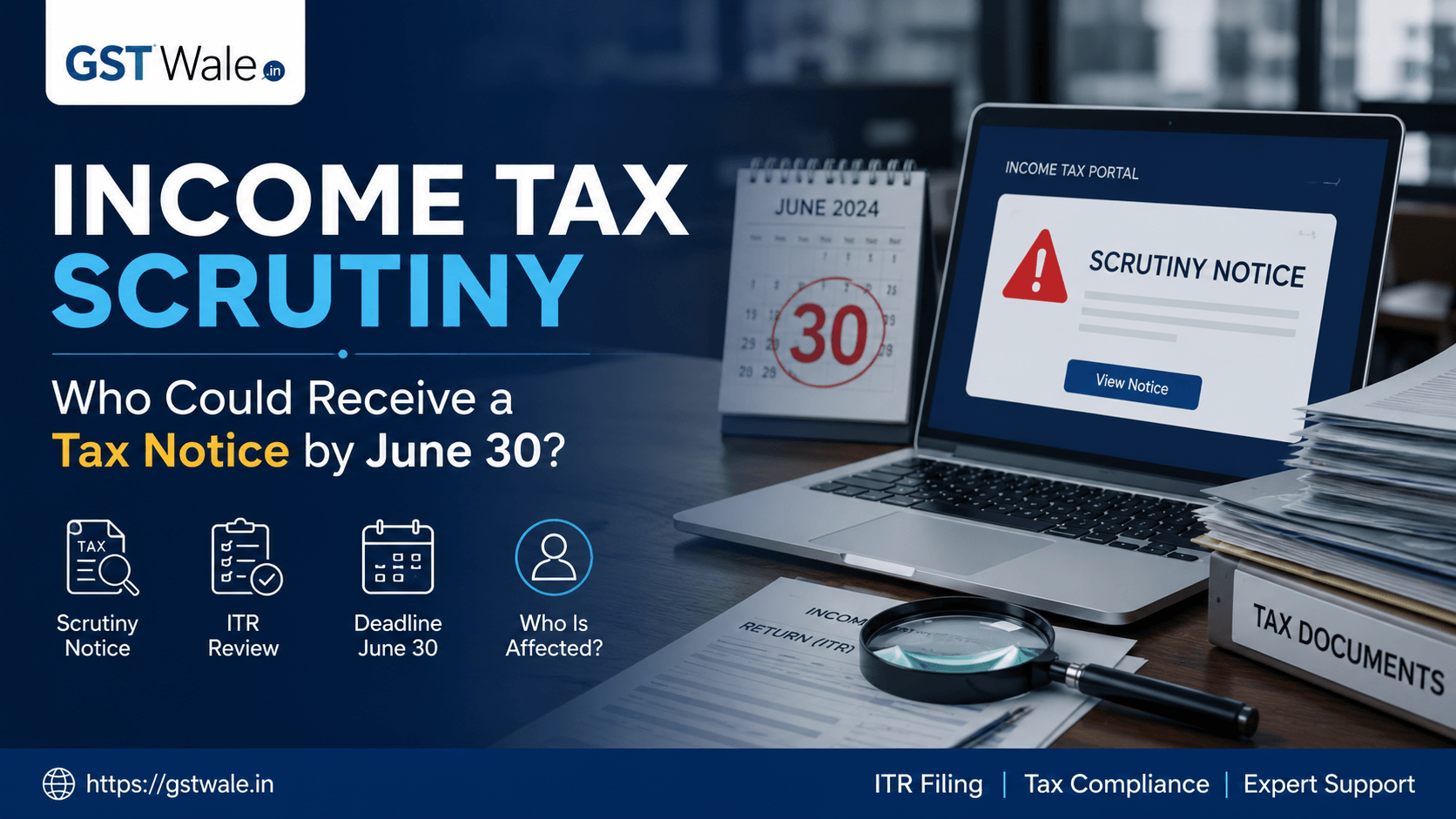
Income Tax Scrutiny: Who Could Receive a Tax Notice by June 30?
Income Tax Scrutiny: Who Could Receive a Tax Notice by June 30?
Income Tax Scrutiny: Who Could Receive a Tax Notice by June 30 and What to Do If You've Made a Mistake
As we cross the mid-way point of June, an annual countdown begins for taxpayers who filed their Income Tax Returns (ITR) in the preceding financial year. In the corridors of the Income Tax Department, June 30 is a critical statutory cutoff date. If your return has been flagged for a detailed evaluation, a formal Section 143(2) scrutiny notice must be served to you on or before this date.
At GST Wale, we regularly see panic spikes around this time of the year. Business owners, salaried professionals, and freelancers all ask the same question: "Am I on the list" If your ITR contains mistakes or mismatch indicators, knowing where you stand and how to rectify those errors can save you from severe financial penalties. Proper documentation during initial ITR Filing is the best way to safeguard against these situations, but if you are currently staring at an impending deadline or a mistake in your past return, here is exactly what you need to understand.
Why June 30 is the Critical Deadline for Scrutiny Notices
Under Section 143(2) of the Income Tax Act, 1961, the tax department is bound by a strict time frame to initiate a regular scrutiny assessment. The law mandates that a scrutiny notice must be issued within 3 months from the end of the financial year in which the return was filed.
For the vast pool of tax returns submitted during the Financial Year 2025-26, the corresponding financial year ended on March 31, 2026. Counting three months forward brings us to June 30, 2026.
If the clock strikes midnight on June 30 and you haven’t received a notice under Section 143(2), your tax return for that specific filing cycle cannot ordinarily be opened for routine scrutiny under this section. It gives taxpayers a massive sigh of relief—but until that date passes, the risk remains active.
Who Could Receive a Tax Notice by June 30?
The Central Board of Direct Taxes (CBDT) issues specific internal parameters that dictate which returns get filtered out for manual or compulsory scrutiny. You are at a significantly higher risk of receiving a tax notice by June 30 if your financial profile falls into any of the following categories:
Taxpayers with High-Value Transactions: If your Annual Information Statement (AIS) or Taxpayer Information Summary (TIS) shows credit card bills exceeding ₹10 lakhs, high-value property deals, or massive stock market trades that do not align proportionately with your declared income.
Recurring Legal and Factual Issues (CS05 Category): Individuals or businesses who had large tax additions or adjustments made to their income by the department in previous assessment years on recurring items of law or facts.
Credible Tax Evasion Information (CS06 Category): Cases where law enforcement wings, the GST department, or intelligence units share specific data pointing toward hidden income or structural tax evasion.
Severe Data Mismatches: A basic variance between the Tax Deducted at Source (TDS) claimed in your ITR versus what is visibly recorded in your Form 26AS.
What to Do If You've Made a Mistake in Your ITR
Discovering an error or a major omission in your tax return before the department catches it is a stressful realization. Your course of action depends entirely on whether a notice has already reached your portal.
Scenario A: You Realize a Mistake, But No Notice Has Arrived Yet
Since the standard window to file a revised return for the past cycle closes early, you cannot simply click "Revise Return" on the portal. However, the law provides a proactive lifeline: The Updated Return (ITR-U).
If you voluntarily wish to correct a mistake, report hidden income, or fix wrong deductions, you can file an ITR-U. Note that this route requires you to pay the tax difference along with an additional penalty of 25% to 50% of the aggregate tax and interest, depending on when you file. Taking this step completely blocks the department from penalizing you for concealment later.
Scenario B: You Receive a Section 143(2) Scrutiny Notice
If a notice lands in your account, filing an ITR-U is no longer an option. Do not try to cover up the mistake with vague explanations. You must deal with it systematically during the e-proceedings.
1.Log In and Download the Notice:Day 1-3.
Access your e-filing dashboard, go to 'Pending Actions' and click on 'e-Proceedings'. Download the complete notice along with its annexures to identify the specific items selected for scrutiny.
2.Evaluate the Discrepancy Factually:Day 4-10.
Cross-examine the error. If you claimed an incorrect deduction or missed out on reporting a bank interest stream, compute the exact tax impact of that specific mistake.
3.Compile Solid Document Evidence:Day 11-15.
Gather your clean financial files: bank books, ledger accounts, Form 16, or contract notes. If the mistake is an honest typographical error, prepare a reconciliation sheet showing the actual figures.
4.Submit Your Response Faceless:Before Due Date.
Draft a transparent, factual submission on the portal. Admit the oversight if a mistake was made, express your willingness to pay the differential tax plus interest, and upload your documents.
Frequently Asked Questions (FAQs)
Does receiving a Section 143(2) notice mean I am guilty of tax evasion?
No. A scrutiny notice is not a tax raid or an accusation of fraud. It simply means the department’s automated risk management systems found a variance or transaction that requires deep validation and documentation.
Can I ignore the notice if the mistake is very minor?
Absolutely not. Ignoring a Section 143(2) notice can attract a statutory flat penalty of ₹10,000 under Section 272A for non-compliance. Furthermore, the officer can pass a 'Best Judgment Assessment' under Section 144, raising massive tax demands based on their own calculations.
How are these scrutiny assessments conducted?
All scrutiny assessments are now conducted under the Faceless Assessment Scheme. You are not required to visit any income tax office. Everything from notice issuance to submitting responses and receiving final orders takes place digitally on the e-filing portal.
Let GST Wale Handle Your Income Tax Scrutiny
Dealing with the Income Tax Department requires a professional understanding of tax provisions, data streams, and legal drafting. A poorly worded reply or an incomplete submission can escalate a minor documentation mistake into a major tax dispute with heavy penalties.
At GST Wale, our expert Chartered Accountants specialize in navigating the Faceless Assessment mechanism. We bridge the gap between your accounts and the department’s expectations. Whether you need to carefully evaluate your risk before June 30, file a proactive ITR-U to fix an error, or draft a rock-solid, evidence-backed response to a live scrutiny notice, we’ve got you covered. Contact GST Wale today and let our specialists manage your tax peace of mind!
 Previous