


The Smart Way to Rectify Errors in Your ITR Return Filing Online
The Smart Way to Rectify Errors in Your ITR Return Filing Online
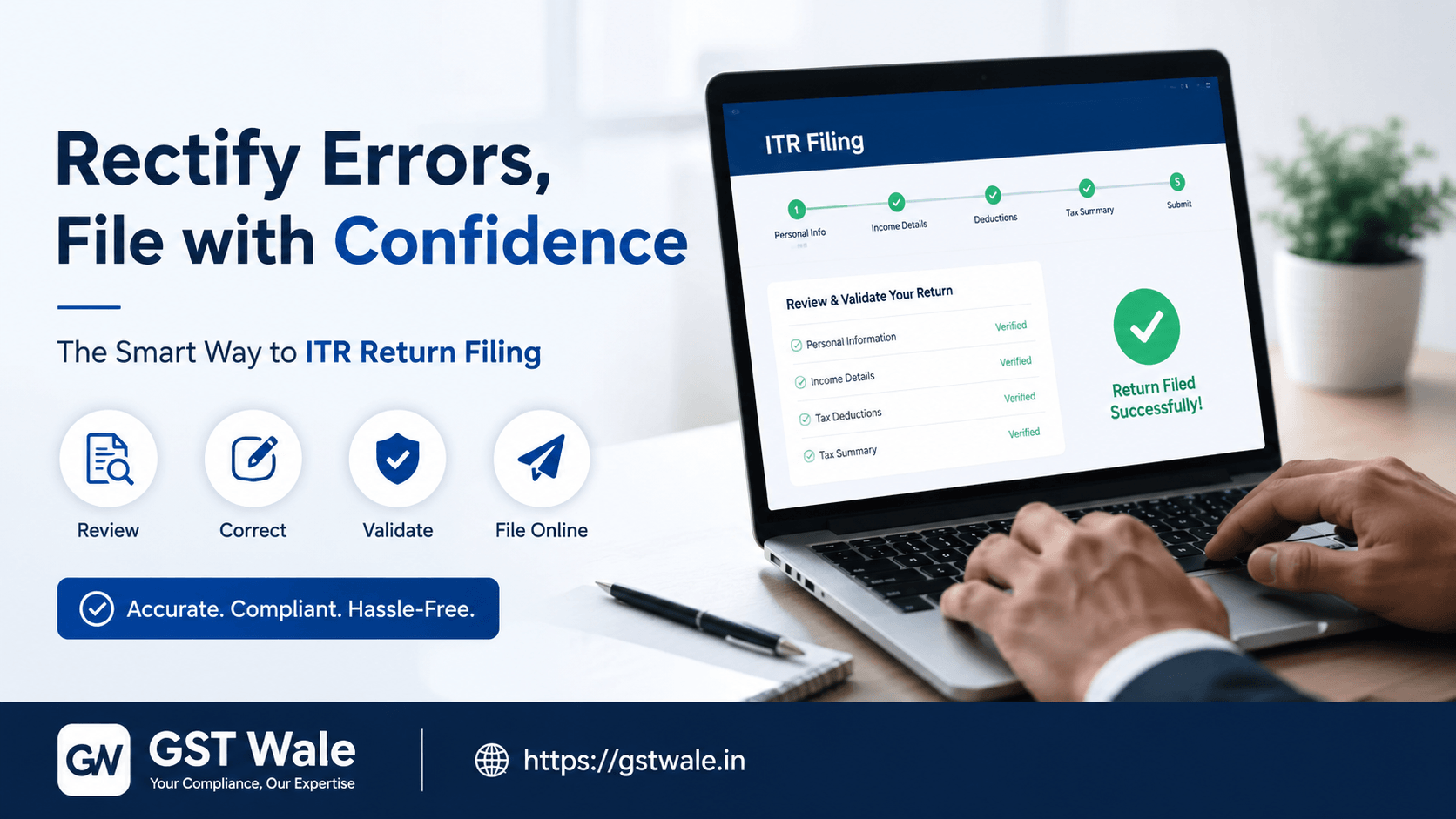
We have all been there. You hit the 'Submit' button on the Income Tax portal, breathe a sigh of relief, and suddenly realize: you forgot to report that small interest income from your savings account or entered the wrong TDS amount. It happens to the best of us. As professionals at GST Wale, we handle thousands of cases every year, and we always tell our clients that while precision is the goal, mistakes are fixable. Ensuring accuracy in your ITR return filing is crucial to avoid unwanted scrutiny from the Income Tax Department, but panicking is never the answer.
If you find yourself in this situation, don't worry. Whether you are managing your personal taxes or need assistance with professional ITR Filing, we are here to walk you through the correction process. The law provides clear mechanisms to fix these discrepancies, provided you act within the stipulated timelines.
When Should You Consider a Revised Tax Return?
The Income Tax Act is quite taxpayer-friendly in this regard. If you have discovered an omission or a wrong statement in your original return, you can file a revised tax return. Under Section 139 5, the law allows taxpayers to correct errors.
However, keep in mind that you can only revise your return if you have already filed it. If you missed the original deadline and did not file at all, you would be looking at a 'belated return' rather than a revision. Use the revision option to:
Correct clerical errors (e.g., PAN, bank account details).
Add income that was previously missed.
Claim deductions that were inadvertently left out.
Adjust wrong tax calculations or TDS credits.
Step-by-Step Guide to Correct E-filed ITR
The process to correct e-filed ITR data is entirely digital and straightforward. Follow these steps to ensure you get it right the first time:
Login to the Portal: Log in to the official Income Tax e-filing website using your credentials.
Download the XML/JSON: It is often easier to download the JSON of the originally filed return to see exactly what you submitted.
Prepare the Rectified Data: Make the necessary corrections in the appropriate schedules. Ensure you select the 'Revised Return' option under Section 139(5) in the 'Filing Type' section.
Provide Acknowledgment Details: You will be required to provide the acknowledgment number and the date of filing of your original return.
Verify and Submit: Once the data is corrected, validate the form, generate the XML/JSON file, and upload it back to the portal.
E-Verify: Do not forget to e-verify your revised return, as the process is incomplete without it.
Addressing Minor Errors: Tax Rectification Request
Sometimes, the error is not in your data entry but in the processing of the return by the Income Tax Department—for instance, if there is a mismatch between your claimed TDS and the data available in Form 26AS. In such cases, you don't necessarily need a revised return. Instead, you can raise a tax rectification request directly on the portal.
This is specifically useful when the Centralized Processing Centre (CPC) sends you an intimation under Section 143(1) pointing out a mismatch. You can log in to your dashboard, navigate to the 'Rectification' tab, select the relevant assessment year, and submit your request with the necessary supporting documents.
Why You Should Amend Tax Return Promptly
Procrastination is your worst enemy in taxation. If you realize your ITR return filing has an error, you must amend tax return details as soon as possible.
Avoid Interest and Penalties: Late revisions might attract interest under Section 234A/B/C.
Prevent Notices: If the department detects a discrepancy before you do, you might receive a formal notice, which is far more stressful than a voluntary correction.
Speed Up Refunds: If you under-reported your tax payments, correcting it ensures that your refund is processed without hold-ups.
Frequently Asked Questions
Is there a fee for filing a revised return?
No, there is no government fee for filing a revised return. However, if your revision results in additional tax liability, you must pay the tax along with applicable interest before filing.
Can I revise my return multiple times?
Yes, you can file a revised return as many times as you want, provided it is done within the statutory time limit.
What is the deadline to file a revised return?
You can file a revised return at any time before the end of the relevant assessment year or before the completion of the assessment, whichever is earlier.
Will a revised return invite an audit?
Filing a revised return does not automatically invite a tax audit. It is a standard procedure meant for transparency. As long as your revised figures are accurate and supported by documents, there is no reason for concern.
Expert Advice from GST Wale
Tax laws can be complex, and a small error in ITR return filing can lead to significant headaches down the road. While the digital portal makes it easy to rectify mistakes, it is always wise to double-check your data with an expert before hitting submit.
At GST Wale, we specialize in making tax compliance simple for businesses and individuals across India. Whether it is a complex revision or a simple rectification request, our team is equipped to handle your requirements with precision and care. Don't let tax errors keep you up at night—reach out to us today, and let us handle your taxation needs professionally.
 Previous