


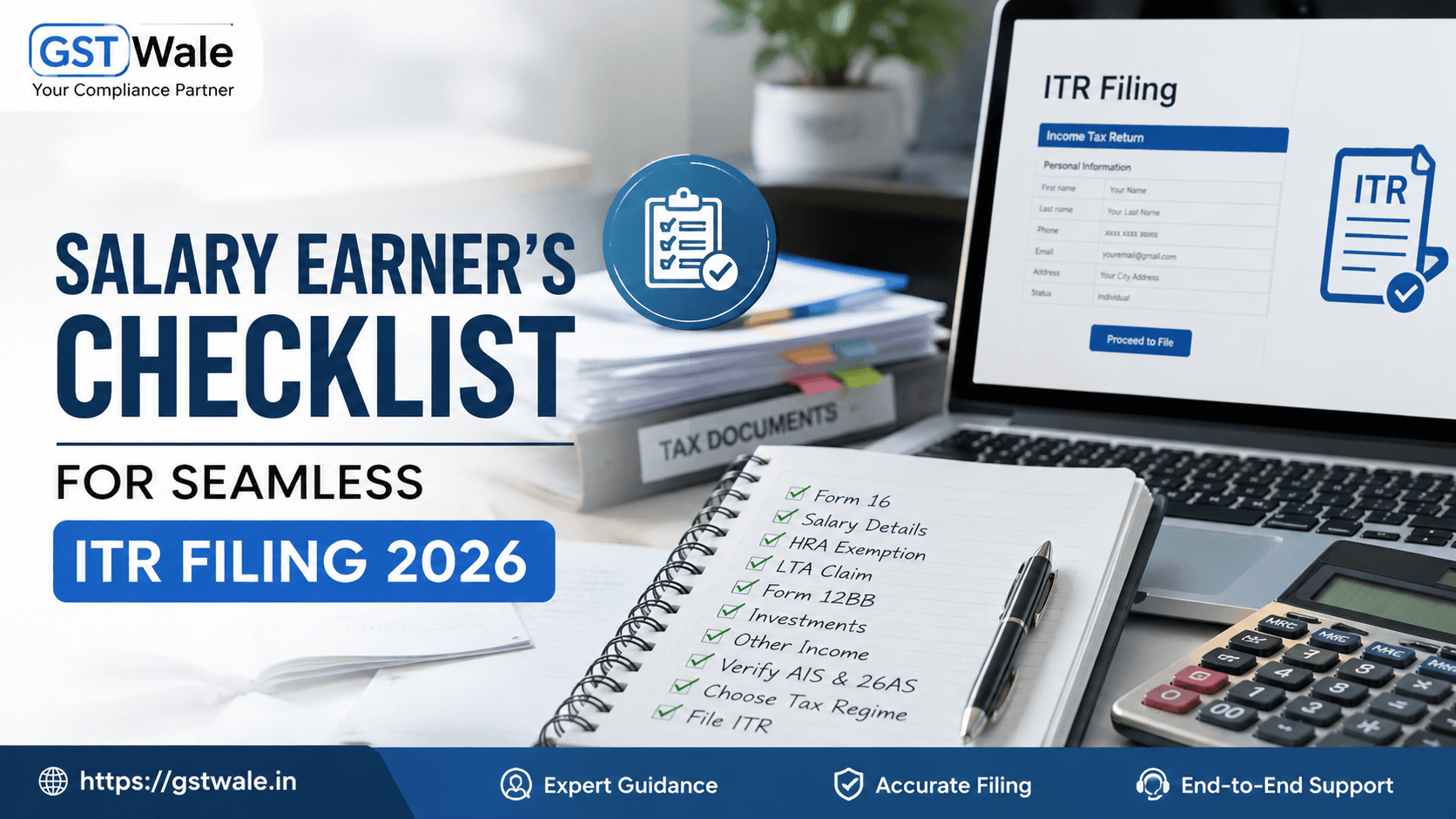
The Salary Earner's Checklist for Seamless ITR Filing 2026
The Salary Earner's Checklist for Seamless ITR Filing 2026
For salaried individuals, the financial year-end often brings one important responsibility — ITR Filing. While many employees assume that filing an Income Tax Return is straightforward because tax is already deducted by the employer, the reality is quite different. Missing documents, incorrect salary details, unclaimed deductions, or errors in reporting can lead to notices, delayed refunds, or excess tax payments.
At GST Wale, we regularly help salaried taxpayers who discover mistakes in their returns after submission. A simple mismatch in Form 16, forgotten bank interest, or incorrect HRA exemption claim can create unnecessary stress later. That’s why proper preparation before ITR Filing is extremely important.
If you want hassle-free and accurate ITR Filing, following a structured checklist can save both time and money. In this guide, GST Wale shares a practical salary earner’s checklist for seamless ITR Filing in 2026.
Why Proper ITR Filing Matters for Salary Earners
Many salaried employees think ITR Filing is only about complying with tax laws. However, filing your return correctly offers several long-term benefits:
- Faster loan approvals
- Easy visa processing
- Claiming tax refunds
- Carry forward of losses
- Avoiding income tax notices
- Better financial documentation
Even if your employer deducts TDS correctly, you are still responsible for accurate ITR Filing.
Keep Your Basic Documents Ready Before ITR Filing
Before starting your ITR Filing process, gather all the necessary documents in one place. This reduces errors and makes filing smoother.
Essential Documents Checklist
- PAN Card
- Aadhaar Card
- Form 16 from employer
- Salary slips
- Bank statements
- Interest certificates
- Investment proofs
- Home loan certificate
- Rent receipts for HRA exemption
- Form 12BB submitted to employer
- Details of previous employer income (if changed jobs)
A common mistake during ITR Filing is relying only on Form 16. Your bank interest, freelance income, or capital gains may not appear there.
Verify Your Salary Structure Carefully
Your salary structure directly affects your tax liability. Many employees ignore salary breakup details and end up paying higher taxes.
Components You Should Check
Basic Salary
This forms the base for PF, gratuity, and several exemptions.
HRA Exemption
If you live in rented accommodation, ensure your HRA exemption is correctly calculated.
You must keep:
- Rent receipts
- Rental agreement
- Landlord PAN (if rent exceeds prescribed limits)
A wrong HRA exemption claim during ITR Filing may attract scrutiny from the Income Tax Department.
LTA (Leave Travel Allowance)
LTA can provide tax benefits if claimed properly. However:
- It applies only to domestic travel
- Bills and travel proofs are necessary
- Food and hotel expenses are generally not covered
Many employees forget to claim eligible LTA benefits while filing returns.
Professional Tax
Professional tax deducted by your employer is eligible for deduction under the old tax regime. Ensure it reflects correctly in your salary details.
Perquisites
Employer-provided benefits such as:
- Company car
- Rent-free accommodation
- Stock options
- Club memberships
must be properly disclosed during ITR Filing.
Check Form 16 Thoroughly
Form 16 is one of the most important documents for salaried taxpayers.
Verify These Details in Form 16
- PAN number
- Aadhaar number
- Employer TAN
- Salary breakup
- TDS deducted
- Exemptions claimed
- Deductions under Chapter VI-A
Many taxpayers directly upload Form 16 details without verification. At GST Wale, we advise reviewing every figure carefully before final ITR Filing.
Match AIS and Form 26AS Before ITR Filing
One of the biggest reasons for tax notices today is mismatch of income details.
What You Must Cross-Check
AIS (Annual Information Statement)
It contains:
- Interest income
- Securities transactions
- Dividend income
- Foreign remittances
- Mutual fund transactions
Form 26AS
This reflects:
- TDS deductions
- Tax payments
- High-value transactions
Even small unreported interest income can trigger compliance issues during ITR Filing.
Choose the Correct Tax Regime
Salary earners now have two options:
Old Tax Regime
Suitable if you claim:
- HRA exemption
- LTA
- Home loan interest
- 80C deductions
- Medical insurance
New Tax Regime
Suitable if:
- You have fewer deductions
- Simpler salary structure
- Lower investments
Before ITR Filing, compare both regimes carefully instead of choosing randomly.
At GST Wale, we often see taxpayers selecting the wrong regime and paying unnecessary tax.
Don’t Ignore Additional Income Sources
A major error during ITR Filing is reporting only salary income.
Additional Income You Must Report
- Savings account interest
- Fixed deposit interest
- Freelance income
- Rental income
- Capital gains
- Dividend income
- Cryptocurrency gains (if applicable)
Even if TDS is deducted, reporting the income remains mandatory.
Claim Eligible Deductions Properly
Tax-saving deductions can significantly reduce your liability if claimed correctly.
Common Deductions for Salaried Individuals
Section 80C
Includes:
- EPF
- PPF
- ELSS
- Life insurance
- Tuition fees
Section 80D
Medical insurance premium deduction.
Home Loan Interest
Available under Section 24(b).
NPS Contribution
Additional deduction under Section 80CCD(1B).
During ITR Filing, always maintain proof of investments and payments.
Importance of Form 12BB in ITR Filing
Form 12BB is often overlooked by employees.
What is Form 12BB?
It is a declaration submitted to employers for claiming:
- HRA exemption
- LTA
- Home loan interest
- Other deductions
If Form 12BB was not submitted properly, your employer may deduct excess TDS. However, you can still claim eligible deductions during ITR Filing.
Common Mistakes Salary Earners Should Avoid
Filing Under Wrong ITR Form
Most salaried individuals use:
- ITR-1
- ITR-2 (if capital gains or multiple properties exist)
Using the wrong form may invalidate your return.
Not Reporting Exempt Income
PPF interest or agricultural income may be exempt but still needs reporting in some cases.
Incorrect Bank Details
Wrong bank account details can delay refunds.
Missing Deadline
Late ITR Filing may result in:
- Penalties
- Interest
- Loss of carry-forward benefits
Step-by-Step Checklist for Seamless ITR Filing
Before Filing
- Collect Form 16
- Verify salary structure
- Download AIS and Form 26AS
- Gather deduction proofs
- Check bank statements
During Filing
- Select correct ITR form
- Compare old vs new regime
- Verify income details
- Claim deductions properly
After Filing
- E-verify your return
- Save acknowledgment copy
- Track refund status
Following this checklist can make your ITR Filing process smooth and error-free.
FAQs on ITR Filing for Salary Earners
Is ITR Filing mandatory if TDS is already deducted?
Yes. TDS deduction does not remove your responsibility to file an Income Tax Return if your income exceeds the exemption limit.
Can I claim HRA exemption without submitting proofs to employer?
Yes, eligible HRA exemption can still be claimed during ITR Filing if proper documents are available.
What happens if I miss reporting FD interest?
Unreported FD interest may lead to notices because banks report such details in AIS and Form 26AS.
Which tax regime is better for salaried employees?
It depends on your deductions, investments, and salary structure. A proper comparison is necessary before ITR Filing.
Is Form 16 enough for filing returns?
No. You should also check AIS, Form 26AS, bank interest, and other income sources.
For salary earners, smooth and accurate ITR Filing is not just about submitting a return before the deadline. It is about proper tax planning, correct income reporting, and claiming all eligible deductions without errors.
From verifying Form 16 and checking your salary structure to claiming HRA exemption, LTA, and reviewing Form 12BB, every step matters. A small mistake can lead to notices, refund delays, or unnecessary tax payments.
At GST Wale, we simplify the entire ITR Filing process for salaried individuals with expert guidance, accurate filing, and complete compliance support. Whether you are filing your first return or managing multiple income sources, our team ensures a hassle-free experience from start to finish.
Get in touch with GST Wale today and make your ITR Filing for 2026 smooth, accurate, and stress-free.
 Previous