


Major Changes in Corporate Income Tax 2026 Every Founder Should Know
Major Changes in Corporate Income Tax 2026 Every Founder Should Know
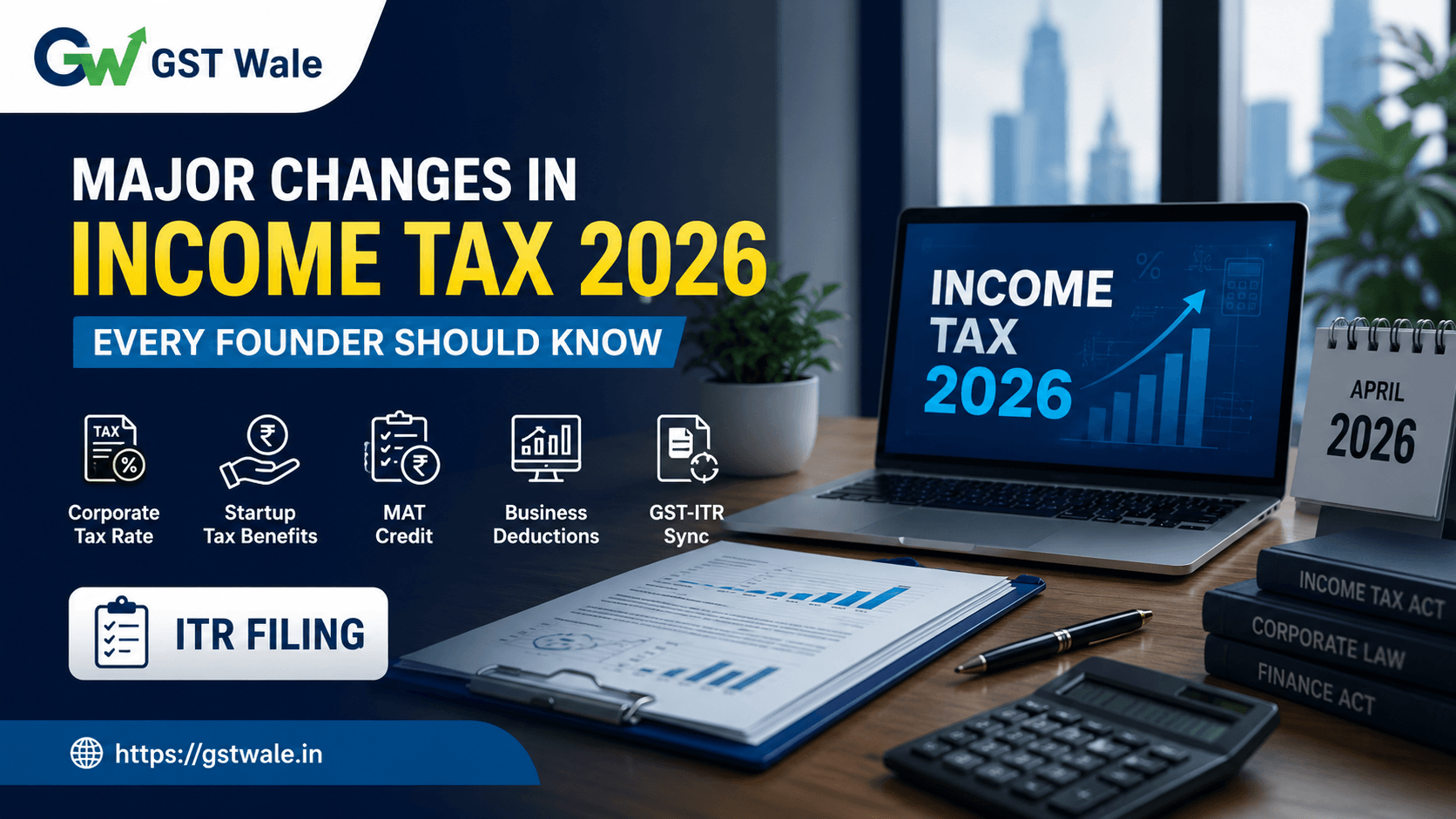
If you’re a founder or business owner, staying updated with Income Tax 2026 changes is no longer optional—it’s essential for survival and growth. This year brings a mix of reforms aimed at simplifying compliance while tightening reporting standards. From revised corporate tax rates to better alignment between GST and income tax filings, the landscape is evolving quickly.
At GST Wale, we’ve seen many businesses struggle not because they lack profits, but because they miss out on proper tax planning. Whether you're running a startup or a growing company, timely compliance like proper ITR Filing can significantly impact your financial health and credibility.
Let’s break down the major updates in Income Tax 2026 in a practical, no-nonsense way.
Key Highlights of Income Tax 2026
Revised Corporate Tax Rate Structure
One of the most talked-about changes in Income Tax 2026 is the rationalization of the corporate tax rate.
- Companies opting for the new regime continue to enjoy a 22% base rate (plus surcharge and cess).
- New manufacturing companies still benefit from the concessional 15% rate, subject to conditions.
- However, certain exemptions and deductions have been further restricted.
Practical Insight:
If your business relies heavily on deductions, the old regime might still be beneficial. But for most startups, the new regime offers simplicity and predictability.
Startup Tax Benefits Under Income Tax 2026
Extended Eligibility and Relaxations
The government has extended several startup tax benefits under Income Tax 2026, especially for DPIIT-recognized startups.
Key benefits include:
- 100% tax deduction on profits for any 3 consecutive years out of 10 years
- Relaxation in angel tax provisions for eligible startups
- Easier carry forward of losses even after change in shareholding
Real-World Example
Let’s say your startup makes a profit of ₹50 lakhs in Year 4, 5, and 6. Under these benefits, you can claim a full deduction, saving significant tax outflow.
Expert Tip:
Ensure proper documentation and timely filings to actually claim these benefits—many founders miss out due to compliance gaps.
MAT Credit Adjustments in Income Tax 2026
What Has Changed?
Minimum Alternate Tax (MAT) continues to apply to companies not opting for the new tax regime. However, MAT credit utilization rules have been streamlined under Income Tax 2026.
- MAT credit can now be carried forward for up to 15 years
- Faster adjustment against future tax liabilities
- Improved clarity in reporting MAT credit in returns
Why It Matters
If your company paid MAT in earlier years, this credit acts like a future tax shield.
Example:
If you paid ₹10 lakhs as MAT earlier and your normal tax liability now is ₹15 lakhs, you can use MAT credit to reduce your outflow.
Changes in Business Deductions
Limited Scope for Certain Deductions
Under Income Tax 2026, the government continues its push towards a simplified tax regime by limiting some traditional business deductions.
Affected areas include:
- Reduced scope for additional depreciation benefits
- Stricter rules for claiming expenses like travel and consultancy
- Enhanced scrutiny on related-party transactions
What Founders Should Do
- Maintain clear documentation for every expense
- Avoid aggressive tax planning that may trigger notices
- Align your accounting practices with updated tax rules
GST-ITR Sync: A Major Compliance Shift
Increased Data Integration
One of the most significant compliance changes in Income Tax 2026 is the tighter GST-ITR sync.
- Income reported in ITR must closely match GST returns
- Automated mismatch alerts are now more frequent
- Higher chances of scrutiny for discrepancies
Practical Impact
If your GST turnover is ₹1 crore but your ITR shows ₹80 lakhs, expect questions from the department.
How to Stay Compliant
- Reconcile GST and income data monthly
- Use accounting software that integrates GST and income tax data
- Conduct periodic internal audits
TDS and TCS Updates in Income Tax 2026
Broader Coverage and Higher Accountability
The scope of Tax Deducted at Source (TDS) and Tax Collected at Source (TCS) has been expanded.
- More transactions are now covered under TDS
- Higher penalties for non-compliance
- Real-time reporting through updated systems
Advice from GST Wale:
Automate your TDS compliance wherever possible to avoid penalties and interest.
Digital Compliance and AI-Based Scrutiny
Smarter Tax Systems
The tax department is increasingly relying on technology under Income Tax 2026.
- AI-based risk assessment for selecting cases
- Pre-filled ITR forms with more data points
- Faceless assessments becoming the norm
What This Means for You
- Less human interaction, but more data accuracy required
- Errors can quickly trigger notices
Step-by-Step: How Founders Should Prepare
To navigate Income Tax 2026 effectively, follow this structured approach:
- Review Your Tax Regime
- Compare old vs new regime benefits
- Reconcile Financial Data
- Ensure GST and income tax figures match
- Track Eligible Deductions
- Don’t miss out on valid claims
- Utilize MAT Credit Properly
- Plan future tax liabilities strategically
- Stay Updated on Compliance
- Monitor deadlines and regulatory updates
Common Mistakes to Avoid
Many founders unknowingly make these errors under Income Tax 2026:
- Ignoring GST-ITR mismatches
- Missing deadlines for filings
- Overclaiming deductions without proof
- Not leveraging startup tax benefits
- Poor record-keeping
Avoiding these can save you from unnecessary penalties and stress.
FAQs on Income Tax 2026
1. What is the biggest change in Income Tax 2026 for companies?
The biggest change is the tighter integration between GST and income tax data, along with simplified tax regimes and reduced deductions.
2. Are startup tax benefits still available in Income Tax 2026?
Yes, eligible startups can still claim 100% profit deduction for 3 years, subject to conditions.
3. Can MAT credit still be used?
Yes, MAT credit can be carried forward up to 15 years and adjusted against future tax liabilities.
4. Is the new tax regime better for all businesses?
Not necessarily. It depends on your deductions and business model. A detailed comparison is recommended.
5. How important is GST-ITR sync now?
Extremely important. Mismatches can trigger automated scrutiny and notices.
The reforms under Income Tax 2026 clearly indicate a shift towards transparency, digital compliance, and simplified taxation. While this reduces complexity on paper, it also increases the need for accuracy and timely reporting.
As a founder, your focus should not just be on earning profits but also on managing taxes efficiently. With proper planning, you can leverage benefits like startup incentives, optimize your corporate tax rate, and make the most of MAT credit.
At GST Wale, we specialize in helping businesses like yours stay compliant while maximizing tax efficiency. If you want to navigate Income Tax 2026 confidently and avoid costly mistakes, our experts are here to guide you every step of the way.
 Previous