


Differences Between ROC Compliance and Income Tax Compliance
Differences Between ROC Compliance and Income Tax Compliance
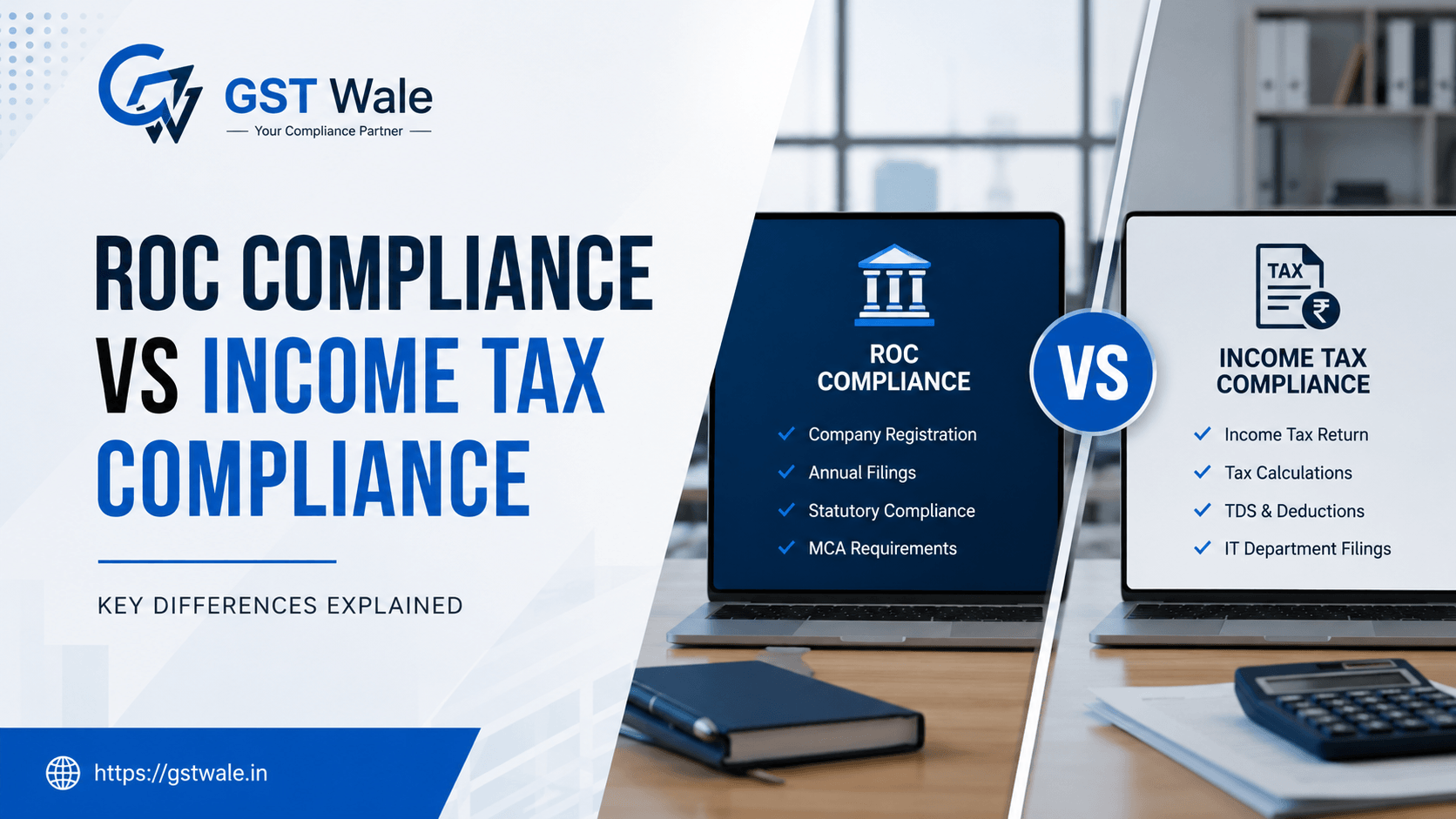
In today’s evolving business environment, staying compliant is not just a legal formality but a necessity for smooth operations. As a practicing Chartered Accountant team at GST Wale, we often see business owners confused between ROC Compliance and Income Tax Compliance. Both are critical, yet they serve entirely different purposes in India’s regulatory framework.
Simply put, ROC Compliance deals with company law requirements under the Ministry of Corporate Affairs (MCA), while Income Tax Compliance focuses on tax obligations under the Income Tax Act. If you are running a company or planning to start one, understanding ROC Compliance is essential to avoid penalties and maintain your business credibility.
For businesses seeking professional assistance, you can explore structured support through our dedicated service on ROC Compliance which simplifies filings and ensures timely adherence to legal requirements.
In this article, we will break down ROC Compliance vs Income Tax Compliance in a practical, easy-to-understand manner so that business owners can make informed decisions.
What is ROC Compliance?
ROC Compliance refers to the mandatory filings and disclosures that companies registered under the Companies Act, 2013 must submit to the Registrar of Companies (ROC). This is a key part of corporate compliance India, ensuring transparency in business operations.
Under ROC Compliance, companies are required to maintain proper records, submit annual returns, financial statements, and notify the government about structural changes.
In simple terms, ROC Compliance ensures that a company is functioning legally and transparently within the framework of corporate law.
Key ROC Compliance Requirements
- Filing of Annual Return (MGT-7)
- Filing of Financial Statements (AOC-4)
- Maintenance of statutory registers
- Board meeting compliance
- Disclosure of shareholding patterns
Failing ROC Compliance can lead to heavy penalties and even disqualification of directors.
What is Income Tax Compliance?
Income Tax Compliance relates to fulfilling obligations under the Income Tax Act, 1961. It applies to individuals, businesses, and companies based on their income levels.
Unlike ROC Compliance, which is company-specific, income tax compliance is based on earnings and taxation rules.
This includes filing Income Tax Returns (ITR), paying advance tax, deducting TDS, and maintaining proper financial records.
Key Income Tax Compliance Requirements
- Filing of Income Tax Returns (ITR-1 to ITR-7)
- Payment of advance tax in installments
- TDS/TCS compliance
- Maintenance of books of accounts (for businesses)
- Tax audit (if applicable)
ROC Compliance vs Income Tax Compliance: Core Differences
Understanding roc vs income tax compliance is crucial for every entrepreneur and business owner in India. Though both are legal obligations, their purpose and governing laws differ significantly.
1. Governing Authority
- ROC Compliance is governed by the Ministry of Corporate Affairs (MCA)
- Income Tax Compliance is governed by the Income Tax Department
2. Applicability
- ROC Compliance applies only to registered companies and LLPs
- Income Tax Compliance applies to individuals, firms, and companies
3. Objective
- ROC Compliance ensures corporate transparency and governance
- Income Tax Compliance ensures proper tax collection and reporting
4. Filing Frequency
- ROC Compliance is usually annual (with some event-based filings)
- Income Tax Compliance is annual but includes quarterly obligations like advance tax and TDS
This distinction forms the foundation of tax vs ROC filing understanding in India’s regulatory ecosystem.
Why ROC Compliance is Important for Businesses
Many businesses underestimate ROC Compliance until penalties arrive. However, maintaining proper ROC Compliance ensures:
Business Continuity
Non-compliance can lead to strike-off of company names from the ROC register.
Legal Protection
Proper compliance protects directors from personal liability in certain cases.
Investor Confidence
Investors prefer companies with clean ROC Compliance records.
Smooth Business Operations
Regular filings avoid legal hurdles and scrutiny.
In short, ROC Compliance is not just a legal requirement but a trust-building factor for your business.
Common Mistakes Businesses Make in ROC Compliance
From our experience at GST Wale, here are common errors:
- Missing annual filing deadlines
- Not maintaining statutory registers
- Ignoring board meeting requirements
- Incorrect financial disclosures
- Assuming inactive companies don’t need compliance
Avoiding these mistakes ensures your ROC Compliance remains smooth and penalty-free.
How Income Tax Compliance Differs in Practice
Income tax compliance is more calculation-driven and financial-year based. Businesses must ensure accurate income reporting, expense tracking, and timely tax payments.
Unlike ROC Compliance, which is structural, income tax compliance focuses on financial performance.
For example:
- A company with no business activity still needs ROC filings
- But income tax returns may show nil income
This clearly shows the difference in roc vs income tax compliance obligations.
Step-by-Step Compliance Process
Step 1: Identify Entity Type
Determine whether you are a company, LLP, or individual.
Step 2: Maintain Records
Keep proper books of accounts and statutory records.
Step 3: Track Due Dates
Maintain a compliance calendar for both ROC Compliance and tax filings.
Step 4: File Returns on Time
Submit ROC forms and Income Tax Returns before deadlines.
Step 5: Review and Audit
Conduct internal audits to ensure accuracy.
Regulatory Compliance in India: A Broader Perspective
Both ROC Compliance and Income Tax Compliance fall under the umbrella of regulatory compliance India. Businesses often need to comply with multiple laws such as GST, labour laws, and industry-specific regulations.
Understanding business compliance types India helps entrepreneurs avoid legal risks and operate efficiently.
FAQs on ROC Compliance and Income Tax Compliance
1. Is ROC Compliance mandatory for all businesses?
No, ROC Compliance is mandatory only for companies and LLPs registered under MCA.
2. Can a company skip Income Tax return if there is no income?
No, Income Tax Compliance requires filing even if the income is zero.
3. What happens if ROC Compliance is not filed?
Late fees, penalties, and in severe cases, strike-off of the company name.
4. Are ROC and Income Tax filings connected?
No, both are independent compliances governed by different authorities.
5. Which is more important: ROC Compliance or Income Tax Compliance?
Both are equally important for legal and financial stability of a business.
Why Professional Guidance Matters
In conclusion, understanding ROC Compliance and Income Tax Compliance is essential for every business in India. While ROC Compliance ensures corporate transparency, income tax compliance ensures financial accountability.
Both together form the backbone of regulatory compliance India. Ignoring either can lead to penalties, legal complications, and business disruptions.
At GST Wale, we help businesses stay stress-free with complete compliance solutions tailored to your needs. Whether it is ROC Compliance or taxation, our experts ensure accuracy, timeliness, and peace of mind.
If you want hassle-free compliance management, connect with GST Wale today and keep your business fully compliant and future-ready.
 Previous