


Forms Required for ROC Compliance: AOC-4, MGT-7 & More
Forms Required for ROC Compliance: AOC-4, MGT-7 & More
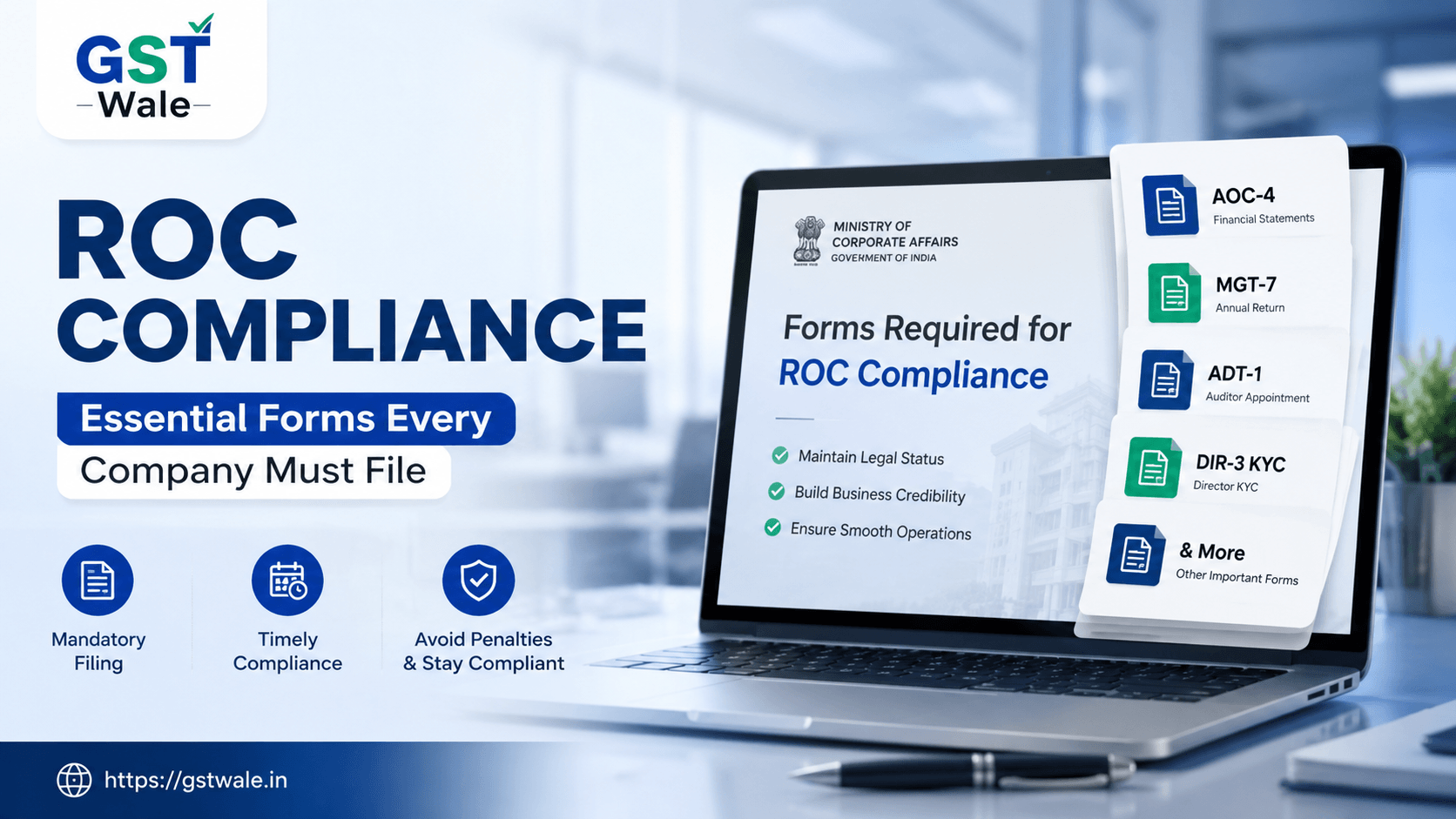
For every company registered under the Companies Act, maintaining proper ROC Compliance is not just a legal formality—it is an essential business responsibility. Whether you run a private limited company, OPC, or LLP, filing the correct forms with the Registrar of Companies (ROC) helps your business stay legally active and avoid unnecessary penalties.
At GST Wale, we often meet business owners who are confused about which ROC forms need to be filed, when they should be filed, and what happens if they miss the deadlines. This confusion is common, especially among startups and small businesses managing multiple compliances together.
If your company wants to maintain smooth ROC Compliance, understanding important ROC forms like AOC-4, MGT-7, ADT-1, and DIR-3 KYC becomes extremely important.
In this guide, we will explain the major ROC filing forms in simple language, their purpose, due dates, penalties, and practical compliance tips every company should know.
What is ROC Compliance?
ROC Compliance refers to the mandatory filings and disclosures that companies must submit to the Registrar of Companies under the Ministry of Corporate Affairs (MCA).
These filings help the government monitor whether companies are operating legally and maintaining proper financial transparency.
ROC Compliance generally includes:
- Filing annual financial statements
- Filing annual returns
- Reporting director-related changes
- Maintaining statutory records
- Filing event-based forms
Failure to complete ROC Compliance on time may lead to heavy penalties, director disqualification, and legal notices from MCA.
Why ROC Compliance is Important for Companies
Many business owners think ROC filings are only for large companies. In reality, even small private limited companies must complete annual ROC Compliance.
Here’s why it matters:
Avoid Heavy Penalties
Late filing fees can increase daily and become a major financial burden.
Maintain Active Company Status
Non-compliance can result in the company being marked inactive or struck off by ROC.
Build Business Credibility
Investors, banks, and government authorities often verify ROC Compliance before approving funding or loans.
Prevent Director Disqualification
Continuous non-filing may disqualify directors from holding positions in companies.
Important ROC Forms List India
Understanding the major company filing forms is the first step toward proper ROC Compliance.
Below is the most important ROC forms list India businesses should know.
AOC-4 Filing – Financial Statements Submission
What is AOC-4?
AOC-4 filing is used to submit the company’s financial statements to ROC.
This form contains:
- Balance Sheet
- Profit & Loss Account
- Auditor’s Report
- Board Report
- Cash Flow Statement
Every company registered under the Companies Act must complete AOC-4 filing annually.
Due Date for AOC-4 Filing
AOC-4 must be filed within 30 days from the Annual General Meeting (AGM).
For example:
- If AGM is held on 30th September, AOC-4 filing deadline becomes 30th October.
Penalty for Late Filing
Late filing attracts:
- Additional government fees per day
- Penalties on company and directors
At GST Wale, we advise clients to prepare financial statements early to avoid last-minute filing issues.
MGT-7 Return Filing – Annual Return of Company
What is MGT-7?
MGT-7 return filing is the annual return form containing company details for a financial year.
It includes:
- Shareholding pattern
- Director details
- Registered office details
- Share transfers
- Company management information
MGT-7 is one of the most important annual return forms India companies must file.
Due Date for MGT-7 Return Filing
MGT-7 must be filed within 60 days from the AGM date.
Difference Between AOC-4 and MGT-7
Many business owners confuse these two forms.
| Form | Purpose |
|---|---|
| AOC-4 | Filing financial statements |
| MGT-7 | Filing company annual return details |
Both are mandatory for proper ROC Compliance.
ADT-1 – Auditor Appointment Form
What is ADT-1?
ADT-1 is filed for appointment of the company auditor.
Whenever an auditor is appointed or reappointed, the company must inform ROC through this form.
Due Date
ADT-1 should be filed within 15 days of auditor appointment.
Why ADT-1 Matters
Failure to file ADT-1 may create compliance issues during future audits and MCA inspections.
DIR-3 KYC – Director KYC Compliance
Purpose of DIR-3 KYC
Every director holding a DIN (Director Identification Number) must complete DIR-3 KYC annually.
This form verifies:
- Mobile number
- Email address
- PAN details
- Aadhaar details
Consequences of Non-Filing
If DIR-3 KYC is not filed:
- DIN may get deactivated
- Directors may face penalties
This is one of the most ignored MCA forms India businesses forget to complete.
DPT-3 – Reporting Company Loans and Outstanding Money
What is DPT-3?
DPT-3 is used to report:
- Loans
- Advances
- Outstanding receipts
- Non-deposit transactions
Even companies without deposits may need to file DPT-3 in certain situations.
Importance in ROC Compliance
Incorrect reporting in DPT-3 may attract scrutiny from MCA.
MSME-1 Form
Purpose of MSME-1
Companies must file MSME-1 if payments to MSME vendors remain pending for more than 45 days.
Why It Matters
This form promotes payment transparency and protects small businesses.
Common Mistakes in ROC Compliance
At GST Wale, we frequently notice businesses making these mistakes:
Ignoring Due Dates
Many companies wait until the last week for filing.
Incorrect Financial Data
Mismatch in financial statements can trigger notices.
Missing Director KYC
Directors often forget DIR-3 KYC renewal.
Wrong Form Selection
Using incorrect company filing forms may lead to rejection.
Not Maintaining Proper Records
Statutory registers and board resolutions are equally important for ROC Compliance.
Practical Tips for Smooth ROC Compliance
Maintain Proper Accounting Records
Keep books updated throughout the year.
Conduct Board Meetings Properly
Document all important decisions through resolutions.
Track ROC Filing Calendar
Prepare a compliance calendar for:
- AOC-4 filing
- MGT-7 return filing
- DIR-3 KYC
- DPT-3
Work with Compliance Professionals
Professional guidance reduces the risk of penalties and filing errors.
Penalties for Non-Compliance
Ignoring ROC Compliance can become costly.
Possible consequences include:
- Daily late filing fees
- Penalties on directors
- Company strike-off
- Director disqualification
- Legal notices from MCA
In severe cases, banks and investors may also hesitate to work with non-compliant companies.
How GST Wale Helps Businesses with ROC Compliance
At GST Wale, we simplify ROC Compliance for startups, private limited companies, LLPs, and growing businesses.
Our services include:
- AOC-4 filing
- MGT-7 return filing
- DIR-3 KYC
- Annual ROC filings
- Compliance reminders
- MCA documentation support
We ensure your company remains fully compliant without unnecessary stress.
FAQs on ROC Compliance
Is ROC Compliance mandatory for all private limited companies?
Yes, every registered company must complete annual ROC Compliance, even if there is no business activity.
What happens if AOC-4 filing is delayed?
Late filing attracts additional fees and penalties. Continuous delay may lead to legal action.
Can a company file MGT-7 without filing AOC-4?
Both forms are separate but interconnected annual filings. Ideally, financial statements should be finalized before MGT-7 return filing.
Are LLPs also required to complete ROC Compliance?
Yes, LLPs also have ROC filing obligations, though forms and requirements differ slightly.
Can directors be disqualified for non-compliance?
Yes, continuous failure in ROC Compliance may result in director disqualification under the Companies Act.
Proper ROC Compliance is essential for every registered company in India. Forms like AOC-4, MGT-7, ADT-1, DIR-3 KYC, and DPT-3 are not just routine paperwork—they protect your business from penalties, legal risks, and operational disruptions.
Many companies delay compliance until they receive notices from MCA, but proactive filing always saves time, money, and stress. Maintaining accurate records and filing annual return forms India businesses require should become a regular business practice.
At GST Wale, we help businesses manage ROC Compliance smoothly with expert guidance, timely filing support, and practical compliance solutions. Whether you are a startup or an established company, our team ensures your filings are accurate, timely, and hassle-free.
 Previous