


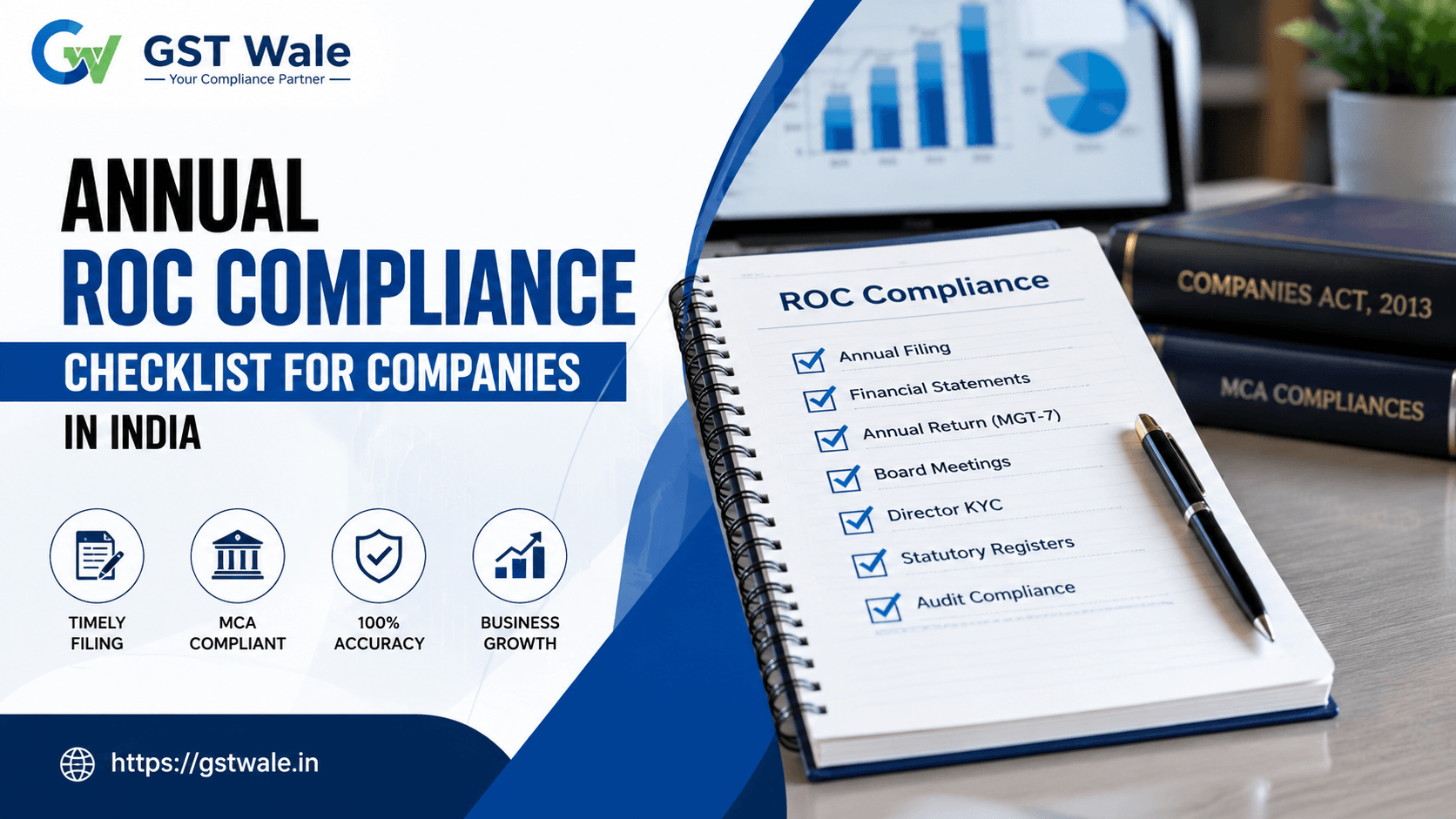
Annual ROC Compliance Checklist for Companies in India
Annual ROC Compliance Checklist for Companies in India
Running a company in India comes with several legal responsibilities, and one of the most important among them is ROC Compliance. Whether you own a private limited company, OPC, or LLP, staying compliant with the Registrar of Companies (ROC) is essential to avoid penalties, legal notices, and business disruptions.
At GST Wale, we often meet business owners who are focused on growth but unintentionally miss important ROC yearly compliance deadlines. This can lead to hefty fines and unnecessary stress later. That’s why having a proper annual compliance checklist India businesses can follow is extremely important.
If your company needs professional guidance for ROC Compliance, it is always better to act early rather than wait for notices from the MCA portal.
In this article, we will explain the complete annual ROC Compliance checklist in simple language so that business owners can easily understand their responsibilities and complete their company compliance tasks India on time.
What is ROC Compliance?
ROC Compliance refers to the mandatory legal filings and disclosures that companies registered under the Companies Act, 2013 must submit to the Registrar of Companies (ROC).
These filings help the Ministry of Corporate Affairs (MCA) keep company records updated regarding:
- Financial statements
- Annual returns
- Director details
- Shareholding structure
- Company status
Every registered company, even if it has no business activity, must complete ROC yearly compliance requirements annually.
Why ROC Compliance is Important for Companies
Many entrepreneurs assume ROC Compliance matters only for large companies. However, even small startups and dormant companies must comply with MCA annual filing requirements.
Here’s why timely compliance is important:
Avoid Heavy Penalties
Late filing fees under ROC Compliance can increase daily. In some cases, penalties may go into lakhs of rupees.
Maintain Active Company Status
Non-compliance can lead to company strike-off by ROC.
Build Business Credibility
Investors, banks, and financial institutions often check ROC records before approvals.
Smooth Fundraising and Loans
Proper ROC yearly compliance improves trust among lenders and investors.
Avoid Director Disqualification
Continuous non-filing can result in director disqualification under the Companies Act.
Annual ROC Compliance Checklist for Companies in India
Below is a practical business compliance checklist that every company should follow annually.
Conduct Board Meetings
Private limited companies are required to conduct a minimum number of board meetings every year.
Key Points
- Minimum 4 board meetings annually
- Gap between meetings should not exceed 120 days
- Maintain meeting minutes properly
For OPCs and small companies, compliance requirements may be relaxed.
Proper documentation of meetings is an important part of ROC Compliance.
Hold Annual General Meeting (AGM)
Every company must conduct an AGM within the prescribed timeline.
AGM Requirements
- AGM must be held within 6 months from the end of the financial year
- Discuss financial statements and auditor reports
- Approve annual filings
For most companies in India, the AGM deadline falls on or before 30th September.
Missing AGM deadlines can directly affect ROC Compliance status.
File Financial Statements – Form AOC-4
One of the most critical MCA annual filing requirements is filing Form AOC-4.
What Does AOC-4 Include?
- Balance Sheet
- Profit & Loss Account
- Cash Flow Statement
- Auditor’s Report
- Board Report
Due Date
Form AOC-4 must generally be filed within 30 days of the AGM.
Failure to file this form on time attracts additional filing fees.
File Annual Return – Form MGT-7
Form MGT-7 is another mandatory ROC Compliance filing for companies.
Details Covered in MGT-7
- Shareholding pattern
- Director information
- Registered office details
- Company members
- Debentures and securities
Due Date
MGT-7 must be filed within 60 days of the AGM.
This is one of the most important company compliance tasks India businesses should never ignore.
DIR-3 KYC for Directors
Every director with a DIN (Director Identification Number) must complete DIR-3 KYC annually.
Important Details
- Mandatory for all active DIN holders
- Includes mobile and email verification
- Non-filing may deactivate DIN
This requirement is often missed by small businesses during ROC yearly compliance.
Maintain Statutory Registers
Companies are legally required to maintain updated statutory registers.
Important Registers
- Register of Members
- Register of Directors
- Register of Charges
- Share Transfer Register
Maintaining proper records supports smooth ROC Compliance during inspections or audits.
Auditor Appointment Compliance
Auditor-related filings are also part of annual ROC Compliance requirements.
Key Compliance Points
- Appointment of auditor in AGM
- Filing ADT-1 where applicable
- Maintain auditor consent and eligibility certificates
Professional handling of auditor compliance reduces future legal complications.
Income Tax and GST Coordination
Although ROC Compliance is separate from GST and Income Tax, all records should match across departments.
Ensure Consistency In:
- Turnover figures
- Director remuneration
- Financial statements
- Share capital details
Mismatch in records may trigger notices from authorities.
At GST Wale, we advise businesses to align ROC filings with tax filings for smoother compliance management.
Common Mistakes Companies Make in ROC Compliance
Many companies face penalties due to avoidable errors.
Missing Filing Deadlines
The most common issue in ROC yearly compliance is delayed filing.
Incorrect Financial Data
Errors in balance sheet reporting can create legal complications.
Ignoring Dormant Company Filings
Even inactive companies have ROC Compliance obligations.
Not Updating Director Information
Changes in director details must be updated promptly.
Poor Record Maintenance
Lack of documentation can create issues during scrutiny.
Penalties for Non-Compliance
The MCA has become stricter regarding company compliance tasks India businesses must complete.
Possible Consequences
- Additional filing fees per day
- Company strike-off
- Director disqualification
- Legal notices from ROC
- Difficulty in obtaining loans or investments
In many cases, companies end up paying far more in penalties than the actual professional compliance cost.
Practical Tips for Smooth ROC Compliance
Here are some practical suggestions from GST Wale to simplify annual compliance checklist India requirements.
Maintain a Compliance Calendar
Track important due dates in advance.
Keep Financial Records Updated
Avoid last-minute accounting work before filing.
Conduct Internal Compliance Reviews
Quarterly reviews help identify missing documents early.
Work with Professionals
Experienced consultants help reduce errors and filing delays.
Avoid Last-Day Filing
MCA portal traffic often increases near deadlines.
FAQs on ROC Compliance
Is ROC Compliance mandatory for inactive companies?
Yes. Even dormant or inactive companies must complete certain ROC yearly compliance filings.
What happens if ROC filing is delayed?
Late filing attracts additional fees and may result in legal action or director disqualification.
Is AGM compulsory for private limited companies?
Yes, most private limited companies must hold an AGM every financial year.
Can a company file ROC forms without a CA or CS?
Technically, some forms can be filed directly, but professional guidance helps avoid mistakes and penalties.
What is the difference between ROC Compliance and GST compliance?
ROC Compliance relates to company law filings with MCA, while GST compliance relates to indirect tax filings under GST law.
Managing ROC Compliance is not just about avoiding penalties—it is about maintaining the legal health and credibility of your company. From AGM meetings and MCA annual filing to maintaining statutory registers, every compliance step plays a vital role in smooth business operations.
Unfortunately, many businesses in India ignore annual filings until they receive notices from authorities. A proactive approach can save both money and stress.
At GST Wale, we help companies handle complete ROC yearly compliance with accuracy, timely filing, and expert guidance. Whether you are a startup, private limited company, OPC, or growing business, our experts ensure your annual compliance checklist India requirements are managed professionally.
If you want hassle-free ROC Compliance support, connect with GST Wale today and keep your business fully compliant throughout the year.
 Previous