


The Essential Guide to Incometax Provisions for Non-Profit Organizations and Trusts
The Essential Guide to Incometax Provisions for Non-Profit Organizations and Trusts
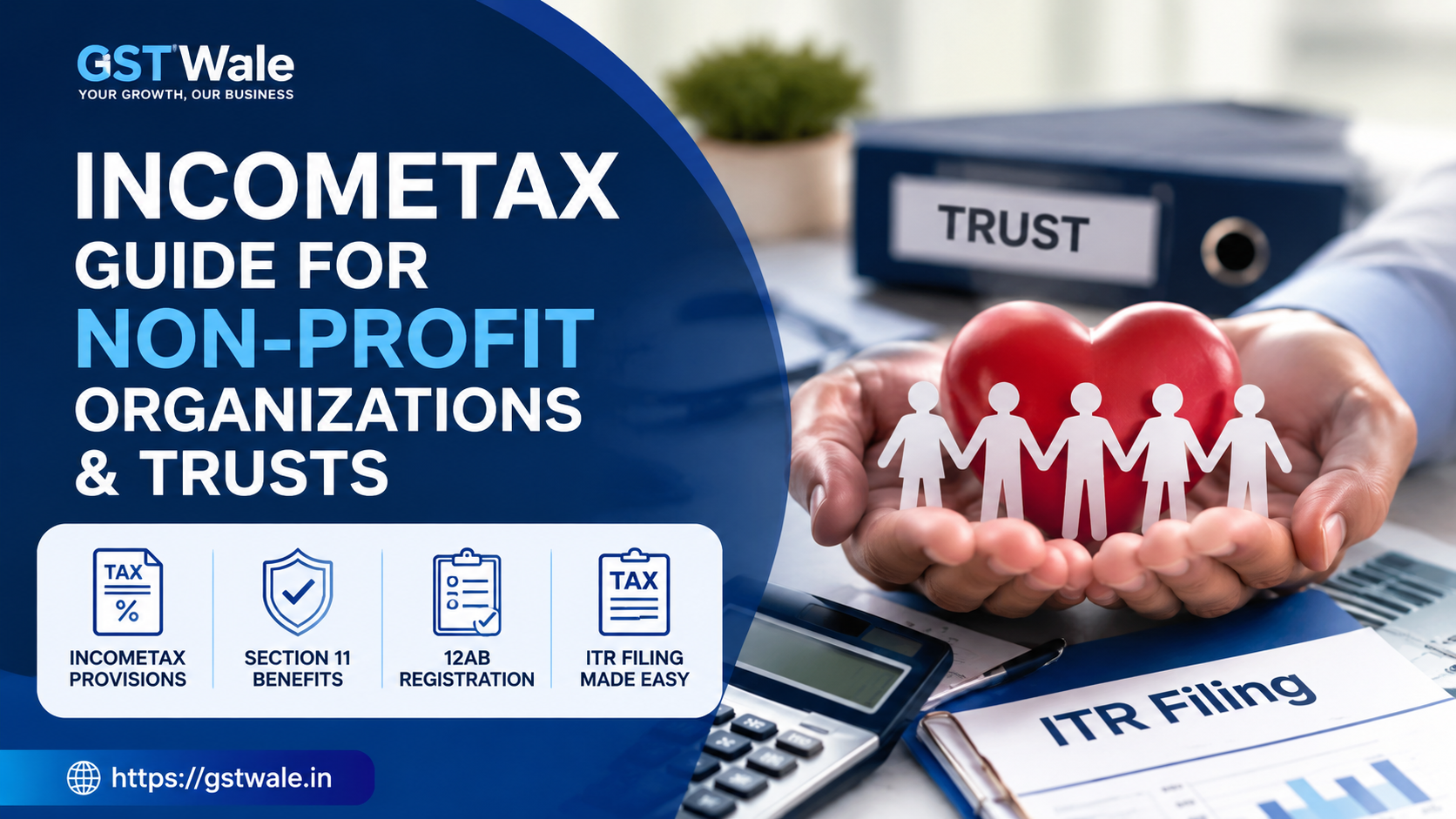
For a charitable trust or non-profit organization, managing incometax compliance is just as important as carrying out its social objectives. Many organizations focus heavily on donations, welfare activities, education, healthcare, or community development but overlook the tax and documentation requirements that support their exemption status. This can create avoidable problems during assessment or filing. For organizations that need professional support with annual returns, proper ITR Filing can make the compliance process much smoother.
The good news is that the incometax framework provides significant benefits to eligible charitable and religious trusts. However, these benefits are conditional. Registration, application of income, maintenance of books, audit requirements, donation records, and timely filing all need to be handled properly. As a practical guide from GST Wale, let us understand the key provisions that every trust and non-profit organization should know.
Understanding Incometax Rules for Charitable Trusts
A trust established for charitable or religious purposes may receive tax benefits under the Income-tax Act, 1961, subject to applicable conditions. The Income Tax Department confirms that trusts created wholly for charitable or religious purposes can receive benefits including exemption under Section 11.
However, exemption does not mean that every receipt automatically becomes tax-free. The organization must satisfy the prescribed conditions and maintain evidence showing that its income and assets are being used for its stated charitable objectives.
For example, suppose a charitable trust receives ₹30 lakh during a financial year and spends the money on running a school for underprivileged children. The trust should maintain proper records of the donations, expenditure, invoices, bank transactions, and supporting documents. Proper accounting helps establish that the funds have actually been applied toward charitable purposes.
Section 11 and Application of Income
One of the most important provisions for charitable trusts is Section 11. Broadly speaking, the exemption available to a qualifying trust depends upon the manner in which its income is applied and the other statutory conditions applicable to it.
A common practical requirement is the application of income toward charitable or religious purposes. In general situations, a trust needs to carefully track the portion of its income that is applied during the year and the amount that is accumulated or set apart.
Consider a trust earning ₹20 lakh from donations and other eligible sources. If ₹17 lakh is spent on eligible charitable activities, the accounting treatment and supporting documentation for the remaining amount must be reviewed carefully. The exact tax treatment depends on the nature of income, application, accumulation and compliance with the relevant provisions.
The important lesson is simple: do not look at Section 11 only from the perspective of exemption. Look at it as a compliance framework that connects income, expenditure, charitable objectives and documentation.
Registration 12AB: Why It Matters
For many charitable institutions, registration 12AB is a fundamental part of the incometax compliance structure. A trust seeking exemption under Sections 11 and 12 must follow the applicable registration provisions and prescribed procedures.
Registration and renewal should not be treated as a one-time administrative exercise. The organization should regularly verify:
- Whether its registration is valid for the relevant period
- Whether its objects remain consistent with its registered charitable purpose
- Whether prescribed forms and statements have been submitted
- Whether changes in the trust deed or governing documents require reporting
- Whether books and supporting documents are properly maintained
The Income Tax Department provides Form 10A for applications relating to registration or provisional registration of charitable or religious trusts and institutions.
A trust should also keep its PAN, registration documents, trust deed, bank records and financial statements organized. This becomes particularly useful when the organization changes trustees, expands activities or undergoes scrutiny.
Form 10B and Tax Audit Requirements
Form 10B is another important area that trustees should understand. It is an audit report associated with charitable or religious trusts and institutions claiming benefits under the relevant provisions.
For Assessment Year 2023-24 onwards, Form 10B applies in specified situations, including where total income calculated without giving effect to the relevant exemption provisions exceeds ₹5 crore, where the entity receives foreign contribution, or where income is applied outside India. The Income Tax Department also states that Form 10BB applies in other specified cases.
The Form 10B process involves the taxpayer assigning the form to a CA through the e-filing portal, after which the CA completes and submits the audit report electronically.
This is why trusts should not wait until the income-tax return deadline to start their audit work. Financial statements, donation records, expense details and supporting documents should ideally be reconciled well in advance.
Charitable Donation: Maintain Proper Records
A charitable donation is not simply an amount received in the bank account. From a compliance perspective, the organization should maintain adequate information about donations and their nature.
The trust should maintain records showing:
- Donor details as required under applicable law
- Date and amount of donation
- Mode of receipt
- Whether the donation is corpus or non-corpus
- Relevant purpose or restriction attached to the contribution
- Bank and accounting records supporting the receipt
Eligible institutions also have specific reporting responsibilities concerning donation statements. For example, the Income Tax Department lists Form 10BD for furnishing particulars of donations received.
A strong donation-recording system reduces the chances of discrepancies between the books, donor statements, audit report and income-tax return.
Corpus Fund and Its Tax Treatment
A corpus fund generally represents contributions received with a specific direction that they form part of the corpus of the trust. The organization should clearly identify such contributions in its books and preserve the donor's direction or other relevant evidence.
Trustees should avoid casually treating every large donation as corpus. The documentation and nature of the contribution matter.
For example, if a donor contributes ₹5 lakh specifically toward the permanent corpus of a charitable institution, the trust should preserve appropriate evidence of that direction and record the contribution separately. The subsequent treatment of the corpus and its investment or application should also be reviewed under the applicable incometax provisions.
The Income Tax Department's current return framework separately identifies corpus donations in the voluntary-contribution schedule, highlighting the importance of correctly classifying these receipts.
Anonymous Donation: A Common Compliance Risk
An anonymous donation is a contribution where the recipient institution does not maintain the prescribed information about the donor. Such donations can attract special tax treatment under Section 115BBC, subject to the applicable exceptions and thresholds.
The current ITR framework specifically requires reporting of anonymous donations chargeable under Section 115BBC and calculates the taxable portion using the prescribed threshold mechanism.
This is an area where proper documentation can save a trust from unnecessary tax exposure. If the organization receives donations regularly, it should have a systematic process for capturing donor information at the time the contribution is received rather than trying to reconstruct records at year-end.
How a Trust Can Stay Compliant
A practical compliance system can be divided into a few simple steps.
Step 1: Maintain Proper Books
Record donations, grants, interest income, expenses, investments and other transactions systematically. Keep separate records wherever required for restricted or corpus contributions.
Step 2: Reconcile Bank Accounts
Bank reconciliation should be performed regularly. Unidentified credits and unexplained withdrawals can create questions during audit or assessment.
Step 3: Track Application of Income
Maintain a clear record of expenditure incurred for charitable purposes. Every major expense should have invoices, payment evidence and an identifiable connection with the organization's objectives.
Step 4: Review Registration Status
Check registration 12AB details and ensure the trust continues to satisfy the applicable conditions.
Step 5: Prepare for Audit Early
Where Form 10B or another applicable audit report is required, do not leave the process until the final week. The CA needs sufficient time to review financial records and supporting documents.
Step 6: File the Correct Return
Eligible trusts generally use ITR-7 where applicable. The Income Tax Department's current guidance identifies ITR-7 for specified persons including trusts covered under the relevant provisions.
Common Mistakes Non-Profit Organizations Should Avoid
Even organizations doing genuine charitable work can face compliance issues because of basic administrative mistakes.
Some common examples include:
- Treating all donations as corpus without proper direction
- Failing to maintain donor records
- Mixing personal and organizational transactions
- Delaying bookkeeping until the end of the financial year
- Ignoring registration or renewal requirements
- Missing applicable audit-report deadlines
- Reporting figures inconsistently between financial statements, Form 10B and the income-tax return
- Failing to maintain supporting documents for charitable expenditure
The Income Tax Department has published validation rules showing that certain figures reported in ITR-7 are expected to correspond with information reported in Form 10B.
This makes reconciliation particularly important.
FAQs About Incometax for Trusts
Is registration 12AB mandatory for claiming Section 11 benefits?
A trust seeking exemption under Sections 11 and 12 generally needs to comply with the applicable registration requirements. The exact registration procedure depends on the organization's circumstances, including whether it is applying for provisional or regular registration. Professional review is advisable before filing the relevant forms.
What is Form 10B?
Form 10B is an audit report for specified charitable or religious trusts and institutions. From AY 2023-24 onwards, its applicability depends on conditions such as the ₹5 crore total-income threshold, receipt of foreign contribution, or application of income outside India.
Is every charitable donation exempt from tax?
Not necessarily. The tax treatment depends on the nature of the trust, its registration, the source and character of the contribution, application of income and compliance with applicable provisions. Donations should therefore be properly classified and supported by appropriate records.
What is an anonymous donation?
An anonymous donation generally refers to a donation where the prescribed donor information is not maintained. Certain anonymous donations can be taxable under Section 115BBC, subject to the statutory exceptions and threshold provisions.
Can a trust carry forward or accumulate income?
Certain accumulation mechanisms are available under the incometax law, but they come with specific conditions and procedural requirements. Depending on the circumstances, forms such as Form 10 or Form 9A may become relevant.
Manage Incometax Compliance Before It Becomes a Problem
For non-profit organizations and charitable trusts, incometax compliance is not merely about filing an annual return. It involves maintaining valid registration 12AB, correctly applying income under Section 11, documenting every charitable donation, separately tracking corpus fund contributions, identifying anonymous donation risks and completing applicable audit and reporting requirements on time.
A trust may have a genuinely charitable purpose, but strong intentions should always be supported by strong documentation and disciplined accounting. At GST Wale, we believe that good tax compliance should make an organization's work easier, not more complicated. If you manage a charitable trust, NGO or non-profit institution and need professional guidance for incometax compliance, return filing and related requirements, GST Wale can help you approach the process with greater clarity and confidence.
 Previous