


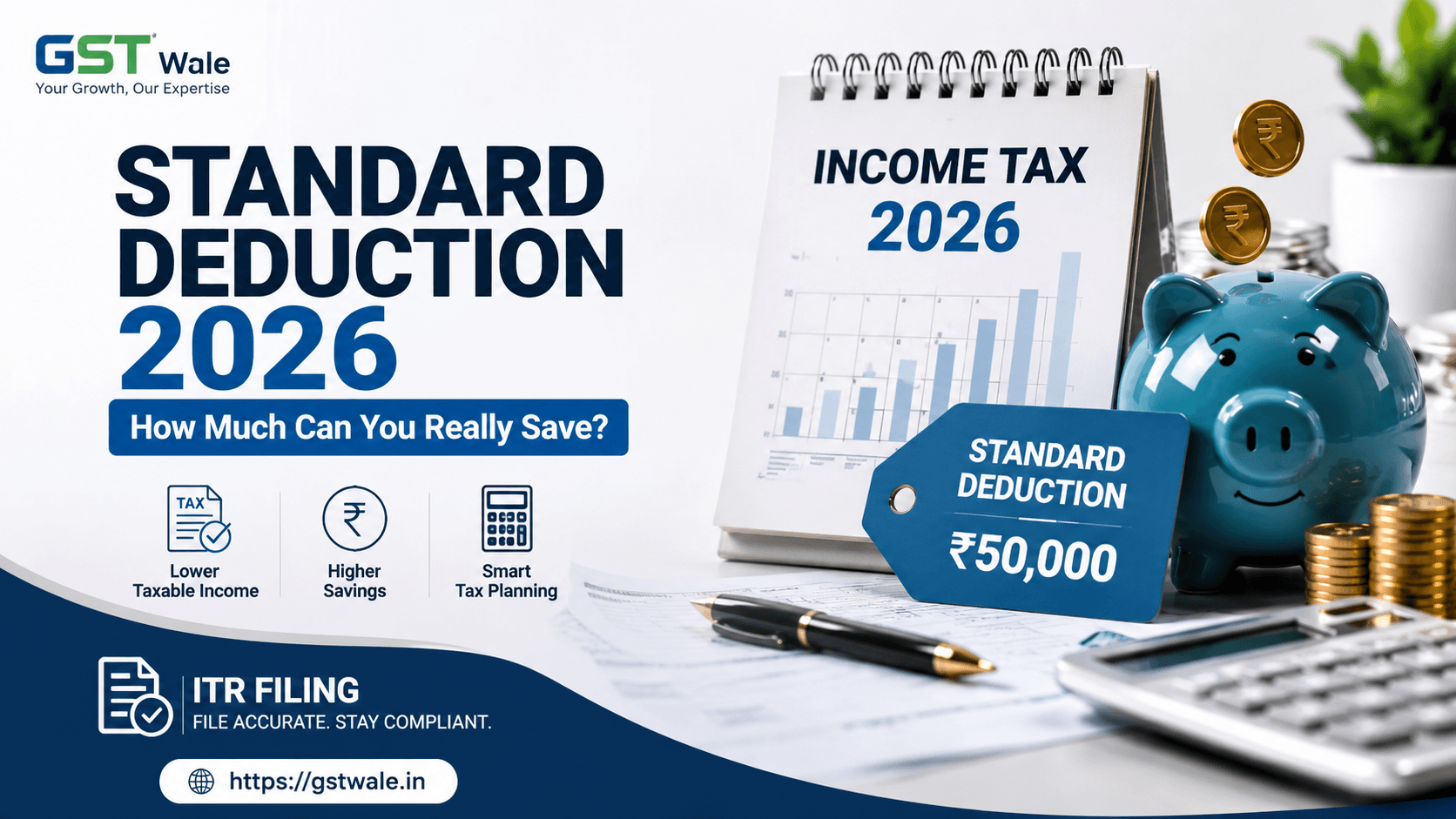
Standard Deduction 2026: How Much Can You Really Save?
Standard Deduction 2026: How Much Can You Really Save?
Understanding Standard Deduction in Income Tax 2026
When it comes to saving taxes legally, one of the simplest benefits available to salaried individuals and pensioners is the standard deduction. In Income Tax 2026, this fixed deduction continues to play a major role in reducing overall tax liability and improving take-home income.
At GST Wale, we regularly meet taxpayers who still don’t fully understand how this deduction works or how much they can actually save through it. Whether you are a salaried employee, retired pensioner, or business owner managing payroll, understanding this concept is essential for smart tax planning.
If you are preparing your return this year, professional support for ITR Filing can also help you avoid mistakes and maximize eligible deductions under Income Tax 2026.
What Is Standard Deduction?
Standard deduction is a fixed deduction allowed from salary or pension income without requiring any bills, proofs, or investments. It directly reduces your taxable income, which means you pay tax on a lower amount.
Earlier, taxpayers had to claim transport allowance and medical reimbursement separately. To simplify compliance, the government introduced a single fixed deduction benefit.
Under Income Tax 2026, eligible taxpayers can continue enjoying this salary tax break without maintaining complicated documentation.
Who Can Claim Standard Deduction?
The following taxpayers are eligible:
- Salaried employees
- Pensioners receiving taxable pension
- Family pension recipients (subject to limits)
This deduction is available under both old and new tax regimes, though conditions may vary depending on government updates.
Standard Deduction Limit in Income Tax 2026
For Income Tax 2026, the standard deduction available to salaried employees and pensioners is expected to remain one of the biggest relief measures for middle-class taxpayers.
Current Deduction Structure
Generally, the deduction amount is:
- ₹50,000 for salaried individuals
- ₹50,000 pension deduction for retired employees
However, taxpayers should always check the latest budget notifications because tax rules can change every financial year.
Example of Tax Savings
Let’s understand with a simple example.
Suppose Mr. Sharma earns:
- Annual salary: ₹8,00,000
- Standard deduction: ₹50,000
His taxable income becomes:
₹8,00,000 – ₹50,000 = ₹7,50,000
Now tax will be calculated on ₹7.5 lakh instead of ₹8 lakh.
This simple fixed deduction helps reduce tax burden without additional investment.
How Much Can You Really Save in Income Tax 2026?
The actual savings depend on your income slab and tax regime.
Savings Under Different Tax Slabs
| Income Slab | Deduction | Approximate Tax Saved |
|---|---|---|
| 5% Slab | ₹50,000 | ₹2,500 |
| 10% Slab | ₹50,000 | ₹5,000 |
| 20% Slab | ₹50,000 | ₹10,000 |
| 30% Slab | ₹50,000 | ₹15,000 |
If cess and surcharge are included, the effective savings may increase slightly.
For high-income earners under Income Tax 2026, this deduction becomes even more useful when combined with proper tax planning.
Standard Deduction Under Old vs New Tax Regime
One major confusion taxpayers face is whether the deduction is available in both tax regimes.
Old Tax Regime
Under the old regime, taxpayers can claim:
- Standard deduction
- Section 80C investments
- HRA exemption
- Home loan benefits
- Medical insurance deduction
This regime is suitable for people with multiple deductions and investments.
New Tax Regime
The government has gradually made the new regime more attractive. In recent updates, standard deduction benefits have also been extended to new regime taxpayers.
This means Income Tax 2026 may continue supporting salaried individuals even under simplified tax structures.
Which Regime Is Better?
There is no one-size-fits-all answer.
Choose the old regime if:
- You invest heavily under 80C
- You claim home loan interest
- You have multiple exemptions
Choose the new regime if:
- You prefer simpler tax filing
- You have limited investments
- You want lower slab rates
At GST Wale, we always recommend comparing both options before filing your return.
Why Standard Deduction Matters for Salaried Employees
Many employees underestimate this salary tax break because it is automatically reflected in Form 16. However, it plays a major role in reducing annual taxes.
Key Benefits
No Documentation Required
Unlike reimbursement claims, no bills or receipts are needed.
Reduces Taxable Income Directly
The deduction lowers overall taxable income immediately.
Available to Pensioners
Retired individuals can also benefit through pension deduction provisions.
Simple and Hassle-Free
This fixed deduction simplifies compliance and reduces paperwork.
Common Mistakes Taxpayers Make
Even though standard deduction is straightforward, taxpayers still make errors during return filing.
Claiming It Twice
Some employees mistakenly claim the deduction separately even when employers already included it in Form 16.
Ignoring Pension Eligibility
Many retired taxpayers are unaware that pension deduction is also available.
Wrong Tax Regime Selection
Choosing the wrong regime may reduce total tax savings despite the standard deduction.
Not Reviewing Form 16
Always verify whether the deduction is correctly reflected before filing returns under Income Tax 2026.
Smart Tax Planning Tips for Income Tax 2026
Standard deduction alone may not be enough for maximum tax savings. Smart tax planning helps you reduce liabilities legally and efficiently.
Combine Deductions Strategically
You can combine standard deduction with:
- Section 80C investments
- Health insurance under 80D
- Home loan interest
- NPS contribution benefits
Review Salary Structure
Employers can help optimize salary components for better tax efficiency.
File Returns on Time
Late filing can attract penalties and interest.
Keep Financial Records Organized
Although standard deduction does not require proof, other deductions do.
Consult Experts
Professional guidance helps avoid notices, mismatches, and incorrect claims.
Standard Deduction for Pensioners in Income Tax 2026
Retired individuals often assume tax-saving benefits are only for salaried employees. That is not true.
Under Income Tax 2026, pensioners receiving taxable pension income can also claim the standard deduction benefit.
Important Points for Pensioners
- Pension is treated as salary income
- Pension deduction is available
- Family pension has separate rules
- Proper ITR selection is important
Senior citizens should especially review their tax liability carefully because many also earn interest income from fixed deposits and savings.
FAQs on Income Tax 2026 Standard Deduction
Is standard deduction automatic?
Yes, employers generally include it automatically in Form 16 for salaried employees.
Can self-employed individuals claim standard deduction?
No, this deduction is available only for salary and pension income.
Is standard deduction available in the new tax regime?
Yes, current provisions allow standard deduction under the new regime as well.
Can pensioners claim this benefit?
Yes, eligible pensioners can claim pension deduction under Income Tax 2026.
Does standard deduction require proof or bills?
No, it is a fixed deduction and does not require documentation.
The standard deduction may look small at first glance, but it provides meaningful savings when combined with proper tax planning. Whether you are a salaried employee or a pensioner, understanding how this fixed deduction works can help you reduce taxable income and improve financial planning.
Under Income Tax 2026, taxpayers should not only focus on deductions but also choose the correct tax regime and file returns accurately. Even a small mistake can lead to unnecessary notices or lost savings.
At GST Wale, we help individuals, professionals, and businesses simplify taxation with expert guidance, accurate return filing, and practical tax-saving strategies. If you want stress-free compliance and maximum eligible savings, connect with GST Wale today and make your Income Tax 2026 filing smarter and easier.
 Previous