


New Income Tax Updates on Foreign Remittances and LRS
New Income Tax Updates on Foreign Remittances and LRS
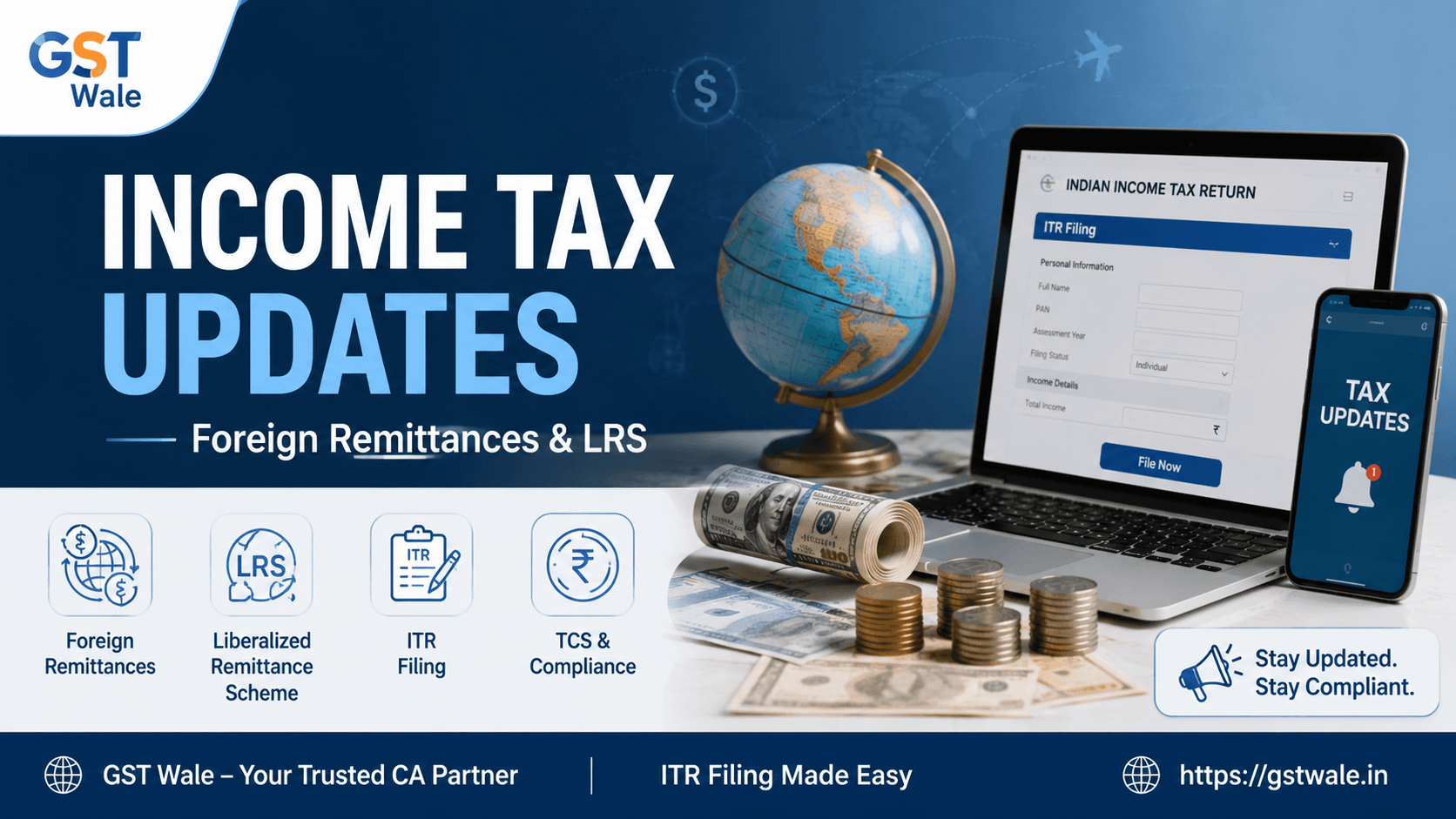
The latest Income Tax Updates related to foreign remittances and the Liberalized Remittance Scheme (LRS) have become a major talking point among taxpayers, students planning education abroad, frequent international travelers, and business owners dealing in foreign transactions. Over the last few years, the government has tightened reporting norms and revised Tax Collected at Source (TCS) provisions to improve transparency in overseas transactions.
At GST Wale, we regularly guide clients who face confusion regarding foreign remittance taxation, FEMA compliance, and TCS applicability. Whether you are sending money abroad for studies, investment, medical treatment, or foreign travel, understanding these recent Income Tax Updates is extremely important for proper tax planning and avoiding notices from the Income Tax Department.
If you are also planning your annual ITR Filing, it is advisable to keep all foreign remittance details properly documented to avoid future scrutiny.
Understanding the Liberalized Remittance Scheme (LRS)
The Liberalized Remittance Scheme, commonly known as LRS, is a facility provided by the Reserve Bank of India (RBI) under FEMA regulations. It allows Indian residents to remit money abroad for permitted current and capital account transactions.
Under the current LRS framework, an Indian resident can remit up to USD 250,000 in a financial year for purposes such as:
- Education abroad
- Foreign travel
- Investment in shares or property overseas
- Medical treatment
- Gifts to relatives
- Maintenance of family members abroad
These Income Tax Updates are especially important because the government is now closely tracking high-value foreign transactions through PAN-linked reporting systems.
Major Income Tax Updates on Foreign Remittances
Increase in TCS on Foreign Remittances
One of the biggest Income Tax Updates introduced recently is the revision in TCS rates under Section 206C(1G) of the Income Tax Act.
Earlier, many foreign remittances attracted lower TCS rates. However, the revised rules increased the compliance burden for taxpayers making overseas payments.
Here is a simplified overview:
| Purpose of Remittance | TCS Rate |
|---|---|
| Education abroad through education loan | 0.5% above threshold |
| Education abroad (other cases) | 5% above threshold |
| Foreign tour packages | 20% |
| Overseas investments | 20% |
| Other LRS remittances | 20% |
This threshold generally applies after crossing ₹7 lakh in a financial year.
These Income Tax Updates have significantly impacted individuals planning international travel and overseas investments.
TCS on Foreign Travel: What Taxpayers Must Know
The revised rules regarding TCS on foreign travel have created confusion among travelers and tour operators alike.
When Does TCS Apply?
TCS applies when:
- You purchase an international tour package
- You remit money abroad under LRS
- The aggregate remittance exceeds prescribed limits
For example:
If a family books an international holiday package worth ₹12 lakh, the tour operator may collect TCS at applicable rates before confirming the booking.
Can You Claim TCS Refund?
Yes. This is one of the most misunderstood Income Tax Updates.
TCS is not an additional tax liability. It works like advance tax and reflects in Form 26AS or AIS (Annual Information Statement). Taxpayers can claim adjustment or refund while filing their income tax return.
Income Tax Updates for Education Abroad
Students planning higher studies overseas must carefully understand the latest Income Tax Updates concerning education abroad remittances.
Lower TCS for Education Loans
If remittance is funded through an approved education loan from a financial institution, TCS is applicable at only 0.5% beyond the threshold limit.
However, if parents directly remit funds from savings without an education loan, higher TCS rates may apply.
Important Documents to Maintain
Students and parents should keep:
- University admission letters
- Loan sanction documents
- Fee receipts
- Bank remittance proofs
- PAN details
At GST Wale, we strongly advise families to maintain a proper documentation trail to avoid tax notices later.
FEMA Compliance and Forex Tax Implications
Many taxpayers focus only on income tax provisions but ignore FEMA regulations. This can become risky.
Difference Between FEMA and Income Tax Rules
Under FEMA, foreign remittances are regulated by the RBI, while taxation is governed by the Income Tax Act.
For example:
- FEMA decides whether a remittance is legally permitted.
- Income tax laws determine TCS and reporting requirements.
These Income Tax Updates have increased coordination between banks, RBI systems, and the Income Tax Department.
Forex Tax on Overseas Investments
If you earn gains from foreign shares, crypto assets, or overseas property, such income may become taxable in India depending on your residential status.
Common taxable foreign income includes:
- Capital gains on foreign stocks
- Rental income from overseas property
- Dividend income
- Interest on foreign bank accounts
Taxpayers must also disclose foreign assets in Schedule FA while filing returns.
How the Government Tracks Foreign Remittances
One of the most important Income Tax Updates is the increased use of technology and data analytics by the department.
The Income Tax Department now receives transaction data from:
- Banks
- Authorized dealers
- Forex companies
- Tour operators
- Credit card issuers
Large foreign remittances are automatically reflected in AIS and may trigger scrutiny if income disclosures do not match spending patterns.
Example
Suppose a taxpayer declares annual income of ₹6 lakh but spends ₹20 lakh on overseas travel and investments. Such mismatch can attract departmental attention.
Practical Tips to Handle LRS Transactions Properly
Keep PAN Updated
Always ensure PAN is linked and correctly provided during remittance transactions.
Track Your ₹7 Lakh Threshold
Many taxpayers unknowingly cross the threshold due to multiple smaller remittances.
Maintain Proper Records
Keep:
- Bank statements
- TCS certificates
- Form 26AS copies
- Remittance purpose declarations
Report Foreign Assets Correctly
Non-disclosure of foreign assets can lead to penalties under black money regulations.
These practical steps can help taxpayers stay compliant with the latest Income Tax Updates.
Common Mistakes Taxpayers Should Avoid
Ignoring TCS Credits
Many individuals fail to claim TCS while filing returns, leading to unnecessary tax outflow.
Wrong Purpose Code Selection
Selecting an incorrect remittance category under LRS may create FEMA compliance issues.
Non-Disclosure of Foreign Income
Even small foreign earnings may need disclosure in Indian income tax returns.
Depending Only on Banks
Banks process remittances but ultimate tax compliance responsibility remains with the taxpayer.
FAQs on Income Tax Updates and LRS
Is TCS on foreign remittance refundable?
Yes. TCS can be claimed as tax credit while filing your income tax return.
Does every foreign remittance attract TCS?
No. TCS applicability depends on the purpose, amount, and threshold limits under LRS.
Are credit card payments abroad covered under LRS?
Certain international credit card transactions may attract reporting and tax implications depending on usage and applicable rules.
What happens if foreign income is not disclosed?
Non-disclosure can result in penalties, scrutiny notices, and legal consequences under income tax laws.
Is FEMA compliance mandatory for individuals?
Yes. Every foreign remittance must comply with FEMA regulations and RBI guidelines.
The recent Income Tax Updates on foreign remittances and the Liberalized Remittance Scheme have changed the way overseas transactions are monitored in India. From higher TCS on foreign travel to stricter FEMA compliance and forex tax reporting, taxpayers now need to be far more careful while sending money abroad.
Whether you are planning education abroad, overseas investment, or international travel, understanding these Income Tax Updates can help you avoid penalties, manage cash flow better, and stay fully compliant.
At GST Wale, our experts help individuals, students, NRIs, and business owners manage foreign remittance taxation, TCS claims, FEMA compliance, and income tax filing with complete accuracy. If you need professional guidance on foreign income disclosures or overseas transaction reporting, connect with GST Wale today and stay ahead of changing tax regulations.
 Previous