


Ways to Save Income Tax Beyond Section 80C
Ways to Save Income Tax Beyond Section 80C
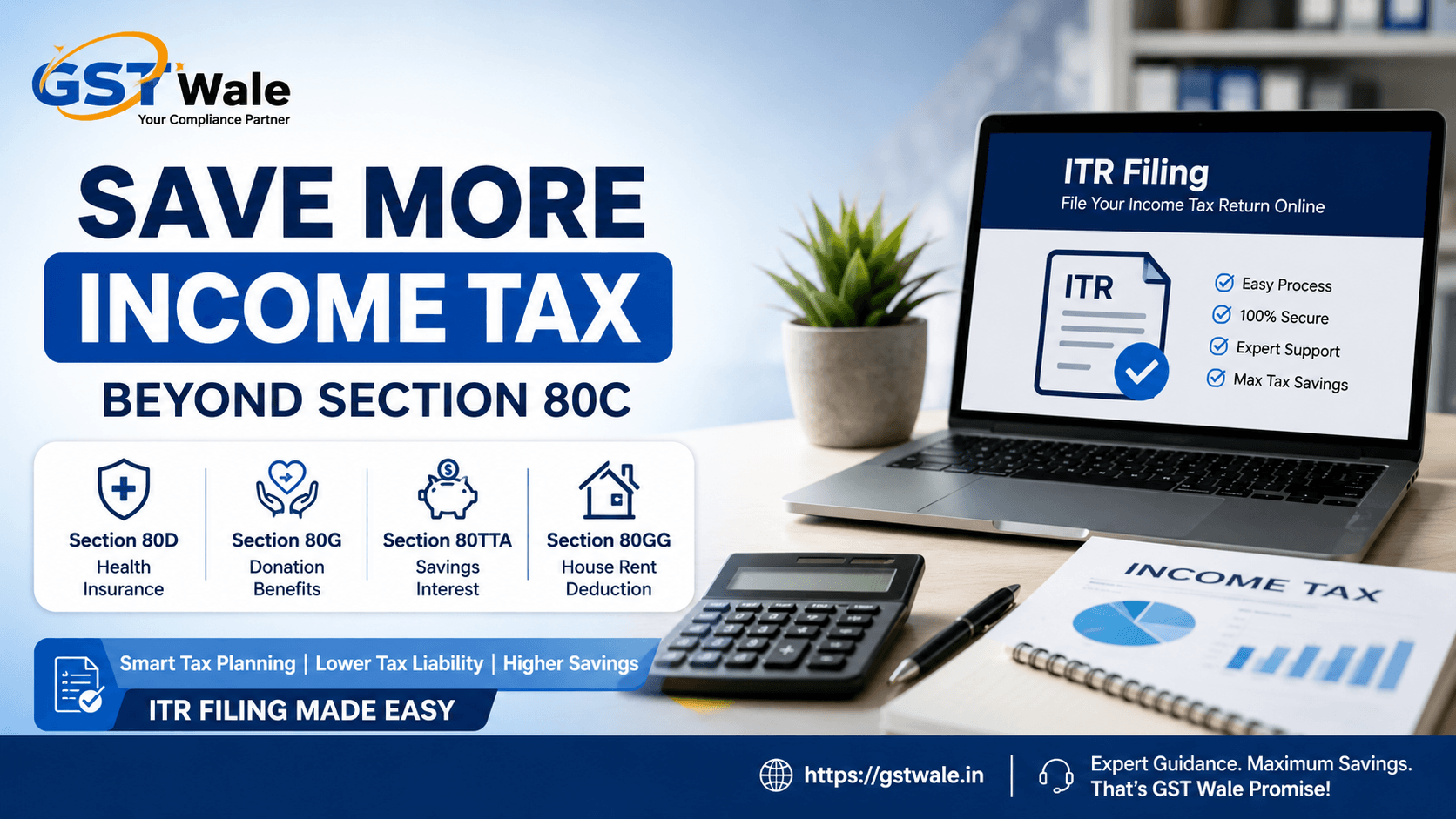
When it comes to saving Income Tax, most taxpayers immediately think about Section 80C investments like LIC, PPF, ELSS, or tax-saving fixed deposits. While these options are useful, many individuals and business owners in India are unaware that there are several other legal ways to reduce their Income Tax liability beyond Section 80C.
At GST Wale, we regularly help salaried employees, freelancers, professionals, and business owners identify hidden deductions that can significantly lower their Income Tax burden. The best part? Many of these deductions are simple to claim if you plan properly during the financial year.
Whether you are filing returns for the first time or looking to optimise your taxes better this year, proper tax planning can help you save thousands of rupees legally. If you need professional assistance with ITR Filing, our experts at GST Wale can guide you through every step.
In this article, we will discuss practical and effective ways to save Income Tax beyond Section 80C using lesser-known deductions and exemptions available under the Income Tax Act.
Why Looking Beyond Section 80C Is Important for Income Tax Savings
Section 80C has a deduction limit of ₹1.5 lakh, which gets exhausted quickly for most taxpayers through EPF, home loan principal, school fees, or insurance premiums.
However, relying only on Section 80C means you may miss out on additional Income Tax benefits available under other sections. Smart taxpayers diversify their deductions across multiple sections to maximise savings.
Some additional benefits include:
- Reduced taxable income
- Better financial planning
- Increased savings
- Legal tax optimisation
- Lower advance tax burden
Let’s explore the best alternatives.
Save Income Tax with Section 80D
Claim Deduction on Health Insurance Premiums
One of the most effective ways to reduce Income Tax is through Section 80D, which allows deductions on medical insurance premiums.
You can claim deductions for:
- Self and family health insurance
- Parents’ health insurance
- Preventive health check-ups
Deduction Limits Under Section 80D
| Category | Maximum Deduction |
|---|---|
| Self + Family | ₹25,000 |
| Parents (below 60 years) | ₹25,000 |
| Senior Citizen Parents | ₹50,000 |
| Preventive Health Check-up | ₹5,000 |
Practical Example
Suppose Rahul pays:
- ₹22,000 for his family health insurance
- ₹48,000 for his senior citizen parents
He can claim ₹70,000 deduction under Section 80D, directly reducing his Income Tax liability.
Expert Tip from GST Wale
Always pay the premium through banking channels. Cash payments are generally not eligible for deduction except preventive health check-ups.
Reduce Income Tax Through Section 80G Donations
Claim Donation Tax Breaks Legally
If you donate to approved charitable institutions, you may qualify for deductions under Section 80G.
Many taxpayers ignore these donation tax breaks, even though they can provide substantial Income Tax savings while supporting social causes.
Eligible Donations Under Section 80G
Common examples include:
- PM National Relief Fund
- Registered NGOs
- Educational trusts
- Religious charities
- Social welfare institutions
Types of Deductions
Depending on the organisation, deductions can be:
- 100% deduction
- 50% deduction
- With or without qualifying limits
Important Conditions
- Donations above ₹2,000 should not be made in cash
- Keep donation receipts safely
- Ensure the organisation has valid Section 80G registration
Real-World Insight
Many business owners make donations at year-end without collecting proper proof. During Income Tax filing, they fail to claim the deduction due to missing documents.
GST Wale always recommends maintaining digital copies of receipts for hassle-free compliance.
Save Income Tax Using Section 80TTA
Earn Tax Benefits on Savings Account Interest
Interest earned from savings bank accounts is taxable, but under Section 80TTA, individuals and HUFs can claim deductions up to ₹10,000.
Applicable On
- Savings bank accounts
- Post office savings accounts
- Cooperative society savings accounts
Not Applicable On
- Fixed deposits
- Recurring deposits
- Corporate bank accounts
Example
If your total savings account interest is ₹8,500 annually, you can claim the full amount under Section 80TTA and reduce your Income Tax.
This is one of the simplest deductions that salaried individuals often forget while filing returns.
Claim House Rent Deduction Under Section 80GG
Useful for Salaried and Self-Employed Individuals
Many people who do not receive HRA from employers miss out on tax benefits available under Section 80GG.
This section allows deduction for house rent paid if:
- You are self-employed, or
- Your salary structure does not include HRA
Conditions for Section 80GG
- You should not own residential property in the city of work
- Form 10BA must be filed
- Rent should actually be paid
Maximum Deduction Allowed
Least of the following:
- ₹5,000 per month
- 25% of total income
- Actual rent minus 10% of total income
GST Wale Suggestion
Even freelancers and consultants working remotely can benefit from Section 80GG if they satisfy conditions properly.
Save Income Tax Through Education Loan Interest
Deduction Under Section 80E
Education loan interest can also reduce Income Tax burden significantly.
You can claim deduction on:
- Higher education loan interest
- Loans for self, spouse, or children
Key Benefit
There is no upper limit on deduction for interest paid.
The deduction is available for 8 consecutive years from the start of repayment.
Additional Income Tax Saving Tips Most People Ignore
Use NPS for Extra Deduction
The National Pension System offers an additional deduction of ₹50,000 under Section 80CCD(1B), over and above Section 80C.
This means your total Income Tax deduction can increase substantially.
Claim Interest on Home Loan
Under Section 24(b), interest paid on a self-occupied home loan can provide deduction up to ₹2 lakh annually.
Medical Expenses for Senior Citizens
Under certain conditions, medical expenditure for senior citizens without insurance can also qualify for deduction.
Common Mistakes While Claiming Income Tax Deductions
Avoid these common errors:
- Forgetting to collect payment receipts
- Claiming deductions without eligibility
- Missing deadlines
- Incorrect ITR selection
- Ignoring small deductions like Section 80TTA
- Not maintaining proof for donation tax breaks
Improper claims can result in Income Tax notices or delayed refunds.
How Proper Tax Planning Helps in Income Tax Savings
Many taxpayers wait until March to save taxes, which leads to rushed investments and poor decisions.
Instead, systematic tax planning throughout the year helps you:
- Choose better investments
- Maintain liquidity
- Avoid unnecessary expenses
- Maximise Income Tax deductions legally
At GST Wale, we recommend quarterly tax reviews for professionals and business owners to ensure optimal compliance and savings.
FAQs on Income Tax Savings Beyond Section 80C
Can I claim both Section 80C and Section 80D together?
Yes, both sections are separate. You can claim deductions under both if eligible.
Is savings account interest fully tax-free?
No. Only deduction up to ₹10,000 is allowed under Section 80TTA.
Are all donations eligible for Section 80G deduction?
No. Only donations made to approved institutions qualify for deduction.
Can self-employed individuals claim Section 80GG?
Yes, if they pay rent and satisfy prescribed conditions.
Is NPS deduction separate from Section 80C?
Yes. An additional ₹50,000 deduction is available under Section 80CCD(1B).
Saving Income Tax does not end with Section 80C. Several powerful deductions under Section 80D, Section 80G, Section 80TTA, Section 80GG, and other provisions can help individuals and businesses reduce their tax burden legally and effectively.
The key is proper planning, maintaining documents, and understanding which deductions apply to your financial situation. Even small deductions, when combined smartly, can create substantial Income Tax savings over time.
At GST Wale, our experts help taxpayers identify every eligible deduction while ensuring complete compliance with Income Tax rules. Whether you are salaried, self-employed, or running a business, professional guidance can help you save more and file accurately.
 Previous