


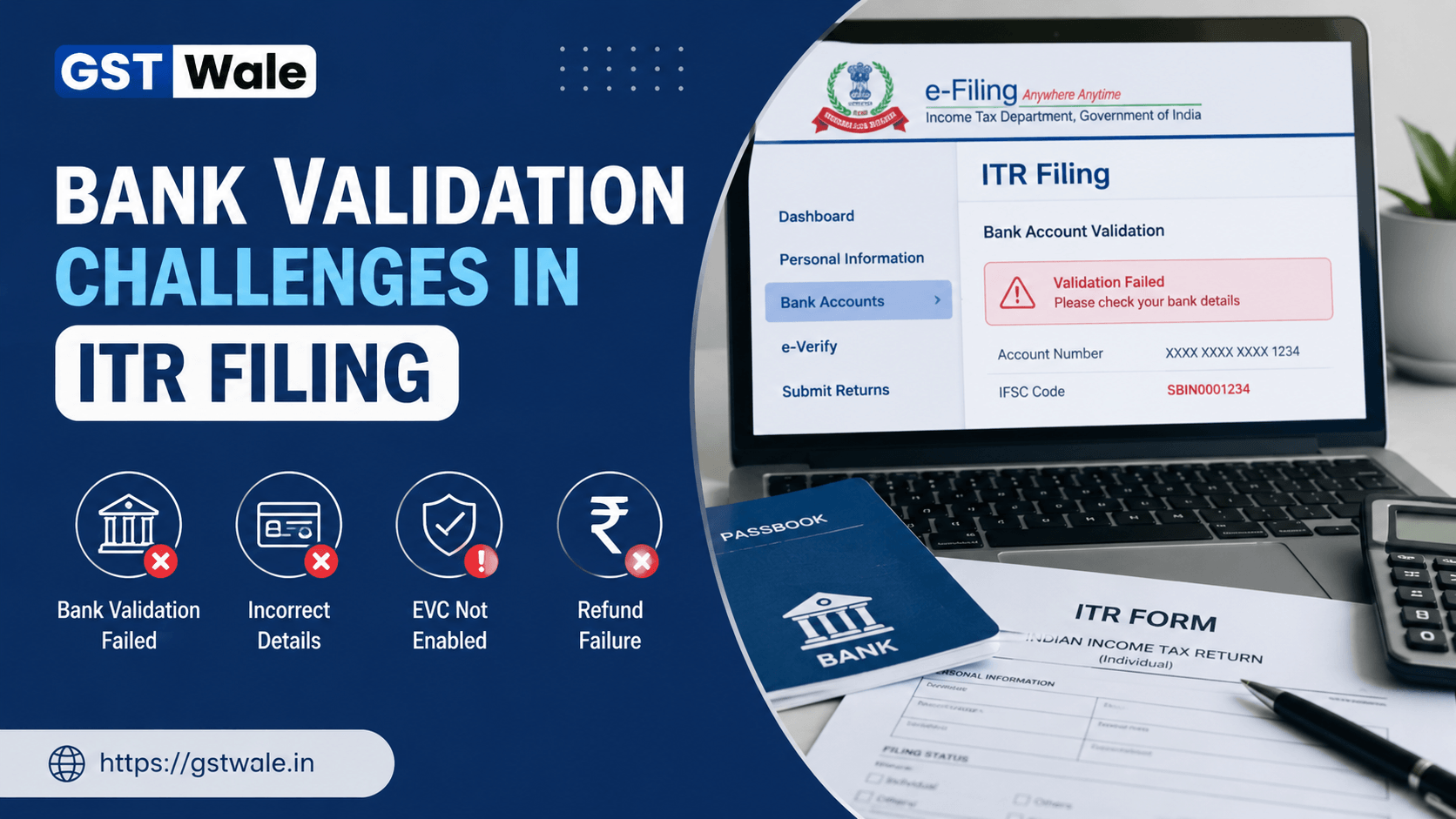
Common Challenges in Validating Bank Accounts for ITR Filing
Common Challenges in Validating Bank Accounts for ITR Filing
Common Challenges in Validating Bank Accounts for ITR Filing
When it comes to ITR Filing, most taxpayers focus on income details, deductions, and tax calculations. However, one small mistake that often creates major problems is incorrect bank account validation. Whether you are a salaried employee, freelancer, trader, or business owner, your bank account must be properly linked and validated on the income tax portal to avoid delays in refunds and verification issues.
At GST Wale, we regularly help taxpayers who face refund failures, bank validation errors, or EVC enabled account issues during ITR Filing. If you are planning your ITR Filing, understanding these common banking challenges can save you from unnecessary stress and delays.
In this article, we will explain the most common bank account validation issues, why they happen, and how you can resolve them smoothly.
Why Bank Account Validation Is Important in ITR Filing
The Income Tax Department requires taxpayers to pre-validate their bank accounts before filing returns and claiming refunds. This process ensures that the refund amount reaches the correct bank account securely.
Without successful Bank pre-validation, taxpayers may face:
- Delayed tax refunds
- Refund failure messages
- Problems in e-verification
- Issues in primary account selection
- Difficulty in receiving notices or communications
In many cases, taxpayers complete their ITR Filing correctly but still do not receive refunds due to banking mismatches.
Common Challenges Faced During Bank Pre-Validation
Incorrect IFSC Code Entry
One of the most common mistakes during ITR Filing is entering the wrong IFSC code. Even a small typing error can lead to validation failure.
What happens if the IFSC code is wrong?
- Bank account cannot be validated
- Refund may fail
- EVC services may not activate
- Taxpayer may need to repeat the process
Expert Tip from GST Wale
Always cross-check your IFSC code directly from:
- Bank passbook
- Cheque book
- Official bank website
- Net banking portal
Avoid copying IFSC details from outdated online sources because banks occasionally merge branches or update codes.
Name Mismatch Between PAN and Bank Account
This issue is extremely common among salaried individuals, homemakers, and small business owners.
Examples of mismatches:
- PAN name: “Rakesh Kumar Sharma”
- Bank account name: “Rakesh Sharma”
Or:
- PAN includes middle name
- Bank account does not
Even small spelling differences can create Bank pre-validation failure during ITR Filing.
How to resolve this issue
You can:
- Update the bank account name
- Correct PAN details if required
- Ensure Aadhaar, PAN, and bank records match
At GST Wale, we suggest checking these details before starting ITR Filing instead of waiting for rejection notices later.
Bank Account Not EVC Enabled
Many taxpayers are unaware that not every bank account is automatically EVC enabled for tax verification.
Why EVC enabled accounts matter
An EVC enabled bank account helps taxpayers:
- Verify returns instantly
- Avoid physical ITR-V submission
- Complete ITR Filing faster
Common reasons why EVC activation fails
- Mobile number not linked with bank
- PAN not linked to bank account
- Inactive net banking
- Joint account restrictions
Practical Example
A freelancer recently approached GST Wale after repeatedly failing to e-verify his ITR Filing. The issue was simple — his bank account was active but not EVC enabled because his PAN was not updated in bank records.
After updating PAN details with the bank, verification was completed within minutes.
Issues in Primary Account Selection
During ITR Filing, taxpayers must choose one validated bank account as the primary account for refunds.
Common mistakes in primary account selection
- Selecting inactive accounts
- Choosing dormant bank accounts
- Using old salary accounts
- Selecting joint accounts without proper permissions
If the selected account cannot receive refunds, taxpayers may face refund failure even after successful return filing.
GST Wale Recommendation
Always choose a bank account that is:
- Active regularly
- Individually held
- Linked with PAN
- Enabled for online transactions
Refund Failure Due to Closed or Dormant Accounts
Refund failure is one of the biggest frustrations taxpayers face after ITR Filing.
Common causes of refund failure
- Bank account closed recently
- Dormant savings account
- Incorrect account number
- Mismatch in account type
Sometimes taxpayers forget they had selected an old account during previous ITR Filing and continue using outdated details year after year.
What happens after refund failure?
The Income Tax Department usually asks taxpayers to revalidate another account and raise a refund reissue request.
This process can delay refunds by several weeks or even months.
Problems Due to Joint Bank Accounts
Joint accounts often create confusion during ITR Filing.
Common challenges include:
- PAN mismatch
- Primary holder mismatch
- EVC restrictions
- Refund processing issues
Usually, the taxpayer should preferably use an individual savings account for smoother processing.
Technical Errors on the Income Tax Portal
Not all issues are taxpayer-related. Sometimes the portal itself creates temporary validation problems.
Common portal-related errors
- Validation request pending for days
- OTP not received
- Session timeout
- Incorrect error messages
- Bank server not responding
What should taxpayers do?
- Retry after some time
- Clear browser cache
- Use updated browsers
- Avoid filing during peak deadlines
At GST Wale, we notice that portal traffic increases significantly near due dates, causing more validation failures during ITR Filing.
Step-by-Step Process for Smooth Bank Validation
Step 1: Verify PAN Linkage
Ensure your PAN is linked with:
- Aadhaar
- Bank account
- Mobile number
Step 2: Check Bank Details Carefully
Confirm:
- Account number
- IFSC code
- Account type
- Name spelling
Step 3: Complete Bank Pre-validation
Log in to the income tax portal and submit validation requests early before starting ITR Filing.
Step 4: Ensure the Account Is EVC Enabled
Activate net banking and verify that your account supports EVC services.
Step 5: Select the Correct Primary Account
Choose the account where you want refunds credited safely.
How GST Wale Helps in Hassle-Free ITR Filing
At GST Wale, we understand that many taxpayers struggle with technical and banking-related issues despite having correct tax calculations.
Our experts assist with:
- Bank pre-validation support
- Refund failure resolution
- PAN and bank mismatch correction
- EVC enabled account setup
- Error-free ITR Filing
- Refund reissue assistance
We ensure your ITR Filing process is smooth, compliant, and stress-free.
FAQs on Bank Validation and ITR Filing
Is bank account validation mandatory for ITR Filing?
Yes, bank account validation is mandatory if you want to receive tax refunds and complete verification smoothly.
Can I use a joint account for ITR Filing?
Yes, but it is better to use an individual account to avoid refund and verification issues.
What should I do if my refund fails?
You should log in to the income tax portal, validate another bank account, and submit a refund reissue request.
How long does Bank pre-validation take?
Usually, validation happens within a few minutes to 24 hours, depending on the bank.
Why is my bank account not EVC enabled?
This usually happens due to PAN mismatch, inactive net banking, or missing mobile number linkage.
Bank account validation may look like a small step, but it plays a critical role in successful ITR Filing. Issues like incorrect IFSC code, refund failure, inactive accounts, or wrong primary account selection can delay refunds and create unnecessary stress.
The best approach is to verify all banking details well before starting your ITR Filing process. A little attention today can save weeks of follow-up later.
If you want error-free and professionally managed ITR Filing support, GST Wale is here to help. Our experienced tax professionals ensure smooth filing, quick validations, and hassle-free refund processing for individuals, freelancers, and businesses across India.
 Previous