


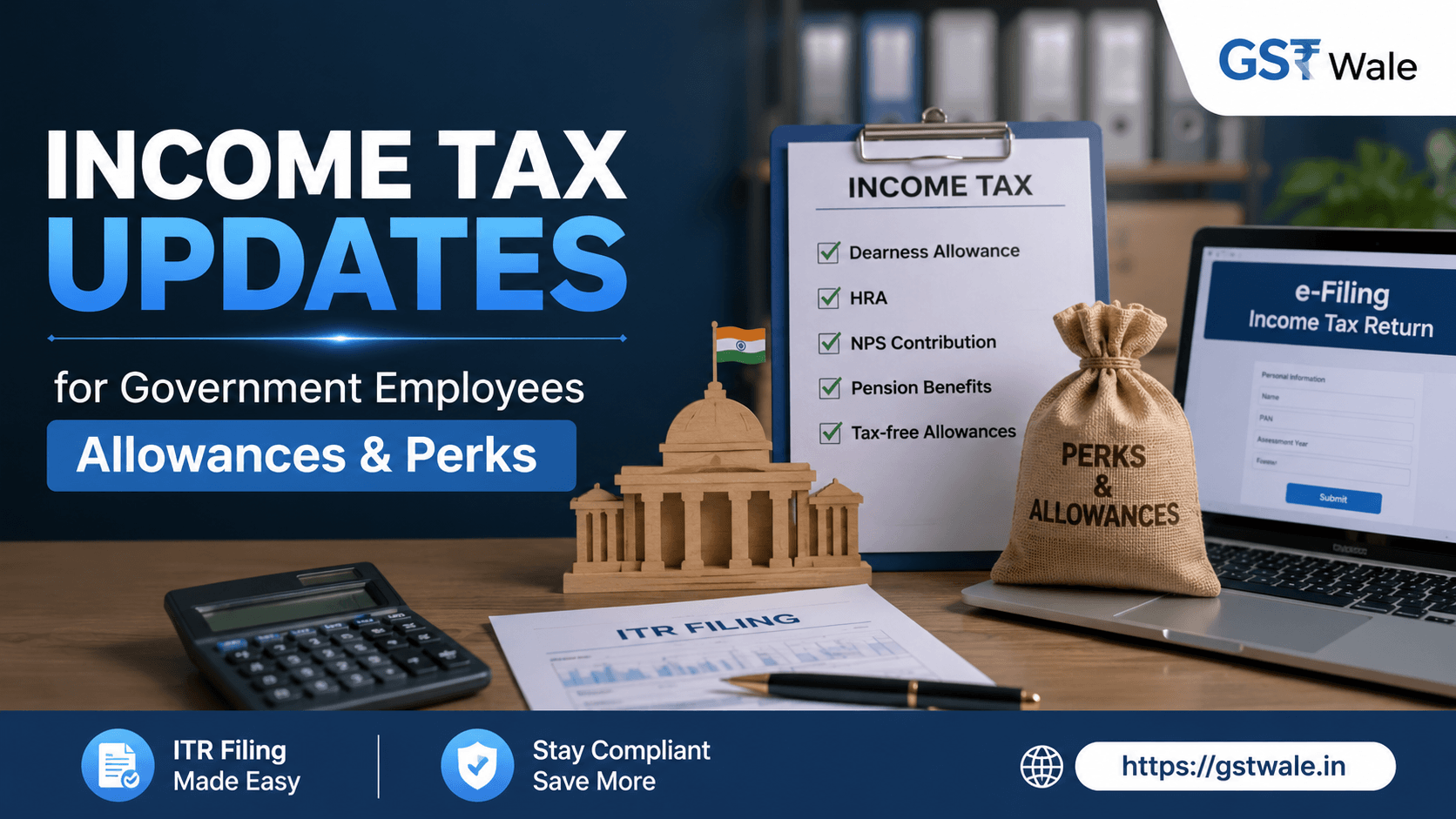
Income Tax Updates for Government Employees: Allowances and Perks
Income Tax Updates for Government Employees: Allowances and Perks
Government employees in India often enjoy a structured salary along with multiple allowances and perks. However, understanding how these components are taxed is crucial for effective financial planning. In recent years, several Income Tax Updates have impacted how allowances like Dearness Allowance, HRA, and pension benefits are treated. At GST Wale, we regularly guide our clients to stay compliant and optimize their tax liability.
If you are a government employee planning your taxes or preparing your return, it’s important to stay informed. Many professionals rely on expert assistance like our ITR Filing services to ensure accuracy and maximum tax efficiency.
Income Tax Updates for Government Employees: What Has Changed?
Recent Income Tax Updates have brought clarity and some changes in the taxation of allowances and perks. While some benefits remain partially or fully exempt, others are now more closely scrutinized.
Here’s what you need to focus on:
- Revised treatment of allowances under the new tax regime
- Increased emphasis on documentation
- Clear distinction between taxable and tax-free allowances
- Updates in standard deduction and pension taxation
Understanding these Income Tax Updates can help you make informed decisions about choosing between the old and new tax regimes.
Dearness Allowance: Fully Taxable but Important
What is Dearness Allowance?
Dearness allowance (DA) is provided to government employees to offset inflation. It is a significant component of salary, especially after periodic hikes.
Tax Treatment as per Income Tax Updates
As per the latest Income Tax Updates:
- DA is fully taxable
- It must be declared under salary income
- It is considered for retirement benefits calculation
Practical Insight
Many employees assume DA has some exemption, but that’s not the case. Proper reporting is essential to avoid notices from the Income Tax Department.
HRA (House Rent Allowance): Still a Major Tax Saver
Eligibility and Conditions
HRA continues to be one of the most beneficial components under the old tax regime.
Calculation of Exemption
As per current Income Tax Updates, HRA exemption is the least of:
- Actual HRA received
- 50% of salary (metro) / 40% (non-metro)
- Rent paid minus 10% of salary
Key Tips from GST Wale
- Always keep rent receipts
- Use proper PAN details of landlord if rent exceeds ₹1 lakh annually
- Evaluate whether the old regime benefits you more due to HRA
NPS Contribution: Dual Tax Benefits
Employer and Employee Contributions
The National Pension System (NPS) is highly beneficial for government employees.
Tax Benefits as per Income Tax Updates
- Employee contribution eligible under Section 80CCD(1)
- Additional ₹50,000 under Section 80CCD(1B)
- Employer contribution up to 10% of salary is tax-free
Why It Matters
These Income Tax Updates make NPS one of the best long-term tax-saving tools. It not only reduces taxable income but also builds retirement corpus.
Pension Benefits: Taxation Simplified
Types of Pension
- Uncommuted pension (monthly)
- Commuted pension (lump sum)
Latest Tax Treatment
As per recent Income Tax Updates:
- Uncommuted pension is fully taxable
- Commuted pension is partially or fully exempt depending on employment type
Example
A retired government employee receiving commuted pension can enjoy significant tax relief compared to private employees.
Tax-Free Allowances: What You Can Still Claim
Common Tax-Free Allowances
Some allowances still enjoy exemptions under specific conditions:
- Leave Travel Allowance (LTA)
- Children education allowance
- Transport allowance (for specially-abled employees)
Key Income Tax Updates to Note
- Exemptions are mostly available only in the old tax regime
- Proper documentation is mandatory
- Claims without proof may lead to scrutiny
Old vs New Tax Regime: Which One to Choose?
Important Income Tax Updates
Government employees now have the option to choose between:
- Old regime (with deductions and exemptions)
- New regime (lower rates but fewer exemptions)
Decision-Making Checklist
Choose old regime if you have:
- High HRA
- NPS contributions
- Multiple deductions
Choose new regime if:
- You prefer simplicity
- You have fewer exemptions
At GST Wale, we always recommend a comparative calculation before making a decision.
Step-by-Step Tax Planning for Government Employees
To make the most of these Income Tax Updates, follow this approach:
Step 1: Understand Your Salary Structure
Break down your salary into basic, DA, HRA, and other allowances.
Step 2: Identify Taxable Components
Mark fully taxable items like DA and pension.
Step 3: Claim Eligible Exemptions
Utilize HRA, LTA, and other tax-free allowances.
Step 4: Invest Smartly
Maximize NPS contribution and other deductions.
Step 5: Choose the Right Tax Regime
Compare both regimes before filing.
Common Mistakes to Avoid
Even with regular Income Tax Updates, many employees make avoidable errors:
- Not declaring all allowances correctly
- Missing out on HRA exemption
- Ignoring NPS benefits
- Choosing the wrong tax regime
- Poor documentation
Avoiding these mistakes can save you significant tax and stress.
FAQs on Income Tax Updates for Government Employees
1. Are all allowances taxable for government employees?
No, as per recent Income Tax Updates, some allowances like HRA and LTA are partially or fully exempt under conditions.
2. Is Dearness Allowance tax-free?
No, Dearness allowance is fully taxable and must be included in salary income.
3. Can I claim both HRA and home loan benefits?
Yes, subject to conditions. These Income Tax Updates allow both claims if eligibility criteria are met.
4. Is NPS mandatory for government employees?
For many government employees, NPS is mandatory, and it also provides excellent tax benefits.
5. Which tax regime is better for government employees?
It depends on your deductions and allowances. The old regime is often beneficial if you claim multiple exemptions.
Stay Ahead with the Latest Income Tax Updates
Keeping track of Income Tax Updates is no longer optional—it’s essential for every government employee. With changing rules around allowances like HRA, Dearness allowance, NPS contribution, and pension benefits, proactive tax planning can make a significant difference in your take-home income.
At GST Wale, we understand the complexities of government salary structures and taxation. Whether it’s choosing the right tax regime or maximizing your tax-free allowances, our experts are here to guide you every step of the way.
Don’t leave your tax planning to guesswork—connect with GST Wale today and ensure your finances are optimized, compliant, and stress-free.
 Previous