


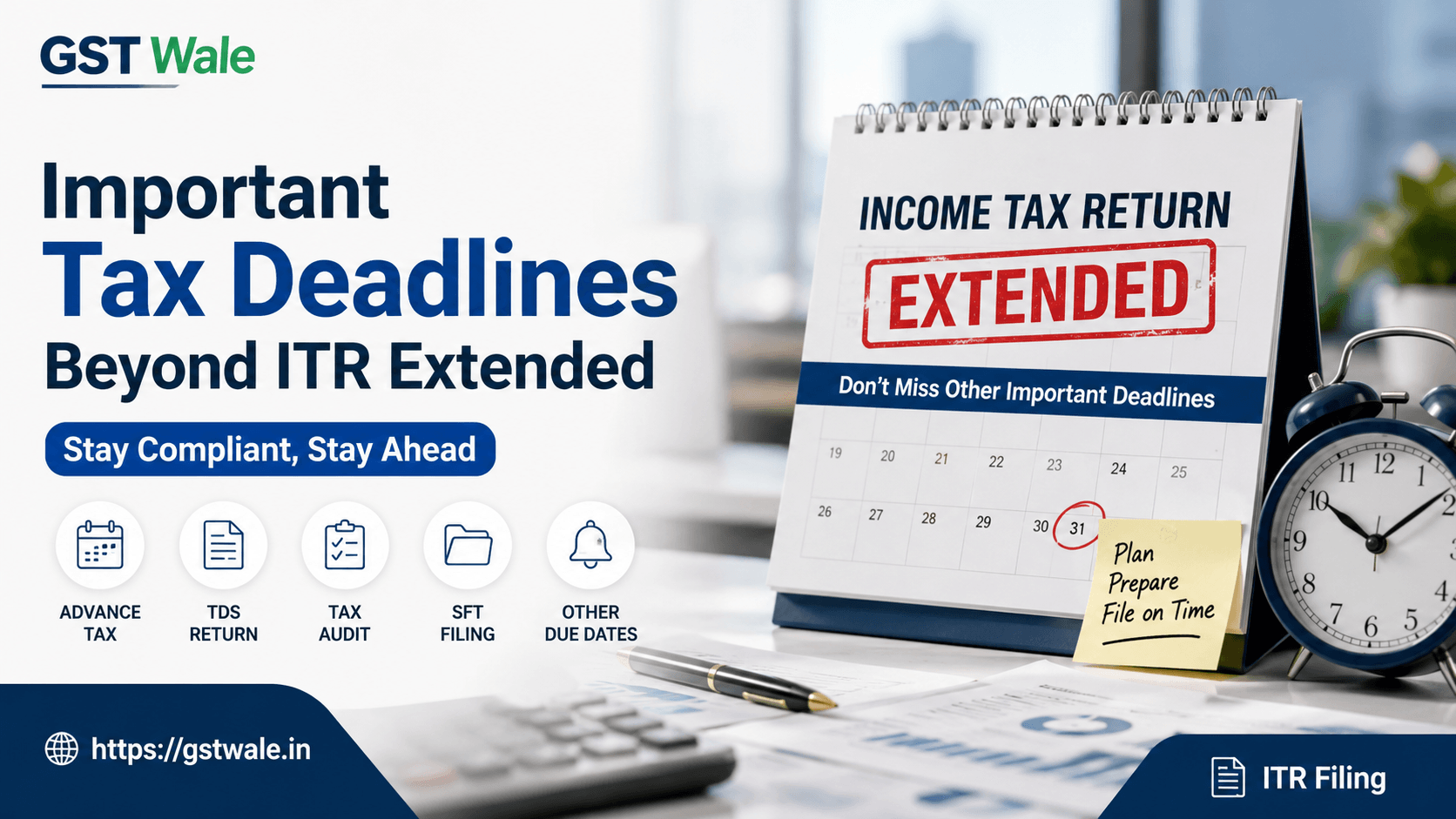
Important Deadlines to Memorize Beyond the Income Tax Return Extended Announcement
Important Deadlines to Memorize Beyond the Income Tax Return Extended Announcement
Why the Income Tax Return Extended News Is Not the Whole Story
Whenever taxpayers hear that the income tax return extended deadline has been announced, there is an immediate sense of relief. But as experienced tax professionals at GST Wale, we always remind clients of one important point: an extension of the ITR filing date does not automatically extend every other tax compliance deadline.
For example, your ITR may have a later filing date, while advance tax installments, TDS compliance, tax audit reports and other reporting requirements continue according to their own schedules. If you are looking for professional support with your ITR Filing, it is equally important to maintain a complete financial calendar so that one extended deadline does not make you overlook another.
For AY 2026-27, different categories of taxpayers have different ITR timelines. For instance, ITR-4 for eligible taxpayers is currently due on 31 August 2026, while the tax audit report for AY 2026-27 is due on 30 September 2026.
The real tax-planning habit, therefore, is not simply to remember when the income tax return extended announcement comes out. It is to understand the complete compliance cycle.
Income Tax Return Extended Does Not Mean Every Tax Deadline Is Extended
This is one of the most common misunderstandings among taxpayers.
Suppose the government extends the deadline for filing a particular category of income tax return. That extension applies to the specified return and taxpayers covered by the notification. It does not necessarily change the due date for:
- Advance tax installments
- TDS deposits
- TDS quarterly return
- Tax audit report
- SFT filing
- Other statutory forms and statements
Last year, for example, the ITR deadline for certain non-audit taxpayers was extended from 31 July 2025 to 15 September 2025, followed by a further one-day extension to 16 September 2025. Such announcements can create the impression that taxpayers have extra time for everything, but that is not how tax compliance works.
Our advice at GST Wale is simple: treat every government extension as category-specific unless the notification clearly says otherwise.
Important Advance Tax Installments to Remember
Advance tax is particularly important for individuals and businesses whose tax liability is not fully covered through TDS.
If your estimated tax liability, after considering applicable TDS and other credits, exceeds the prescribed threshold, advance tax may become applicable. The Income Tax Department currently lists the following schedule for regular taxpayers:
Advance Tax Installments and Their Due Dates
The four regular installments are:
- 15 June – 15% of the annual advance tax liability
- 15 September – 45% cumulatively
- 15 December – 75% cumulatively
- 15 March – 100% cumulatively
The Income Tax Department confirms these installment percentages and dates for individuals.
Consider a business owner who receives significant professional income during the year. Even if an income tax return extended announcement provides additional time for filing the final return, it does not mean the taxpayer can simply postpone advance tax payments without considering interest implications.
A good practice is to review estimated profit, capital gains, interest income, rental income and other taxable receipts before every advance tax installment.
TDS Quarterly Return Deadlines Should Be on Your Calendar
Businesses that deduct TDS should pay particular attention to quarterly reporting.
The TDS quarterly return, now reported through the applicable forms under the current tax framework, has prescribed filing dates. For example, the quarterly statement covering April to June is generally due by 31 July, July to September by 31 October, October to December by 31 January and January to March by 31 May of the following financial year.
Why TDS Compliance Needs Separate Attention
TDS compliance has multiple stages. Deducting tax is only one part of the process.
You should monitor:
- Correct deduction of TDS.
- Timely deposit of the deducted amount.
- Correct reporting in the quarterly statement.
- Reconciliation of deductions with books of accounts.
- Correction of errors, if any.
- Issuance and availability of applicable TDS certificates.
The general TDS deposit timeline continues to require payment by the 7th of the following month, with specific rules and exceptions applying to certain transactions.
So, even if you are waiting for an income tax return extended announcement, your TDS calendar should continue normally.
Tax Audit Report Has Its Own Deadline
Businesses and professionals covered by tax audit provisions should not confuse the ITR deadline with the tax audit report deadline.
For FY 2025-26 relevant to AY 2026-27, the Income Tax Department states that the tax audit report is due by 30 September 2026. The applicable audit forms for this year continue under the Income Tax Act, 1961.
What Should Businesses Prepare Before Tax Audit?
Do not wait until September to start collecting documents. A business should ideally keep the following ready throughout the year:
- Sales and purchase records
- Bank statements
- Expense invoices
- Fixed asset details
- Loan and interest statements
- GST records
- TDS records
- Stock information
- Details of related-party transactions
- Previous-year tax and audit records
The earlier the books are reconciled, the easier it becomes for the CA to identify inconsistencies and complete the audit properly.
SFT Filing Is Another Deadline You Should Not Ignore
Specified Financial Transactions, commonly referred to as SFT, involve reporting certain high-value or specified transactions to the Income Tax Department by reporting entities.
Banks, financial institutions and other specified entities may have SFT reporting responsibilities. Taxpayers should therefore understand that transactions appearing in AIS or reported through SFT can influence the information available to the department.
If a taxpayer sees an unexpected transaction in AIS, it is better to investigate it early rather than discover the issue while filing the return.
For businesses and professionals, maintaining proper transaction records throughout the year makes reconciliation much easier.
Build a Financial Calendar Instead of Memorizing One Date
One of the most practical suggestions from GST Wale is to maintain a financial calendar.
Instead of remembering only the ITR due date, divide the year into recurring compliance checkpoints.
Monthly
Review:
- TDS deductions and payments
- GST-related records and reconciliations
- Bookkeeping
- Bank reconciliation
- Tax liability estimates
Quarterly
Review:
- TDS quarterly return
- Advance tax position
- Profit and loss figures
- AIS/TIS information where relevant
- Outstanding tax demands
- Business and professional income estimates
Annually
Review:
- Income tax return
- Tax audit report
- SFT-related information
- Capital gains
- Investments and deductions
- Loans and interest
- Tax payment records
This approach turns tax compliance into a routine business process rather than a last-minute emergency.
What To Do After an Income Tax Return Extended Announcement
If the government extends an ITR deadline, use the additional time intelligently.
Step 1: Confirm Who Is Covered
Read the official notification carefully. Do not assume that the extension applies to every taxpayer.
Step 2: Check Your Other Deadlines
Look separately at advance tax installments, TDS, audit and reporting obligations.
Step 3: Reconcile Your Records
Match your books, bank accounts, TDS credits, AIS and other financial information.
Step 4: Calculate Your Actual Tax Position
Do not wait until the final day to discover that additional tax is payable.
Step 5: File Early
An extended deadline is additional breathing room, not an invitation to postpone everything until the last day.
The Income Tax Department has also made clear that revised-return timelines have changed from AY 2026-27, with revised returns permitted up to 31 March of the relevant assessment year, subject to applicable additional fees for certain late revisions.
Common Mistakes Taxpayers Make After a Deadline Extension
A few mistakes are seen repeatedly:
Waiting for Another Extension
Taxpayers sometimes delay filing because they expect another announcement. This is risky. A taxpayer should work with the currently notified deadline unless an official extension is actually issued.
Ignoring Advance Tax
An ITR extension does not automatically postpone advance tax obligations.
Forgetting TDS Compliance
Businesses may focus on their own ITR while overlooking their responsibility as a deductor.
Leaving Books for the Last Month
Incomplete books make tax filing and audit unnecessarily stressful.
Not Checking AIS
Information reported by banks, employers and other reporting entities may appear in AIS. Reconciliation before filing can help identify discrepancies early.
FAQs About Income Tax Return Extended Deadlines
Does an income tax return extended deadline apply to all taxpayers?
No. An extension applies only to the taxpayer categories, returns or compliance requirements specifically covered by the government notification. Taxpayers should read the official notification rather than assume that every tax deadline has moved.
Does an ITR extension change advance tax due dates?
Generally, no. Advance tax installments have separate statutory timelines. For regular taxpayers, the major dates are 15 June, 15 September, 15 December and 15 March, subject to the applicable provisions.
What is the TDS quarterly return deadline?
The prescribed quarterly TDS statement deadlines are generally 31 July, 31 October, 31 January and 31 May for the respective quarters. The applicable form and rules should be checked for the relevant tax year.
When is the tax audit report due for AY 2026-27?
For FY 2025-26 relevant to AY 2026-27, the Income Tax Department states that the tax audit report is due by 30 September 2026.
Should I wait for an extension before filing my return?
No. The safest approach is to plan according to the currently applicable deadline. If the government subsequently announces an extension, you can use the additional time for reconciliation and review instead of depending on an extension that may never come.
Look Beyond the Income Tax Return Extended Announcement
An income tax return extended announcement can certainly give taxpayers additional breathing space, but smart tax planning goes beyond one deadline. Advance tax installments, TDS quarterly return requirements, tax audit report filing, SFT-related reporting and other compliance dates continue to form part of your overall financial calendar.
At GST Wale, we believe tax compliance should be planned throughout the year rather than handled during the final few days. Keep your books updated, reconcile your tax information regularly, track every statutory deadline and take professional advice whenever your tax position is complicated.
Do not build your compliance strategy around waiting for an income tax return extended announcement. Build a financial calendar, stay prepared and file correctly and on time.
For reliable tax and compliance guidance, connect with GST Wale and make your income tax compliance simpler, more organised and less stressful.
 Previous