


How to Legally Avoid a Delayed Refund After Submitting Your Return of Income
How to Legally Avoid a Delayed Refund After Submitting Your Return of Income
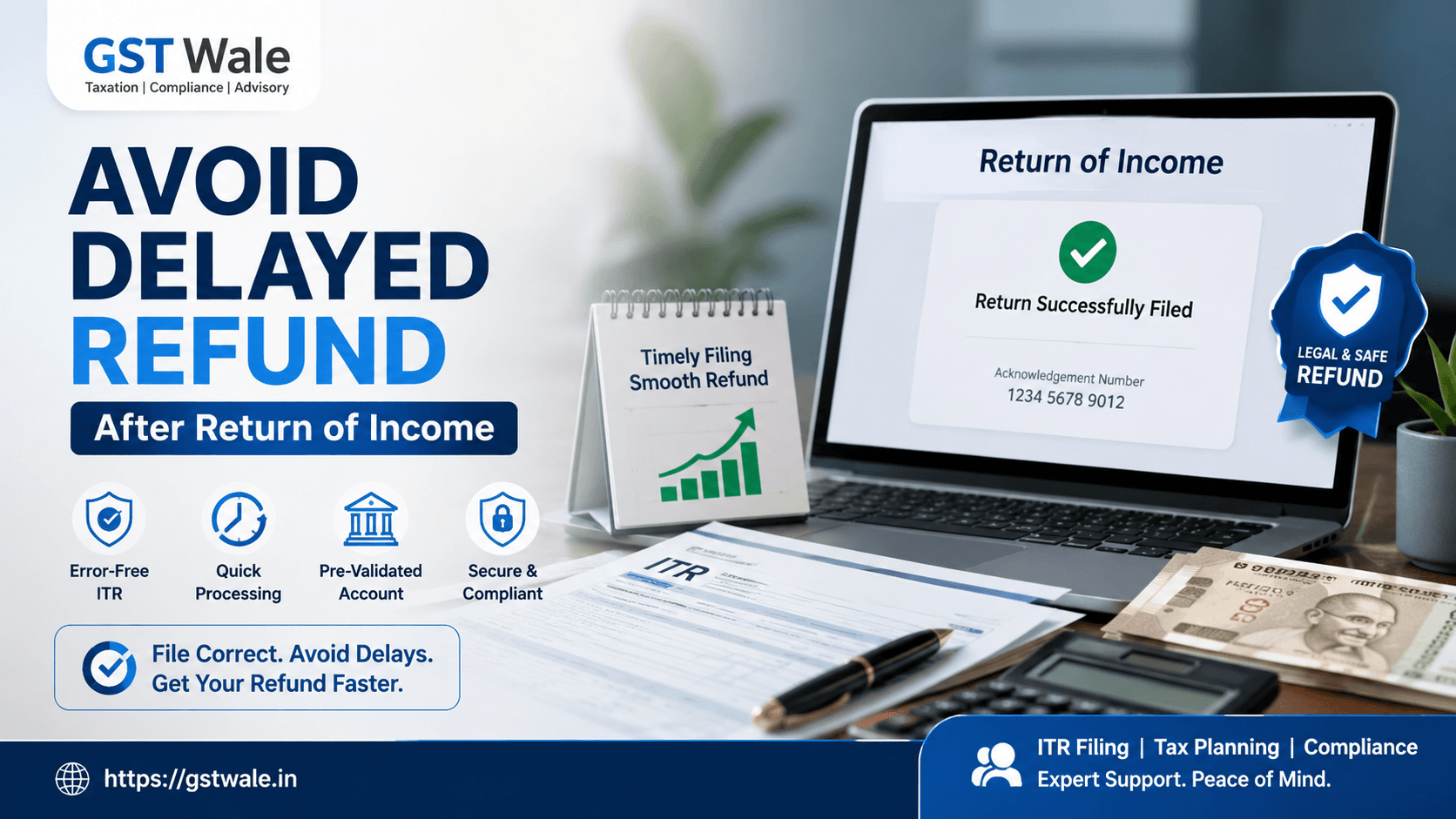
A tax refund is something every taxpayer looks forward to, especially when excess tax has already been deducted during the financial year. However, many taxpayers experience unnecessary delays even after submitting their return of income. In most cases, the problem is not the refund itself but an error, mismatch, verification issue, or incorrect bank detail that slows down processing. If you want professional assistance with accurate and timely ITR Filing, GST Wale can help you avoid common mistakes that lead to unnecessary delays.
The good news is that taxpayers can legally reduce the chances of a delayed refund by taking a few practical steps before and immediately after filing their return of income. A properly prepared return, a pre-validated account, matched AIS information, and swift e-verification can make the overall process much smoother.
Why Your Return of Income Refund May Get Delayed
The Income Tax Department processes thousands of returns, and every return goes through automated checks and validations. A discrepancy does not necessarily mean that your return of income is wrong, but it may require additional verification before the refund is issued.
Some common reasons include:
- Incorrect bank account details
- Bank account not being pre-validated
- PAN and bank details not matching
- Difference between TDS claimed and Form 26AS
- Income or transaction mismatch with AIS
- Incorrect computation of tax liability
- Failure to complete e-verification
- Incorrect deduction claims
- Outstanding tax demands from earlier years
- Significant differences between reported income and information available with the department
For example, suppose ₹80,000 was deducted as TDS from your income, but the tax credit appearing in Form 26AS does not match the amount claimed in your return. Such a discrepancy can affect the processing of your return of income and consequently delay the refund.
How to Make Your Return of Income Error-Free
The first step towards faster refund processing is to prepare an error-free ITR. Filing in a hurry just before the deadline can increase the possibility of mistakes.
Before submitting your return of income, carefully review your income from all relevant sources, including salary, professional income, interest, rental income, capital gains, and other taxable receipts.
Check Your Form 26AS and AIS
Your Annual Information Statement (AIS) contains important information reported by various financial institutions and other reporting entities. Before filing, compare the information in AIS with your actual records.
A matched AIS does not mean that every figure must automatically be accepted. If you find incorrect or unfamiliar information, investigate it and take appropriate action rather than blindly incorporating it into your return.
Similarly, verify the TDS information in Form 26AS. The tax credit claimed should be properly supported by the records available with the department.
Verify Deductions Carefully
Refunds are often higher because taxpayers claim eligible deductions or tax credits. However, claiming an incorrect deduction simply to obtain a high refund can create problems later.
Keep supporting documents for deductions under applicable provisions, such as investments, insurance, education loan interest, donations, or eligible medical expenses. A high refund should always result from genuine tax credits or legitimate deductions, not aggressive or unsupported claims.
Use a Pre-Validated Account for Faster Refunds
Your bank account details are extremely important when you are expecting a refund. Make sure the account selected for receiving your refund is active and properly linked with your PAN.
A pre-validated account can reduce avoidable issues related to refund credit. Before submitting your return of income, check whether the correct bank account is selected on the income tax portal.
Also verify:
- Account number
- IFSC
- Account holder's name
- Bank status
- PAN linkage, wherever applicable
- Whether the account is selected for refund
Imagine that your tax refund has been processed, but the bank account details are incorrect or the account cannot receive the refund. You may then have to complete additional steps to receive the money, turning a simple process into a lengthy one.
Complete Swift E-Verification After Filing
Submitting your return of income is not always the final step. You must also complete the prescribed e-verification process.
Taxpayers can generally use available electronic verification methods through the income tax portal. Completing verification promptly helps avoid an incomplete filing status and removes one of the most common administrative delays.
Do not assume that your return has been successfully completed merely because you clicked the submit button. After filing, check the portal and confirm that your return of income has been successfully e-verified.
Don't Wait Until the Last Moment
A practical approach is to file and verify your return as early as possible. Filing early gives you time to identify discrepancies, correct mistakes where legally permitted, and address any technical or banking issue.
Early filing also provides greater comfort if the return requires clarification or correction. Waiting until the deadline can leave very little time to resolve an unexpected problem.
How Accurate Information Supports Quick Processing
Quick processing becomes more likely when the information submitted in your return of income is consistent with the information already available to the Income Tax Department.
This means your income, TDS, deductions, tax payments, and other relevant information should be properly reconciled before submission.
A simple pre-filing review can include:
- Download and review AIS and Form 26AS.
- Match salary, business, professional, interest, and other income with your records.
- Verify TDS and advance tax credits.
- Review deductions and exemptions.
- Check the tax calculation.
- Confirm bank details and pre-validation.
- Submit the return of income.
- Complete swift e-verification.
- Save the acknowledgement for your records.
- Monitor the processing status through the official portal.
This approach does not guarantee a particular processing time or refund date, but it can significantly reduce avoidable errors.
What If Your Refund Is Delayed?
If your return of income has already been filed and the refund is taking longer than expected, do not immediately assume that the refund has been rejected.
First, check the current status of the return and look for any communication, adjustment, outstanding demand, defective return notice, or other action required from your side.
If the department has issued an intimation or notice, read it carefully. Sometimes the difference between the refund claimed and refund processed may be because of an adjustment or a mismatch identified during processing.
If necessary, consult a qualified tax professional before responding. Avoid submitting random corrections simply because you want the refund released quickly.
Don't Chase a High Refund Through Incorrect Claims
A common misconception is that a higher refund is always better. The correct objective is to pay the tax legally payable and claim every legitimate tax credit and deduction available to you.
For instance, if a taxpayer has genuine TDS of ₹1 lakh and the final tax liability is ₹60,000, a refund of ₹40,000 may be perfectly legitimate. But creating artificial deductions merely to increase the refund can result in future tax complications.
The best return of income is not the one showing the biggest refund. It is the one that accurately reflects your income, deductions, tax credits, and legal tax position.
Practical CA Tips for a Smooth Refund
From a practical compliance perspective, taxpayers should develop the habit of reviewing their tax information before filing rather than after receiving a notice.
Keep your salary slips, Form 16, bank statements, investment proofs, loan certificates, invoices, capital-gain statements, and other relevant records organised.
For business owners and professionals, reconciliation becomes even more important because income may come from multiple sources. Review turnover, expenses, TDS, advance tax, and other applicable details before finalising the return of income.
Also remember that an error-free ITR is not just about avoiding mistakes in numbers. It is about ensuring that the entire return is consistent with supporting documents and information available with the department.
FAQs About Return of Income and Refund Delays
Can I legally speed up my tax refund?
You cannot demand instant processing, but you can reduce avoidable delays by submitting an accurate return of income, ensuring correct bank details, using a pre-validated account, reconciling AIS and Form 26AS, and completing e-verification promptly.
Does e-verification affect refund processing?
Yes. Completing the required e-verification is an important part of successfully completing the filing process. If verification is not completed properly, processing of the return of income may be affected.
Why is my refund different from the amount I claimed?
The department may process a refund differently after checking the information in your return against available records. Differences can arise because of TDS mismatches, tax calculations, deductions, outstanding demands, or other adjustments.
Can I claim a high refund to get more money back?
You should claim only genuine deductions and tax credits allowed under the Income Tax Act. A high refund should reflect legitimate excess tax payment, not unsupported claims. Incorrect claims can create compliance problems later.
Should I take professional help if my refund is delayed?
If the delay involves a mismatch, notice, adjustment, defective return, or complicated income sources, professional assistance can help you understand the issue and respond correctly instead of making an unnecessary or incorrect correction.
Make Your Return of Income Accurate From Day One
Avoiding a delayed refund is largely about getting the basics right. An accurate return of income, matched AIS and Form 26AS information, correct tax calculations, a pre-validated account, and swift e-verification can help remove many common obstacles to smooth processing.
At GST Wale, we believe tax filing should be accurate, transparent, and stress-free. Whether you are an individual, professional, or business owner, our team can help you approach your return of income with proper checks and practical tax guidance.
If you are preparing your return this year, don't wait until the last minute. Get your records organised, reconcile your information, verify your details, and file with confidence.
 Previous