


How to Match Your TDS Certificates (Form 16A) with Your Income Tax E Filing Accounts
How to Match Your TDS Certificates (Form 16A) with Your Income Tax E Filing Accounts
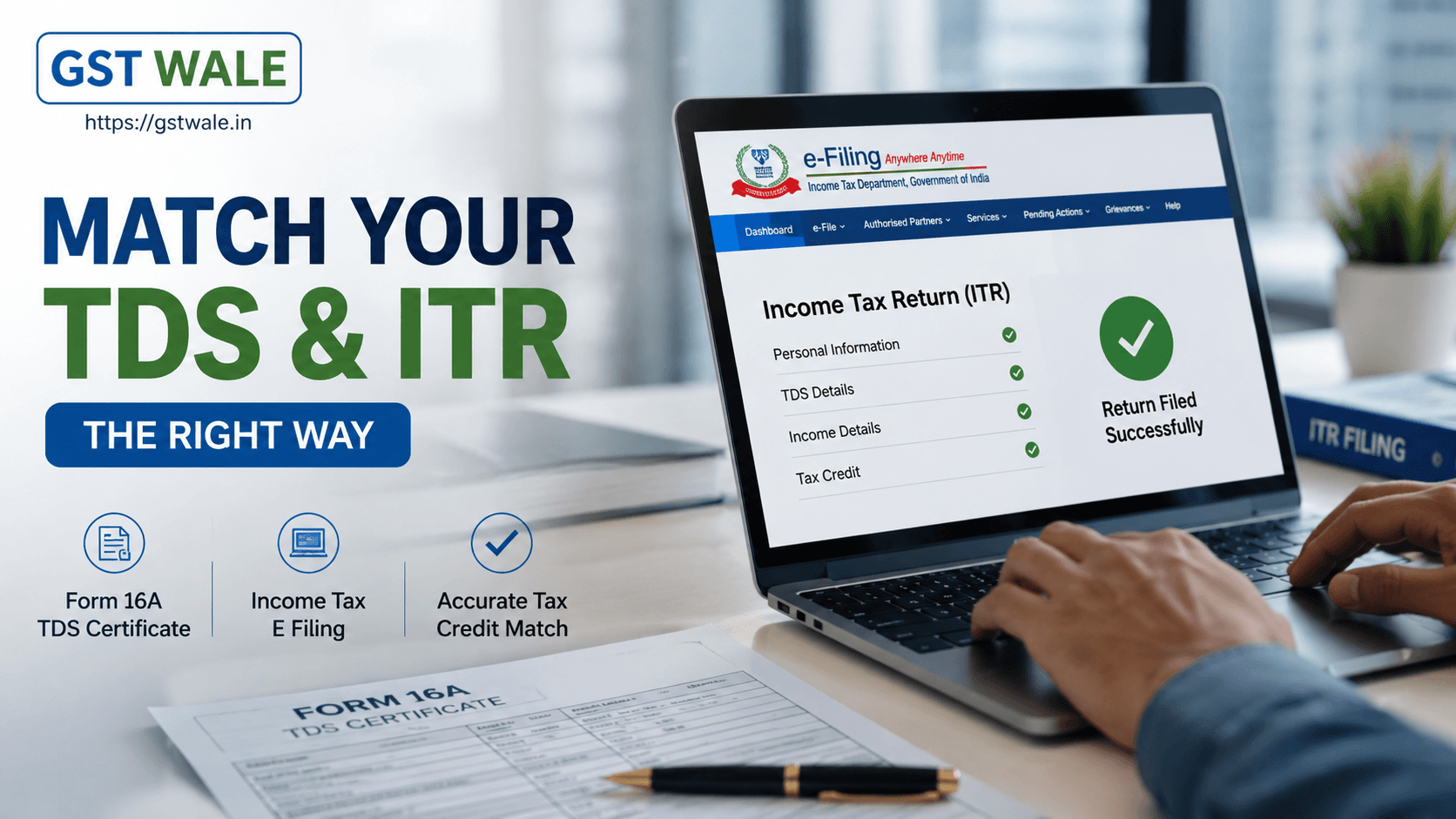
When you receive income on which tax has already been deducted, checking your TDS details before filing your return is extremely important. A proper income tax e filing review helps ensure that the tax deducted from your income is correctly reflected in your records and that you claim the right amount of TDS while filing your return. This becomes particularly important for interest income, professional fees, commission, rent, and other sources where TDS may be deducted under non-salary TDS provisions. If you need professional assistance with your return, you can also consider ITR Filing support from GST Wale.
Form 16A is one of the key documents you should check before completing your income tax e filing. It provides details of TDS deducted on income other than salary. However, simply having a Form 16A does not always mean that the same credit will automatically appear correctly in your tax records. Differences in PAN, TAN, income amounts, deduction dates, or reporting by the deductor can result in a tax credit mismatch.
As a CA, I recommend treating TDS reconciliation as a routine step rather than something to check only after receiving a tax notice.
What Is Form 16A and Why Is It Important for income tax e filing?
Form 16A is a TDS certificate issued for tax deducted from income other than salary. For example, a bank may deduct TDS on fixed deposit interest, a company may deduct TDS from professional fees, or a business may deduct TDS from certain payments made to a service provider.
The certificate generally contains important information such as:
- Name and PAN of the deductee
- TAN of the deductor
- Amount paid or credited
- TDS deducted
- TDS deposited
- Relevant financial year and quarter
- Details of the deductor
During income tax e filing, these details should broadly agree with the tax information available against your PAN. If they do not, you may see a difference between the TDS shown in Form 16A and the TDS credit available for claiming in your return.
How Form 16A Connects With Your income tax e filing Records
The TDS information reported by deductors is used by the Income Tax Department to prepare your tax information records. Therefore, your Form 16A should not be viewed in isolation.
Suppose you earned ₹1,00,000 as professional income and the client deducted ₹10,000 as TDS. Your Form 16A may show the ₹10,000 deduction. However, if the deductor reported your PAN incorrectly, the amount may not appear correctly in your tax records.
This is why checking your information before completing income tax e filing is essential.
Your reconciliation should cover three things:
- The income actually received or credited to you.
- The TDS shown on Form 16A.
- The TDS credit appearing in your tax records.
Ideally, all three should be properly reconciled.
Step-by-Step Process for Matching Form 16A
Step 1: Collect All Your Form 16A Certificates
Start by collecting Form 16A certificates from every deductor.
Do not check only the certificates received from your bank. If you have freelance income, consultancy income, commission income, rent receipts, or other sources involving non-salary TDS, collect the certificates from each relevant deductor.
If you have misplaced a certificate, use the available tax records and request a fresh certificate from the deductor. Keeping your documents organised makes income tax e filing considerably easier.
Step 2: Check Your PAN Details
Compare the PAN mentioned on every Form 16A with your actual PAN.
A small reporting error can cause significant problems. If the deductor has quoted an incorrect PAN, the TDS may not be properly matched with your account.
This is one of the first checks you should perform before starting your income tax e filing.
Step 3: Verify the Deductor's TAN
The matching TAN is another important check.
TAN, or Tax Deduction and Collection Account Number, identifies the deductor. Compare the TAN shown on your Form 16A with the details reported in your tax records.
If the deductor's TAN or other reporting information differs, do not immediately assume that the TDS is lost. First identify whether the difference is due to a reporting or data-entry issue.
Step 4: Compare the TDS Amount
Now compare the TDS amount mentioned in Form 16A with the TDS credit available against your PAN.
For example, assume your bank deducted ₹5,000 as TDS on fixed deposit interest. Your Form 16A shows ₹5,000, but your tax information shows only ₹3,000.
That ₹2,000 difference needs to be investigated before you submit your income tax e filing.
Step 5: Match the Income Amount
TDS reconciliation is not only about matching the tax deducted.
You should also compare the income mentioned in your Form 16A with your books, bank statements, invoices, interest statements, or other supporting records.
For instance, if a company reports ₹2,00,000 paid to you but your books show ₹1,80,000, you should understand the reason for the difference before finalising your return.
Step 6: Review Fixed Deposit Interest Carefully
Banks are a common source of TDS certificates because of fixed deposit interest.
Taxpayers sometimes compare only the TDS amount and overlook the interest income itself. However, the interest income should also be properly considered while preparing your return.
Check your bank statements, interest certificates, Form 16A, and tax information together. This approach reduces the chances of missing taxable interest during income tax e filing.
Step 7: Download and Preserve Your Records
If you need a fresh copy of your certificate, complete the TDS certificate download process through the appropriate tax or deductor-provided system.
Keep digital copies of your Form 16A certificates, bank statements, invoices, and reconciliation workings. Good documentation can be extremely useful if the department later asks for clarification.
What Causes a Tax Credit Mismatch?
A tax credit mismatch can happen for several reasons. Some of the most common include:
- Incorrect PAN reported by the deductor
- Incorrect TAN or deductor details
- TDS deducted but not deposited on time
- TDS deposited but not correctly reported
- Difference in the amount reported by the deductor
- Duplicate or incorrect entries
- TDS certificate issued with incorrect information
- Data updated after you initially checked your records
If your Form 16A and tax records do not match, do not simply claim the higher amount during income tax e filing. The claim should be supported by properly reported TDS information.
What Should You Do If Form 16A Does Not Match?
If you identify a difference, first contact the deductor.
Ask them to verify the relevant TDS statement and correct the information if necessary. The deductor may need to file a correction statement so that the updated information is reflected in your tax records.
For example, suppose your client deducted ₹20,000 but accidentally reported your PAN incorrectly. You may have a valid Form 16A showing ₹20,000, but the credit may not appear against your PAN. The appropriate solution is generally to get the deductor to correct the reporting rather than simply claiming an unsupported credit during income tax e filing.
If the mismatch relates to timing, you should also check whether the deductor has deposited and reported the TDS for the correct quarter.
Practical Example of TDS Reconciliation
Imagine Rahul is a consultant. During the financial year, he received payments from three clients.
Client A deducted ₹12,000, Client B deducted ₹8,000, and Client C deducted ₹5,000. Rahul therefore has total TDS of ₹25,000 according to his Form 16A certificates.
Before his income tax e filing, he checks his tax records and finds only ₹20,000 reflected.
Instead of claiming ₹25,000 immediately, Rahul compares each certificate individually. He discovers that Client C has not correctly reported the ₹5,000 TDS against his PAN.
Rahul contacts Client C and requests correction. Once the information is appropriately updated, he can reconcile the records and proceed with his return.
This simple exercise can prevent unnecessary tax credit disputes later.
Should You Claim TDS Even If It Is Not Showing?
This is an important practical question.
A Form 16A is useful evidence of TDS, but your tax credit should be properly reflected in the applicable tax records before relying on it for your final return calculation. If there is a mismatch, investigate it and seek correction from the deductor wherever required.
During income tax e filing, avoid claiming amounts merely because they appear on an old certificate when the corresponding reporting has not been corrected.
A cautious reconciliation approach is always better than dealing with a notice later.
Common Mistakes Taxpayers Should Avoid
Ignoring Small Differences
Even a relatively small TDS difference should be investigated. Multiple small discrepancies can become significant when combined.
Checking Only Form 16A
Form 16A is important, but it should be compared with your income records and tax information rather than treated as the only source of truth.
Forgetting Non-Salary Income
People often focus on salary TDS and overlook non-salary TDS. Interest, professional fees, commission, rent, and similar income can also carry TDS obligations.
Filing in a Hurry
Do not wait until the last day to reconcile TDS. If a correction is required from a deductor, it may take additional time to reflect.
FAQs
Is Form 16A required for income tax e filing?
Form 16A is not the return itself, but it is an important supporting document for reconciling TDS deducted from non-salary income. It helps you verify the amount deducted by banks, businesses, or other deductors before completing your income tax e filing.
Why does my Form 16A show TDS but my tax records do not?
This can happen because the deductor may have reported incorrect PAN details, not deposited or reported the TDS correctly, or filed a statement that requires correction. Contact the deductor and ask them to verify the relevant TDS statement.
Can fixed deposit interest create a TDS mismatch?
Yes. Fixed deposit interest is commonly subject to TDS when applicable. A mismatch can occur if the bank's reported amount differs from your records or if there is an issue with PAN or quarterly reporting.
What is matching TAN in TDS reconciliation?
Matching TAN means verifying that the Tax Deduction and Collection Account Number of the deductor shown on your Form 16A corresponds with the deductor's reported information. It is one of the useful checks during TDS reconciliation.
Should I check TDS before filing my ITR?
Absolutely. Checking TDS before income tax e filing can help identify incorrect PAN details, missing credits, duplicate entries, and other discrepancies before you submit your return.
Make TDS Reconciliation a Part of Your income tax e filing Process
TDS reconciliation is not merely a compliance formality. It is a practical way to ensure that the tax already deducted from your income is correctly accounted for when you file your return.
Before completing your income tax e filing, collect your Form 16A certificates, verify your PAN, check the deductor's TAN, compare income and TDS amounts, review fixed deposit interest and other non-salary income, and investigate any tax credit mismatch.
At GST Wale, we believe tax compliance should be accurate, transparent, and easy to understand. If you are unsure about your TDS reconciliation, ITR preparation, or other income tax requirements, professional guidance can help you avoid avoidable mistakes and complete your return with greater confidence.
 Previous