


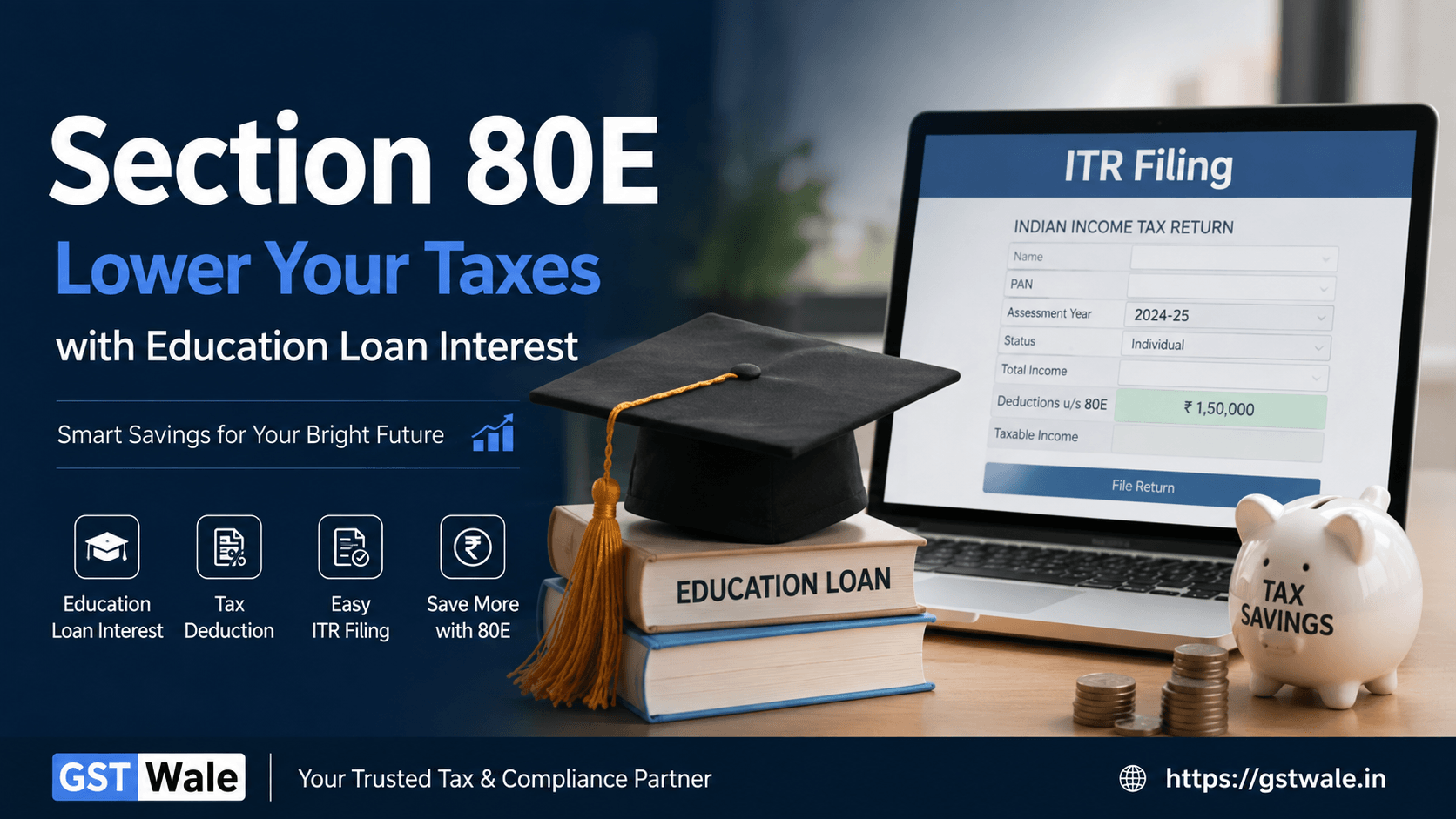
A Guide to Section 80E: How Your Student Loan Can Lower Your Income Tax Return Filing
A Guide to Section 80E: How Your Student Loan Can Lower Your Income Tax Return Filing
Why Section 80E Matters in Income Tax Return Filing
Paying for higher education can be a major financial commitment, especially when an education loan continues into the early years of your career. The good news is that the interest paid on an eligible education loan can provide a valuable tax deduction. During income tax return filing, Section 80E can help eligible taxpayers reduce their taxable income by claiming the qualifying education loan interest paid during the year.
At GST Wale, we often see taxpayers focus only on salary, TDS and Form 16 while preparing their income tax return filing. Important deductions can sometimes be overlooked. If you are preparing your return and need professional assistance, you can also explore our ITR Filing service to understand how eligible deductions can be reported correctly.
Section 80E is particularly relevant for young professionals who have started earning after completing higher studies, as well as parents who have funded a child's education through a qualifying loan.
What Is Section 80E and How Does It Help?
Section 80E provides a deduction for interest paid on a qualifying loan taken for higher education. Under the Income-tax Act, 1961, the deduction is available to an individual who pays eligible interest on a loan obtained from a financial institution or an approved charitable institution for higher education of the individual or a qualifying relative.
The important point is that Section 80E relates to the interest component. The principal portion of an education loan repayment is not the deduction being claimed under this section.
For example, if you paid ₹1,20,000 as eligible education loan interest during a financial year, the eligible amount can potentially reduce your taxable income by ₹1,20,000, subject to the applicable conditions and tax regime.
This is why understanding Section 80E before income tax return filing can make a meaningful difference to your final tax calculation.
How Section 80E Works During Income Tax Return Filing
Suppose Amit earns ₹10 lakh in taxable income before considering his education loan interest. During the year, he pays ₹1 lakh of eligible education loan interest.
If Amit satisfies the requirements of Section 80E and is filing under the tax regime where the deduction is available, the eligible ₹1 lakh can be deducted from his total income.
However, it is important to understand one distinction: a ₹1 lakh deduction does not mean Amit will receive ₹1 lakh as a tax refund. It reduces his taxable income, and the actual tax benefit depends on his applicable tax rates and overall tax position.
Therefore, during income tax return filing, taxpayers should calculate the deduction as part of their overall tax planning rather than treating it as a direct refund.
Who Can Claim the Section 80E Deduction?
Section 80E is available to an individual taxpayer. The loan must be for qualifying higher education and must be obtained from an eligible financial institution or approved charitable institution.
The loan can be for the taxpayer's own education or the higher education of a qualifying relative. The definition of relative includes the taxpayer's spouse and children, as well as a student for whom the taxpayer is the legal guardian.
This makes the provision particularly useful for parents who have taken an education loan for their child's higher studies.
What If a Parent Is a Co-Borrower?
A common question during income tax return filing is whether a parent can claim Section 80E simply because they are a parent as co-borrower on the education loan.
The answer requires more than looking at the name on the loan agreement. The taxpayer claiming the deduction must satisfy the conditions of Section 80E, including the requirement relating to payment of eligible interest from income chargeable to tax. Therefore, parents should review the loan documents, repayment records and interest certificate before claiming the deduction.
Do not assume that being a co-borrower automatically creates a tax deduction.
What Counts as Higher Education?
Section 80E is intended for loans connected with higher education. Under the current law, higher education generally covers a course pursued after passing Senior Secondary Examination or its equivalent, subject to the prescribed recognition requirements.
This can cover a broad range of academic and professional courses. However, taxpayers should verify the eligibility of their particular course and institution instead of assuming that every education-related loan qualifies.
For income tax return filing, it is sensible to retain the admission documents, loan sanction letter and other relevant records along with the annual interest certificate.
How Long Can You Claim Section 80E?
One of the biggest advantages of this provision is its extended deduction period.
The deduction is available from the initial assessment year in which the taxpayer starts paying interest and for seven assessment years immediately following that year, or until the eligible interest is fully paid, whichever happens earlier. In other words, the maximum deduction period can generally extend across eight assessment years.
This is important for income tax return filing because you should know when your deduction period begins. If the loan is repaid early, the deduction does not continue indefinitely simply because eight years have not passed.
Keep your loan records year after year so that you can accurately determine how much eligible interest remains and whether you are still within the permitted deduction period.
What Is the Moratorium Period?
Most education loans have a moratorium period during which the borrower may not have to start regular EMI payments immediately. Depending on the loan terms, interest may continue to accumulate during this period.
From a tax-planning perspective, borrowers should not rely only on the EMI amount shown in their bank account. The lender's annual interest certificate is a much better reference when preparing income tax return filing.
The certificate should help you identify the interest amount relevant to your claim for the particular financial year.
Section 80E and the New Tax Regime
This is one of the most important points to check before income tax return filing.
Under the current ITR rules, Section 80E cannot be claimed when the taxpayer selects the new tax regime. The Income Tax Department's AY 2026-27 ITR validation rules specifically list Section 80E among the deductions that cannot be claimed under the new regime.
The new tax regime is the default regime, but eligible taxpayers can generally opt for the old tax regime subject to the applicable rules.
Therefore, do not automatically choose a regime simply because it is the default. Compare your tax liability under both applicable regimes, particularly if you have substantial education loan interest or other deductions.
How to Claim Section 80E: Step-by-Step
Step 1: Get Your Annual Interest Certificate
Ask your bank or eligible lending institution for the annual education loan statement or interest certificate.
Step 2: Separate Interest From Principal
Your EMI generally contains both principal and interest. For Section 80E, identify the eligible interest amount rather than claiming the complete EMI.
Step 3: Verify Your Loan Details
Check:
- Name of the lending institution
- Loan account number
- Date of sanction
- Total loan amount
- Loan outstanding at year-end
- Eligible interest paid during the year
The Income Tax Department specifically asks for these details when claiming Section 80E in the relevant ITR.
Step 4: Check Your Tax Regime
Before finalising income tax return filing, compare the old and new tax regimes. If you want to claim Section 80E, the applicable old-regime conditions must be satisfied.
Step 5: Enter the Correct Interest Amount
Report the eligible interest based on your loan certificate and supporting records. Avoid estimating the amount from your monthly EMI.
Practical Example of Section 80E Tax Benefit
Consider Neha, who completed her postgraduate course and started working after graduation.
During the financial year:
- Total principal repaid: ₹1,10,000
- Education loan interest paid: ₹90,000
- Eligible Section 80E deduction: ₹90,000
Neha should not treat the entire ₹2 lakh as her Section 80E deduction. The relevant amount is the eligible ₹90,000 education loan interest.
If she satisfies the eligibility requirements and chooses the tax regime under which Section 80E is available, the ₹90,000 deduction can reduce her taxable income.
This simple example shows why checking loan statements carefully is important during income tax return filing.
Common Mistakes Taxpayers Should Avoid
Claiming the Entire EMI
An EMI contains principal and interest. Do not automatically claim the complete EMI under Section 80E.
Ignoring the Tax Regime
Section 80E is not available under the new tax regime. Compare the regimes before completing income tax return filing.
Assuming Every Education Loan Qualifies
Check the lender, course and purpose of the loan against the legal requirements.
Forgetting the Deduction Period
Section 80E is subject to a defined deduction period. Maintain records from the first year in which interest payment begins.
Not Keeping Supporting Documents
Keep your loan sanction letter, annual interest certificate, repayment records and relevant educational documents safely. Good documentation makes income tax return filing much smoother.
FAQs About Section 80E and Income Tax Return Filing
Can I claim the principal repayment under Section 80E?
No. Section 80E provides a deduction for eligible interest paid on a qualifying education loan. The principal repayment should not be included as the Section 80E interest deduction.
Is there a maximum rupee limit under Section 80E?
There is no separate fixed monetary ceiling for eligible interest under the current Section 80E provision. The deduction is based on the eligible interest paid, subject to the conditions of the section and the applicable tax regime.
Can parents claim Section 80E for their child's education?
Yes, an individual may claim the deduction for higher education of a qualifying relative, including children, provided the statutory conditions are met.
Can I claim Section 80E under the new tax regime?
No. The current ITR rules do not allow Section 80E when the new tax regime is selected.
What documents are required for the deduction?
Keep your education loan statement, interest certificate, loan account details, sanction information and repayment records. The ITR also requires specific loan-related information for the Section 80E claim.
Make Income Tax Return Filing More Tax-Efficient
Section 80E can provide useful tax relief to eligible taxpayers who are repaying an education loan for higher studies. The key is to claim only the eligible education loan interest, understand the deduction period, review the moratorium period, maintain proper documentation and choose the appropriate tax regime.
For anyone with an education loan, income tax return filing should not be treated as simply entering figures from Form 16. Reviewing available deductions can help you make a more informed tax decision and avoid missing legitimate benefits.
At GST Wale, our approach is simple: understand your financial situation, check the applicable provisions and prepare your return carefully. If you are unsure about Section 80E, education loan interest or any other deduction, get professional assistance before submitting your return.
Choose GST Wale for reliable tax guidance, accurate compliance and hassle-free income tax return filing. Let our experts help you file correctly and make the most of the deductions available to you.
 Previous