


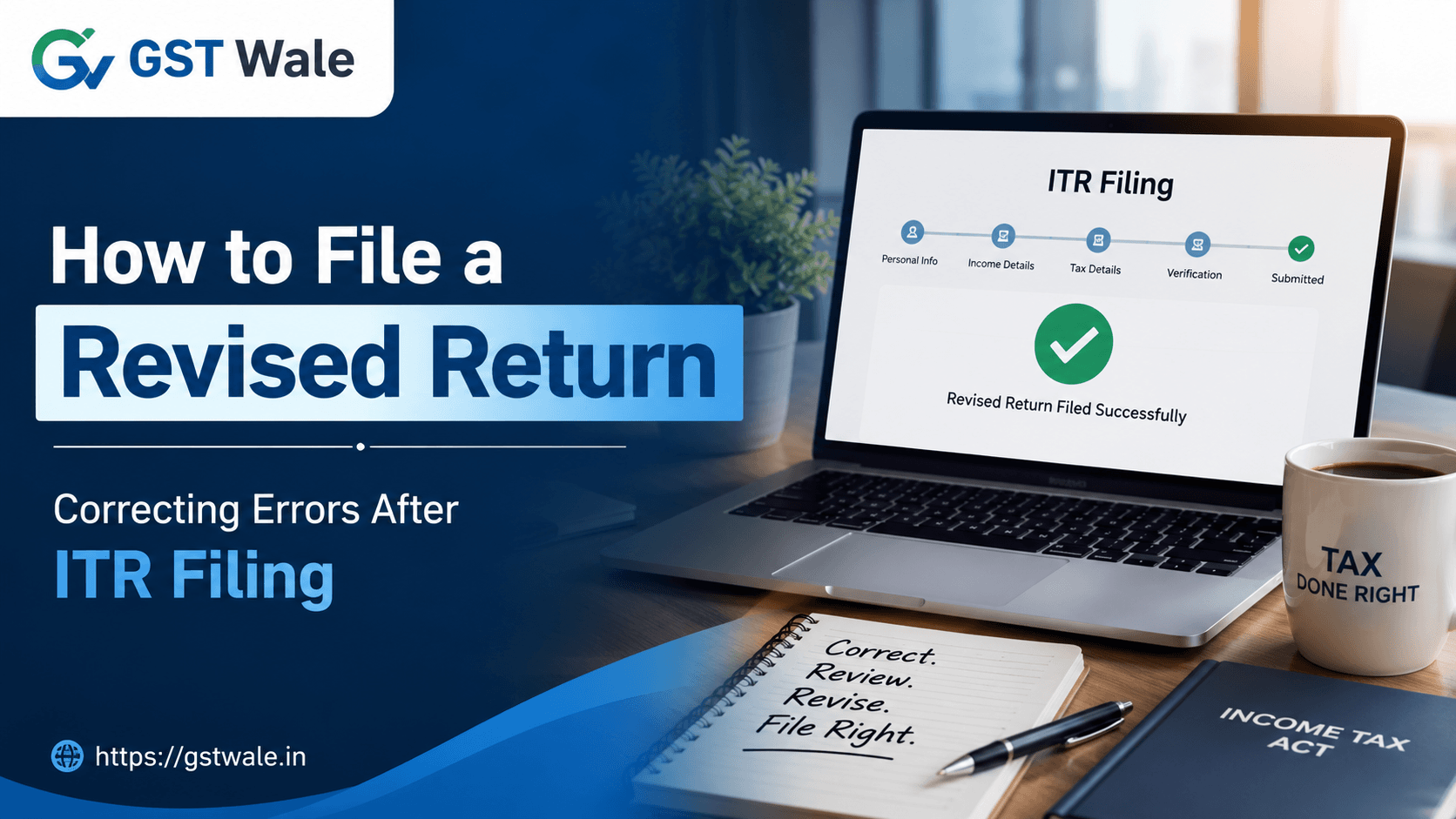
How to File a Revised Return: Correcting Errors After ITR Filing
How to File a Revised Return: Correcting Errors After ITR Filing
Mistakes happen—even during something as important as ITR Filing. Whether you missed reporting an income source, claimed an incorrect deduction, or entered wrong bank details, errors in your income tax return are more common than you think. The good news? The Income Tax Department allows you to correct these mistakes through a revised return.
At GST Wale, we regularly assist clients who discover omissions or inaccuracies after completing their ITR Filing. If you’ve already submitted your return and are now worried about errors, don’t panic. The law provides a clear and structured way to fix it.
If you’re unsure how to proceed, our expert support for ITR Filing can help you handle revisions smoothly and accurately.
What is a Revised Return in ITR Filing?
A revised return is essentially a second chance to correct your original return. Under Section 139(5) of the Income Tax Act, taxpayers can revise their filed return if they discover any mistakes or omissions.
This means that even after completing your ITR Filing, you are not locked in permanently. You can make corrections legally without penalties, provided you follow the prescribed timeline.
When Should You Revise Your ITR Filing?
Not every minor error requires immediate action, but certain situations definitely call for a revised return:
Common reasons for revising ITR Filing:
- Forgot to report additional income (e.g., freelance or interest income)
- Claimed incorrect deductions under sections like 80C or 80D
- Entered wrong personal details such as PAN or bank account
- Missed capital gains or stock transactions
- Errors in tax computation
For example, a business owner once approached us after realizing he had not included interest income from a fixed deposit. Revising his ITR Filing helped him avoid scrutiny and future penalties.
Time Limit to File a Revised Return
As per current income tax rules, you can revise your ITR Filing:
- Before the end of the relevant assessment year, or
- Before completion of assessment, whichever is earlier
For instance, if you filed your return for FY 2024-25, you can revise it until 31st March 2026, unless the department completes assessment earlier.
Step-by-Step Process to Revise Your ITR Filing
Correcting your return is easier than most people think, especially with electronic filing facilities.
Follow these steps:
Step 1: Log in to the Income Tax Portal
Visit the official income tax e-filing portal and log in using your credentials.
Step 2: Select “File Income Tax Return”
Choose the relevant assessment year and proceed.
Step 3: Choose “Revised Return”
Select the option under Section 139(5) instead of a fresh filing.
Step 4: Enter Original Return Details
You’ll need:
- Acknowledgement number of the original return
- Date of filing
Step 5: Make Corrections
Update the incorrect details carefully. Double-check all entries before proceeding.
Step 6: Submit and Verify
Complete your ITR Filing revision and verify it via:
- Aadhaar OTP
- Net banking
- EVC (Electronic Verification Code)
Important Points to Remember
While revising your ITR Filing, keep these practical tips in mind:
- Latest return replaces previous ones: Only the most recent revised return is considered valid.
- Multiple revisions allowed: You can revise your return multiple times within the allowed period.
- No penalty for genuine mistakes: If errors are unintentional, there’s usually no penalty.
- Consistency is key: Ensure all financial details match Form 26AS and AIS.
Revised Return vs Tax Rectification
Many taxpayers confuse revised returns with tax rectification, but both serve different purposes.
Revised Return:
- Used when you discover omissions or errors
- Filed under Section 139(5)
- Allows complete correction of the return
Tax Rectification:
- Used to correct mistakes made by the tax department
- Filed under Section 154
- Limited to apparent errors only
If the mistake is from your side during ITR Filing, always opt for a revised return.
What Happens If You Don’t Revise Errors?
Ignoring mistakes in your ITR Filing can lead to:
- Notices from the Income Tax Department
- Additional tax liability with interest
- Scrutiny or assessment proceedings
- Delays in refunds
For instance, mismatched income data between your return and AIS can trigger an automated notice. Revising early avoids unnecessary complications.
Real-World Example
Let’s say Priya, a salaried employee, completed her ITR Filing but forgot to include ₹50,000 earned from freelance work. Later, she notices this omission while reviewing her bank statements.
Instead of waiting for a notice, she files a revised return under Section 139(5), includes the missed income, pays the additional tax, and avoids penalties.
This proactive approach is exactly what we recommend at GST Wale.
FAQs on ITR Filing Revision
1. Can I revise my ITR Filing after receiving a refund?
Yes, even if you’ve received a refund, you can still file a revised return within the allowed time.
2. Is there a limit on how many times I can revise my return?
No, you can revise your ITR Filing multiple times before the deadline.
3. Do I need to pay a penalty for revising my return?
Generally, no penalty is charged for genuine corrections, but additional tax and interest may apply.
4. Can I revise a belated return?
Yes, belated returns can also be revised under Section 139(5).
5. What documents are required for revising ITR Filing?
You mainly need details of your original return, updated financial data, and supporting documents for corrections.
Errors in ITR Filing are not the end of the road. With provisions like revised returns under Section 139(5), taxpayers have a fair opportunity to correct mistakes and stay compliant.
The key is to act quickly, review your return thoroughly, and ensure all omissions are addressed properly. Whether it’s a minor correction or a significant update, revising your return is always better than facing notices later.
 Previous