


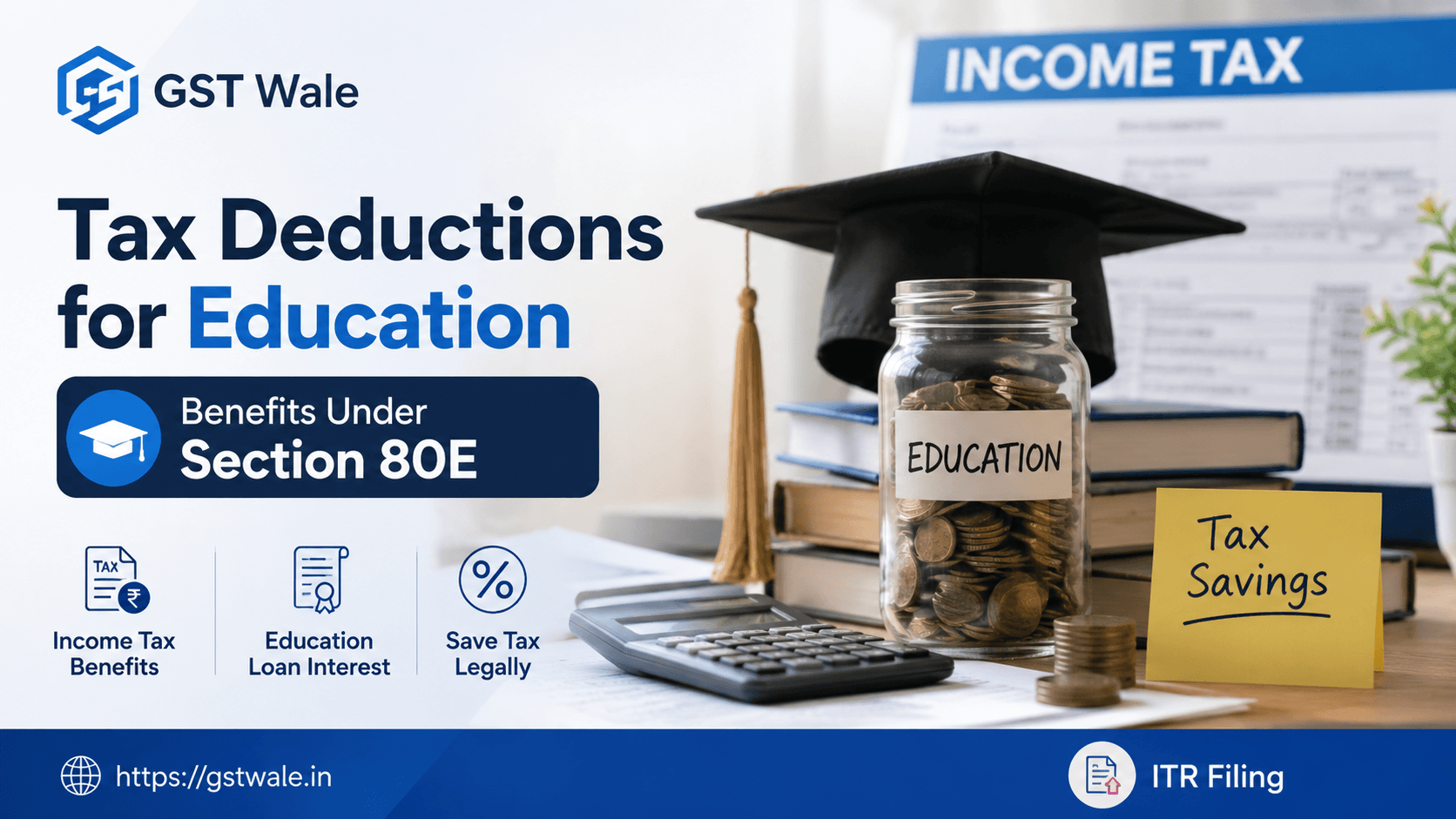
Tax Deductions for Education: Benefits Under Section 80E
Tax Deductions for Education: Benefits Under Section 80E
Pursuing higher education has become expensive, whether it is for studying in India or planning for overseas education. To support students and families, the government provides valuable Income Tax benefits on education loans under Section 80E of the Income Tax Act. This deduction can significantly reduce your tax burden while helping you invest in your future.
At GST Wale, we often guide taxpayers who are unaware that the interest paid on student loans can offer substantial tax breaks. If you are planning to pursue higher studies or are already repaying an education loan, understanding Section 80E can help you save money legally and efficiently. While preparing your ITR Filing, claiming these deductions correctly becomes equally important.
In this article, we will explain everything you need to know about Section 80E, including eligibility, deduction limits, loan conditions, practical examples, and common mistakes to avoid.
Understanding Section 80E in Income Tax
Section 80E of the Income Tax Act allows taxpayers to claim deductions on the interest paid towards education loans. This benefit is specifically designed to encourage individuals to pursue higher studies without worrying excessively about financial burdens.
Unlike some other Income Tax deductions, Section 80E focuses only on the interest component of the education loan repayment and not the principal amount.
Key Highlights of Section 80E
- Deduction available only on education loan interest
- No upper limit on deduction amount
- Available for up to 8 years
- Applicable for higher studies in India and abroad
- Loans can be taken for self, spouse, children, or legal ward
This Income Tax benefit can help salaried employees, professionals, and even self-employed individuals reduce their taxable income substantially.
Who Can Claim Income Tax Deduction Under Section 80E?
Not every taxpayer qualifies automatically. Certain conditions must be fulfilled to claim the deduction.
Eligible Taxpayers
The following individuals can claim the Income Tax deduction:
- Individual taxpayers only
- Parents repaying loans for children’s education
- Spouse repaying the education loan
- Legal guardian repaying student loans
HUFs and companies are not eligible for this deduction.
Eligible Courses for Higher Studies
The deduction applies to loans taken for:
- Graduate courses
- Postgraduate programs
- Professional certifications
- Vocational studies
- Technical education
The course may be pursued in India or overseas education institutions.
What Qualifies as an Education Loan?
For claiming Income Tax deductions under Section 80E, the loan must be taken from:
- A scheduled bank
- Registered financial institution
- Approved charitable institution
Loans borrowed from relatives, friends, or employers do not qualify for tax breaks under Section 80E.
Expenses Covered Under Education Loan
Generally, the loan should be used for:
- Tuition fees
- Examination fees
- Hostel expenses
- Library charges
- Purchase of books and equipment
Banks usually structure education loan interest calculations based on the sanctioned amount and repayment period.
Income Tax Benefits Available Under Section 80E
One of the biggest advantages of Section 80E is that there is no maximum deduction limit on the interest paid.
No Upper Limit on Deduction
Suppose you pay:
- ₹75,000 as annual interest on your education loan
- Entire amount can be claimed as deduction
This directly reduces your taxable income and lowers your Income Tax liability.
Deduction Period
The deduction is available for:
- 8 consecutive assessment years
OR - Until the interest is fully repaid
Whichever is earlier.
This makes Section 80E particularly beneficial for long-term student loans.
Example of Income Tax Savings Under Section 80E
Let us understand with a practical example.
Case Study
Rahul took an education loan for his MBA in Canada. His annual salary in India after returning is ₹12 lakh.
During the financial year:
- Education loan interest paid: ₹1,20,000
- Tax slab: 30%
By claiming deduction under Section 80E:
- Taxable income reduces by ₹1,20,000
- Approximate Income Tax savings: ₹36,000 plus cess
This shows how education loan interest deductions can create meaningful savings for taxpayers pursuing overseas education.
Difference Between Principal and Interest in Education Loans
Many taxpayers mistakenly believe the entire EMI qualifies for Income Tax deduction.
What You Can Claim
Under Section 80E:
- Only interest portion qualifies
- Principal repayment is not deductible
Therefore, always obtain the interest certificate from your lender before filing returns.
Important Documents Required
To avoid issues during Income Tax assessment or verification, maintain proper records.
Essential Documents
- Education loan sanction letter
- Interest certificate from bank
- Fee receipts from educational institution
- Proof of admission
- Repayment statements
These documents help support your claim in case of scrutiny.
Common Mistakes Taxpayers Should Avoid
Many individuals lose legitimate tax breaks due to simple errors.
Claiming Principal Repayment
Only education loan interest qualifies for deduction.
Taking Loan from Relatives
Personal borrowings from family or friends are not eligible under Section 80E.
Incorrect Deduction Period
The deduction cannot continue beyond 8 years even if the loan remains unpaid.
Missing Interest Certificates
Without proper documentation, your Income Tax deduction may be disallowed.
At GST Wale, we recommend reviewing all supporting documents carefully before filing returns.
Can Parents Claim Section 80E Benefits?
Yes, parents can claim Income Tax deductions if:
- The loan is in their name
- They are repaying the loan
This is common when parents finance higher studies for children.
Even loans taken for overseas education programs qualify if all conditions are satisfied.
Benefits of Section 80E for Overseas Education
The rising cost of international education makes this deduction extremely valuable.
Advantages for Students Studying Abroad
- Reduces repayment burden
- Helps manage higher interest costs
- Encourages global education opportunities
- Provides long-term Income Tax savings
Whether pursuing MBA programs in the USA, engineering in Germany, or medical education abroad, Section 80E can ease financial stress significantly.
Section 80E vs Section 80C
Taxpayers often confuse these two sections.
Major Difference
| Feature | Section 80E | Section 80C |
|---|---|---|
| Applicable On | Education loan interest | Investments & principal payments |
| Maximum Limit | No limit | ₹1.5 lakh |
| Deduction Period | 8 years | Financial year basis |
| Eligible Loan | Education loans | Home loan principal, LIC, PPF etc. |
Understanding these distinctions helps taxpayers maximize overall Income Tax savings effectively.
How to Claim Income Tax Deduction Under Section 80E
The process is simple if your documents are ready.
Step-by-Step Process
Step 1: Collect Interest Certificate
Get annual interest statement from your bank.
Step 2: Verify Eligible Amount
Check only the interest component.
Step 3: Report During Return Filing
Mention the deduction under Section 80E while filing your Income Tax return.
Step 4: Retain Documents
Keep all records safely for future reference.
Professional guidance can help avoid filing mistakes and ensure proper compliance.
FAQs on Income Tax Deduction Under Section 80E
Is there any maximum limit for deduction under Section 80E?
No, there is no upper limit on the education loan interest deduction under Income Tax provisions.
Can I claim deduction for overseas education loans?
Yes, loans taken for overseas education are eligible if they meet prescribed conditions.
Can both parents and students claim deduction together?
No, only the person repaying the loan can claim the deduction.
Is principal repayment covered under Section 80E?
No, only the interest component qualifies for deduction.
Can I claim deduction after 8 years?
No, the Income Tax deduction is restricted to 8 assessment years or until interest repayment is completed, whichever is earlier.
Education is one of the best long-term investments, and the government supports this through valuable Income Tax deductions under Section 80E. Whether you are funding higher studies in India or planning overseas education, claiming deductions on education loan interest can reduce your financial burden considerably.
However, proper documentation, accurate calculation, and correct return filing are essential to enjoy these tax breaks without complications. Many taxpayers either miss the deduction or claim it incorrectly due to lack of awareness.
At GST Wale, we help individuals and families manage Income Tax compliance smoothly while maximizing eligible deductions. If you need expert assistance with tax planning, education loan deductions, or return filing, connect with GST Wale today and make your tax journey stress-free.
 Previous