


How to Claim Deductions for Donations Under Section 80G via E Filing of Income Tax
How to Claim Deductions for Donations Under Section 80G via E Filing of Income Tax
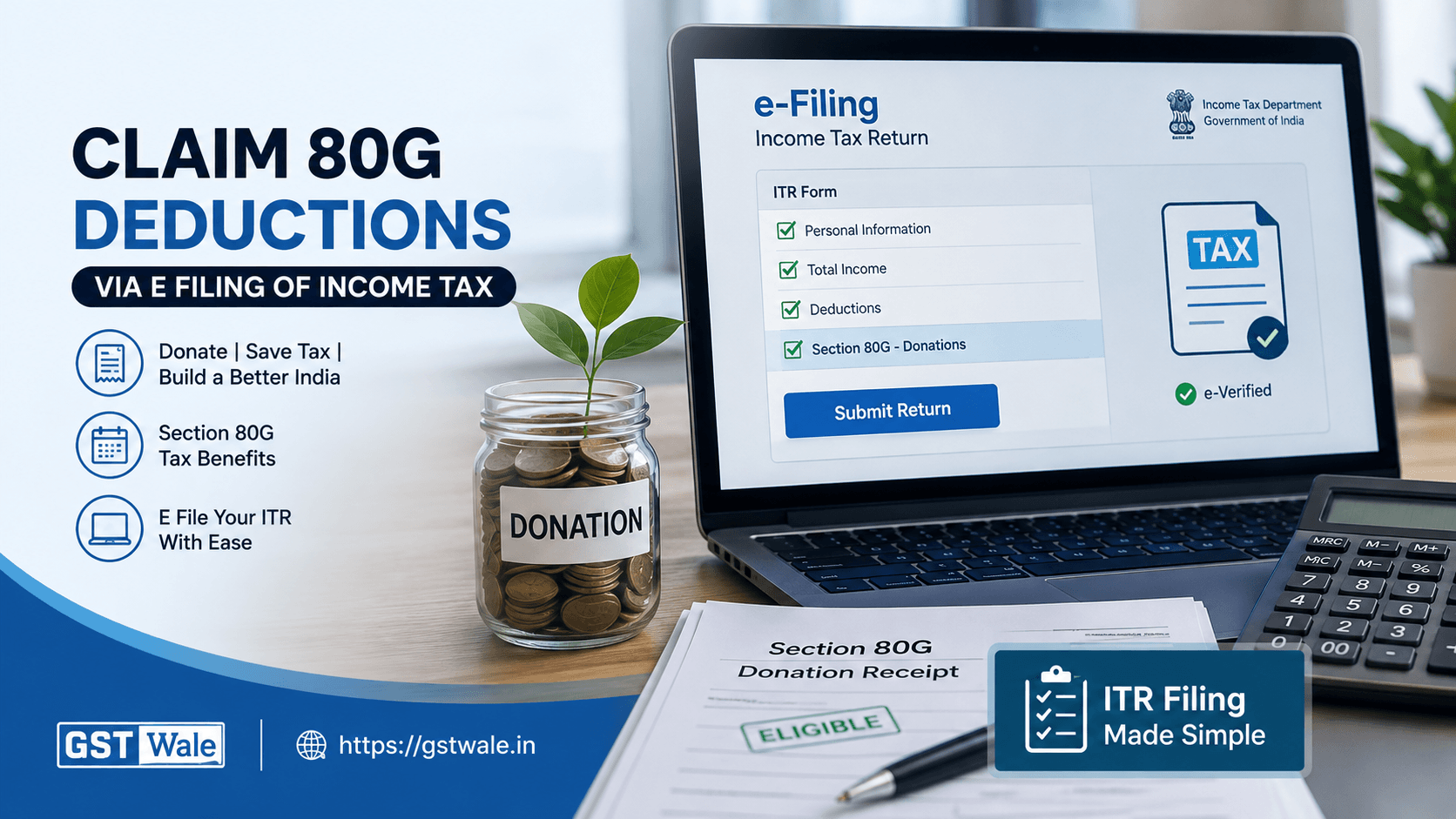
Donating to a genuine charitable organisation is not only a meaningful way to support society; it can also provide a tax benefit under Section 80G of the Income Tax Act. However, simply making a donation does not automatically mean that you can claim a deduction. You need to donate to eligible charities, follow the prescribed payment conditions and report the donation correctly while filing your return.
For taxpayers, proper e filing of income tax is particularly important because the donation details reported by the charitable institution may be checked against the information furnished in your return. If you are preparing your annual return and need professional assistance, you can also consider ITR Filing through GST Wale.
As a practical matter, keep your donation receipt, the PAN of trust or institution and Form 10BE safely before starting the return. These documents can help you avoid unnecessary questions or mismatches later.
What Is Section 80G and How Does It Work?
Section 80G allows eligible taxpayers to claim a deduction for certain donations made to approved funds, charitable institutions and other specified entities. The deduction is not necessarily equal to the amount donated. Depending on the category of the donee, the law may provide a 100 percent deduction or a 50 percent deduction, and some categories are also subject to a qualifying limit.
This distinction is important. For example, if a donation qualifies for a 50 percent deduction and you donate ₹20,000, the eligible deduction may be ₹10,000, subject to the applicable rules and limits.
Therefore, before entering donation details during e filing of income tax, first establish which category your donation falls into.
100 Percent Deduction and 50 Percent Deduction
Section 80G broadly covers four combinations:
- 100% deduction without a qualifying limit
- 50% deduction without a qualifying limit
- 100% deduction subject to a qualifying limit
- 50% deduction subject to a qualifying limit
For donations subject to a qualifying limit, the applicable ceiling is generally linked to 10% of Adjusted Gross Total Income. The exact treatment depends on the nature of the approved donee and the applicable provisions.
The important point is that you should not simply enter the entire donation amount as your deduction. The e filing of income tax utility calculates or validates the eligible amount based on the information you provide.
Cash Donation Limit Under Section 80G
One of the most common mistakes taxpayers make is paying a large donation in cash and then expecting the entire amount to qualify for deduction.
The cash donation limit under Section 80G is ₹2,000. No deduction is allowed for a cash donation exceeding ₹2,000. Donations above this threshold should therefore be made through an eligible non-cash mode such as banking or electronic payment, subject to the applicable rules.
For example, suppose you donate ₹5,000 to an eligible institution in cash. You should not assume that ₹5,000 will qualify for deduction. The statutory restriction on cash donations exceeding ₹2,000 applies.
Our practical advice at GST Wale is simple: whenever possible, make charitable contributions through traceable banking or digital channels and retain the transaction reference.
Documents Required for E Filing of Income Tax
Before starting e filing of income tax, collect the relevant documents. A proper document trail makes the process much easier.
You should generally keep:
- Donation receipt issued by the eligible institution
- Form 10BE, wherever applicable
- Name and address of the donee
- PAN of trust or institution
- Section 80G registration or approval details
- Donation amount and date
- Bank statement or payment reference for non-cash donations
The Income Tax Department states that information such as the donee's name, PAN, address, registration details and amount donated is relevant for claiming the Section 80G deduction.
A donation receipt is useful evidence, but taxpayers should also pay attention to Form 10BE and the information reported by the donee.
Why Form 10BE Is Important
Many taxpayers still rely only on a physical receipt received from the NGO. Under the current reporting mechanism, approved institutions are required to report donations in Form 10BD and issue a donation certificate in Form 10BE to eligible donors. Form 10BE contains important details including the institution's PAN, name, approval information and donation particulars.
The institution generally has to furnish Form 10BD by 31 May following the financial year in which the donation was received and issue Form 10BE by the same date.
This is especially relevant when completing e filing of income tax because a mismatch between your claim and the information reported by the donee can create complications.
Check the PAN of Trust Before Claiming
The PAN of trust or charitable institution should be checked carefully. A simple digit error can result in an incorrect entry in your return.
Compare the PAN appearing on your donation documents with the information in Form 10BE. If the details differ, contact the institution before submitting your return instead of guessing the correct information.
Also confirm that the organisation was eligible for Section 80G benefits for the relevant period. The Income Tax Department specifically advises donors to verify the eligibility of the donee because donations made after cancellation or expiry of the relevant approval may not qualify.
Step-by-Step Process for E Filing of Income Tax With Section 80G Donation
Step 1: Confirm That the Donation Is Eligible
First, check whether the organisation or fund is approved under Section 80G. Not every NGO, temple, society or charitable organisation automatically qualifies.
Step 2: Check the Payment Method
Review whether the donation was made through cash, cheque, bank transfer, UPI or another permitted mode. Remember the cash donation limit of ₹2,000.
Step 3: Collect the Donation Documents
Keep the donation receipt, Form 10BE, payment proof and PAN details together. This is particularly useful if you have made donations to several institutions during the year.
Step 4: Select the Correct ITR and Regime
While carrying out e filing of income tax, select the applicable ITR and tax regime carefully. This point is important because Section 80G deductions are not available when the new tax regime is selected for AY 2026-27. The CBDT's validation rules state that Schedule 80G should be blank where the new tax regime is selected.
Therefore, do not assume that having a valid donation receipt automatically means you can claim the deduction under every tax regime.
Step 5: Enter Donation Details in Schedule 80G
In the applicable ITR, enter the donation information in Schedule 80G. The current ITR structure captures details such as PAN of the donee, amount of donation, payment mode and transaction reference information.
Categorise the donation correctly as 100% or 50%, and as subject to or not subject to the qualifying limit.
Step 6: Verify the Eligible Deduction
Do not confuse the amount donated with the amount deductible. For example, a ₹30,000 donation eligible for a 50 percent deduction may result in a ₹15,000 deduction, subject to the relevant conditions.
Step 7: Submit and E-Verify the Return
After completing all applicable schedules, review your return carefully and submit it. Complete the required e-verification so that the filing process is properly completed.
Practical Example
Suppose Rahul earns taxable income and donates ₹20,000 to an institution that qualifies for a 50% deduction without a qualifying limit. He makes the payment electronically and receives the required documentation.
During e filing of income tax, Rahul should not enter ₹20,000 as his final deduction merely because that is what he paid. If the donation qualifies for 50%, his eligible deduction would be ₹10,000, subject to the applicable provisions.
Now consider another taxpayer who makes a ₹3,000 cash donation. Even if the organisation is approved under Section 80G, the cash donation restriction means the amount cannot simply be claimed as an eligible Section 80G deduction.
These examples show why classification and payment method matter as much as the donation itself.
Common Mistakes to Avoid
Claiming Donations to Non-Eligible Organisations
A donation to an organisation simply described as "charitable" does not necessarily qualify. Verify the Section 80G status.
Ignoring the Cash Donation Limit
Do not assume that every cash donation is deductible. The cash donation limit of ₹2,000 is an important statutory restriction.
Entering the Wrong PAN
The PAN of trust must be entered accurately. Cross-check it with Form 10BE.
Claiming 100 Percent Deduction Automatically
A donation does not automatically qualify for a 100 percent deduction. Some donations qualify only for a 50 percent deduction, while others may be subject to the qualifying limit.
Claiming Under the New Tax Regime
For AY 2026-27, Schedule 80G is required to be blank where the new tax regime is selected, according to the CBDT's ITR validation rules.
FAQs on E Filing of Income Tax and Section 80G
Can I claim a Section 80G deduction for every donation?
No. The donation must be made to an eligible fund, institution or organisation covered by Section 80G, and the applicable payment and documentation requirements must be satisfied.
Is a donation receipt enough to claim the deduction?
A donation receipt is important, but you should also check Form 10BE and the details reported by the donee. These records should be consistent with the information entered in your return.
What is the cash donation limit under Section 80G?
The cash donation limit is ₹2,000. A cash donation exceeding ₹2,000 does not qualify for deduction under Section 80G.
Can I claim a 100 percent deduction for every eligible charity?
No. Depending on the category of the donee, the donation may qualify for a 100 percent deduction or a 50 percent deduction, with some categories also subject to a qualifying limit.
Can I claim Section 80G deduction under the new tax regime?
For AY 2026-27, the CBDT's ITR validation rules specify that Schedule 80G should be blank when the new tax regime is selected.
Make E Filing of Income Tax Easier With GST Wale
Section 80G can provide a valuable tax benefit for genuine charitable contributions, but the claim must be made correctly. Checking eligible charities, following the cash donation limit, retaining the donation receipt, verifying the PAN of trust and matching your Form 10BE details with the ITR are all important steps.
Most importantly, do not treat e filing of income tax as simply entering numbers into an online form. The quality of your supporting documents and the accuracy of your reporting matter.
At GST Wale, we help taxpayers and businesses handle their tax compliance with practical, professional guidance. If you want your return reviewed properly before submission, GST Wale can help you complete the e filing of income tax process accurately and with greater confidence.
 Previous