


How Cryptocurrencies and NFTs Impact Your Annual income tax return itr
How Cryptocurrencies and NFTs Impact Your Annual income tax return itr
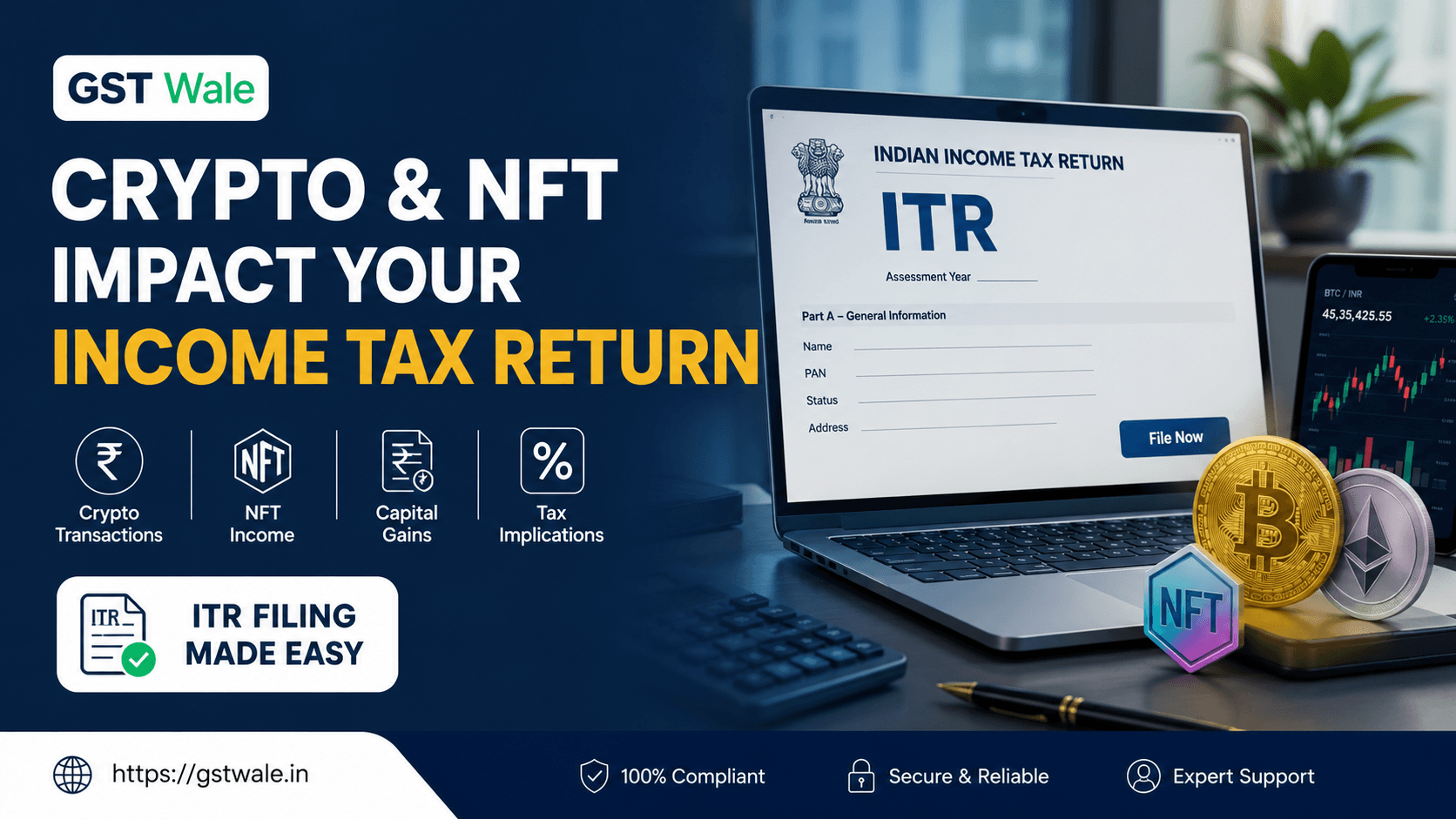
Cryptocurrencies and NFTs are no longer limited to tech enthusiasts or global investors. Today, many Indian traders, freelancers, gamers, and business owners actively deal in Bitcoin, Ethereum, NFTs, and other virtual digital assets. However, while profits from crypto may look exciting, many taxpayers are still confused about how these assets impact their income tax return itr.
At GST Wale, we regularly assist taxpayers who are unsure about crypto taxation rules, disclosure requirements, and how to avoid notices from the Income Tax Department. If you have traded, invested, or earned through digital assets during the financial year, proper reporting in your income tax return itr becomes extremely important. For professional support with ITR Filing, it is always advisable to seek expert guidance before submission.
What Are Virtual Digital Assets Under Income Tax Law?
Under Indian tax laws, cryptocurrencies and NFTs are categorized as Virtual Digital Assets (VDAs). This includes:
- Bitcoin
- Ethereum
- Solana
- NFTs
- Stablecoins
- Crypto tokens
- Digital collectibles
The government introduced specific taxation rules for VDAs under Section 115BBH of the Income Tax Act. These provisions directly impact your income tax return itr and cannot be ignored.
Flat Tax on Crypto Transactions in India
One of the biggest changes introduced by the government is the flat tax on crypto income.
Key Tax Rules You Must Know
- A flat 30% tax applies to gains from crypto and NFTs.
- No basic exemption benefit is available against such gains.
- A 4% cess and applicable surcharge are added separately.
- Losses from crypto cannot generally be adjusted against other income.
This means even if your total taxable income is low, crypto gains reported in your income tax return itr will still attract taxation at 30%.
Example
Suppose you bought Bitcoin worth ₹1,00,000 and sold it for ₹1,50,000.
- Profit = ₹50,000
- Tax = 30% of ₹50,000 = ₹15,000
- Plus cess and surcharge
Even occasional crypto profits need to be disclosed properly while filing your income tax return itr.
Understanding Crypto Capital Gains
Many taxpayers assume crypto taxation works like equity shares or mutual funds. However, crypto capital gains are treated differently.
Taxation of Crypto Gains
The following transactions are taxable:
- Selling cryptocurrency for INR
- Swapping one crypto for another
- Purchasing NFTs using crypto
- Receiving crypto as payment
- Gifting certain digital assets
Even if no money reaches your bank account, tax liability may still arise.
Can You Offset Crypto Losses?
This is where many investors get confused.
As per current tax rules:
- You cannot offset crypto losses against salary, business income, or house property income.
- Loss from one crypto cannot be adjusted against another crypto gain in most cases.
- Unused losses cannot be carried forward.
For example:
- Bitcoin profit = ₹80,000
- Ethereum loss = ₹40,000
You may still end up paying tax on the entire ₹80,000 while filing your income tax return itr.
This rule has surprised many traders who assumed standard capital gain principles would apply.
Importance of Crypto TDS Tracking
Another major compliance requirement is 1% TDS on crypto transactions.
What Is Crypto TDS?
Under Section 194S:
- Buyers may deduct 1% TDS on crypto transactions above prescribed limits.
- Exchanges often deduct this automatically.
- The deducted amount appears in Form 26AS or AIS.
Why Crypto TDS Tracking Matters
Many taxpayers fail to reconcile crypto TDS before filing their income tax return itr. This can create:
- Tax demand notices
- Refund delays
- Mismatch issues
- Compliance scrutiny
At GST Wale, we strongly recommend proper crypto tds tracking throughout the financial year.
Reporting Digital Assets in Your ITR
The Income Tax Department has become more aggressive in tracking crypto transactions. Exchanges now share transaction data with authorities.
This means reporting digital assets correctly is essential.
Information You Should Maintain
Keep proper records of:
- Purchase date
- Sale date
- Wallet transactions
- Exchange statements
- Transaction fees
- TDS deductions
- NFT purchase details
Without documentation, preparing an accurate income tax return itr becomes difficult.
What Is Schedule VDA in ITR?
The government has introduced a dedicated section called Schedule VDA in ITR forms.
Purpose of Schedule VDA
This section captures:
- Type of virtual digital asset
- Purchase value
- Sale consideration
- Profit earned
- Date of transfer
Anyone dealing in crypto or NFTs must carefully complete schedule VDA in ITR while filing returns.
Incorrect reporting can increase the chances of receiving tax notices.
Common Crypto Transactions and Their Tax Treatment
Crypto Trading
Frequent buying and selling attracts 30% tax on profits.
NFT Sales
Profits from selling NFTs are also taxable under VDA provisions.
Mining Income
Crypto mining rewards may be taxable as income from other sources or business income depending on facts.
Staking Rewards
Rewards earned from staking can also become taxable.
Airdrops
Free tokens received through airdrops may create taxable income based on market value.
Every such transaction impacts your income tax return itr differently.
Mistakes Taxpayers Commonly Make
Ignoring Small Transactions
Even small crypto trades are reportable.
Depending Only on Exchange Reports
Many investors use multiple wallets and exchanges. Consolidated reporting becomes necessary.
Forgetting Foreign Exchanges
Transactions on Binance or other overseas platforms also require disclosure.
Incorrect Tax Calculation
People often calculate tax only on withdrawn money instead of actual gains.
Not Reporting NFTs
NFT creators and traders frequently miss reporting requirements.
These errors can create major issues during income tax return itr processing.
How to Prepare Your Income Tax Return ITR Correctly for Crypto Income
Step 1: Collect All Transaction Data
Download statements from:
- Indian exchanges
- Foreign exchanges
- Wallets
- NFT marketplaces
Step 2: Calculate Net Gains
Compute taxable gains transaction-wise as per Indian tax rules.
Step 3: Verify TDS Credits
Cross-check Form 26AS and AIS for TDS deductions.
Step 4: Fill Schedule VDA in ITR
Ensure accurate reporting of all virtual digital asset transactions.
Step 5: File Before Due Date
Late filing may attract:
- Interest
- Penalties
- Loss of certain benefits
A professionally prepared income tax return itr reduces compliance risks significantly.
FAQs on Crypto and Income Tax Return ITR
Is crypto income taxable even if I do not withdraw money to my bank account?
Yes. Tax liability may arise when you sell, swap, or transfer crypto assets, even without bank withdrawal.
Do I need to report crypto losses in my income tax return itr?
Yes. Even though offset crypto losses are restricted, disclosure is still important.
What happens if I do not disclose crypto transactions?
Non-reporting may result in notices, penalties, scrutiny, or reassessment by the Income Tax Department.
Is NFT income also covered under VDA taxation?
Yes. NFTs are treated as virtual digital assets and taxed accordingly.
Can salaried employees also have crypto tax liability?
Absolutely. Salary income and crypto taxation are treated separately in your income tax return itr.
Crypto and NFTs have opened new investment opportunities, but they have also increased tax compliance responsibilities. Whether you are an occasional investor or an active trader, proper disclosure in your income tax return itr is no longer optional.
With increasing government scrutiny, accurate reporting digital assets, proper crypto tds tracking, and correct disclosure under schedule VDA in ITR are extremely important. Many taxpayers unknowingly make errors that later lead to notices and penalties.
At GST Wale, our experienced tax professionals help individuals, traders, freelancers, and business owners manage crypto taxation smoothly and compliantly. If you have cryptocurrency or NFT transactions this year, now is the right time to prepare your income tax return itr correctly and avoid future complications.
 Previous