


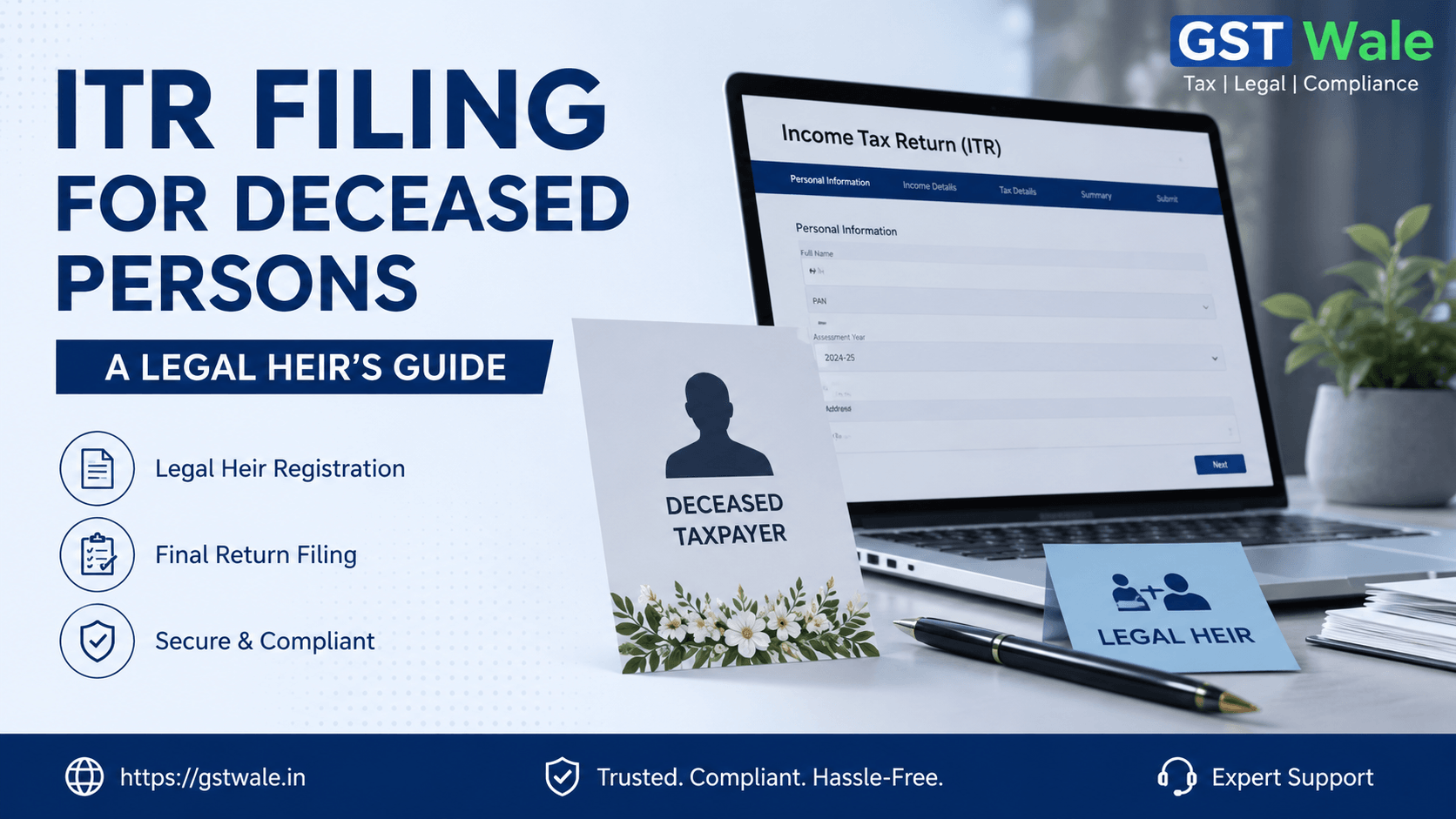
Filing ITR for Deceased Persons: A Legal Heir’s Guide
Filing ITR for Deceased Persons: A Legal Heir’s Guide
When a loved one passes away, handling financial and legal responsibilities can feel overwhelming. One of the most commonly overlooked obligations is ITR Filing for the deceased person. Many families are unaware that income tax compliance does not end immediately after death. In India, the responsibility of filing the income tax return shifts to the legal heir or representative assessee.
At GST Wale, we often help families navigate this sensitive and technical process smoothly. Whether the deceased had salary income, rental income, capital gains, or business income, proper tax compliance is essential to avoid future notices and penalties. If you need professional assistance with ITR Filing, understanding the legal process is the first step.
What Happens to Income Tax Liability After Death?
A taxpayer’s death does not eliminate their tax obligations. Under the Income Tax Act, the legal heir becomes responsible for filing the deceased person’s tax return for the income earned until the date of death.
The legal heir is treated as a “representative assessee” and must ensure that:
- Pending returns are filed
- Taxes are paid
- Notices are responded to
- Refunds are claimed if applicable
For example, if a person passes away on 10th September 2025, the legal heir must file the final return covering income from 1st April 2025 to 10th September 2025.
Who Can File ITR for a Deceased Person?
The following individuals can generally act as the legal heir:
- Spouse of the deceased
- Son or daughter
- Parent
- Sibling
- Any person legally appointed through a will or court order
The Income Tax Department recognizes the legal heir only after successful legal heir registration on the income tax portal.
Importance of Legal Heir Registration in ITR Filing
Before starting ITR Filing for a deceased person, the legal heir must register themselves on the Income Tax e-filing portal.
Without approval of legal heir registration, the portal will not allow access to file the return on behalf of the deceased taxpayer.
Documents Required for Legal Heir Registration
Usually, the following documents are required:
- Death certificate of the deceased
- PAN card of deceased
- PAN card of legal heir
- Aadhaar card of legal heir
- Legal heir certificate or family pension certificate
- Registered will (if available)
Among these, the death certificate is the most critical document for verification.
Step-by-Step Process for ITR Filing of a Deceased Person
Understanding the process can make things much easier during a difficult time.
Step 1: Register as Legal Heir
Visit the Income Tax portal and submit a request for legal heir registration.
The request is verified by the department and may take a few days for approval.
Step 2: Collect Financial Information
Gather all financial records of the deceased, including:
- Form 16
- Bank statements
- AIS/TIS details
- Capital gains statements
- Rental income records
- Business accounts
- Previous ITR copies
Step 3: Compute Income Till Date of Death
Only income earned up to the date of death should be included in the final return.
Any income earned after death is taxable in the hands of the legal heir or estate, depending on the situation.
Step 4: File the Final Return
The legal heir can now proceed with ITR Filing using the credentials linked to the deceased taxpayer after approval.
The return should mention the legal heir’s details while filing.
Step 5: Verify the Return
The return can be verified electronically through the legal heir’s account.
Understanding Estate Taxation After Death
Many people assume that all income stops after death. However, certain assets may continue generating income.
For example:
- Rental property may continue earning rent
- Fixed deposits may earn interest
- Business income may continue temporarily
- Investments may generate dividends
This falls under estate taxation principles.
How Is Post-Death Income Taxed?
The tax treatment depends on whether the estate has been distributed.
Before Distribution of Assets
Income is taxable in the hands of the estate through the executor or representative assessee.
After Distribution of Assets
Income becomes taxable in the hands of the beneficiaries or legal heirs individually.
Proper planning during ITR Filing helps avoid unnecessary tax disputes later.
What If the Deceased Had Pending Tax Notices?
The legal heir may also receive notices related to:
- Scrutiny assessments
- Tax demand
- TDS mismatch
- Non-filing of returns
As a representative assessee, the legal heir is expected to respond appropriately.
However, liability is generally limited to the assets inherited from the deceased.
Common Mistakes During ITR Filing for Deceased Persons
Families often make avoidable errors while filing returns after death.
Filing Income Beyond Date of Death
Only income earned till the date of death should be included in the final return.
Ignoring Legal Heir Registration
Without proper registration, the return may not be accepted by the portal.
Missing Tax Deductions
Eligible deductions under sections like 80C, 80D, and others can still be claimed proportionately.
Not Reporting Capital Gains
If shares, mutual funds, or property were sold before death, capital gains must be disclosed properly.
Delaying Compliance
Delayed ITR Filing may result in penalties, interest, and future complications for heirs.
Real-Life Example of ITR Filing for a Deceased Taxpayer
Suppose Mr. Sharma passed away in November 2025. He had:
- Salary income till October
- Rental income from one property
- Interest income from FDs
His son completed legal heir registration using the death certificate and family pension documents.
After gathering all financial information, he filed the final return for income earned till November. Rental income received after death was later reported separately in the son’s own return after inheritance distribution.
This ensured smooth tax compliance without future notices.
Why Professional Guidance Matters
Handling tax matters during emotional situations can be stressful. Errors in documentation, income reporting, or verification can lead to unnecessary complications.
Professional guidance helps with:
- Accurate income computation
- Smooth legal heir registration
- Handling tax notices
- Proper estate taxation treatment
- Timely filing of final return
At GST Wale, we assist families across India with hassle-free compliance and expert tax support during such situations.
FAQs on ITR Filing for Deceased Persons
Is ITR Filing mandatory after a person’s death?
Yes, if the deceased had taxable income before death, the legal heir must file the return.
Who is considered a representative assessee?
A legal heir or executor managing the deceased person’s tax matters is treated as a representative assessee.
Can a legal heir claim a tax refund?
Yes, any eligible refund can be claimed through proper ITR Filing after legal heir registration approval.
Which document is compulsory for legal heir registration?
The death certificate is mandatory for verification on the income tax portal.
Is the legal heir personally liable for unpaid taxes?
Liability is generally limited to the assets inherited from the deceased person.
ITR Filing for deceased persons is an important legal responsibility that should not be ignored. While the process may seem technical, timely action can prevent future legal and tax complications for the family.
From legal heir registration to filing the final return and understanding estate taxation, every step requires careful attention and proper documentation. Keeping records organized and seeking professional guidance can make the entire process much smoother.
 Previous