


Everything You Need to Know About the New vs Old Tax Regime in Your ITR Form
Everything You Need to Know About the New vs Old Tax Regime in Your ITR Form
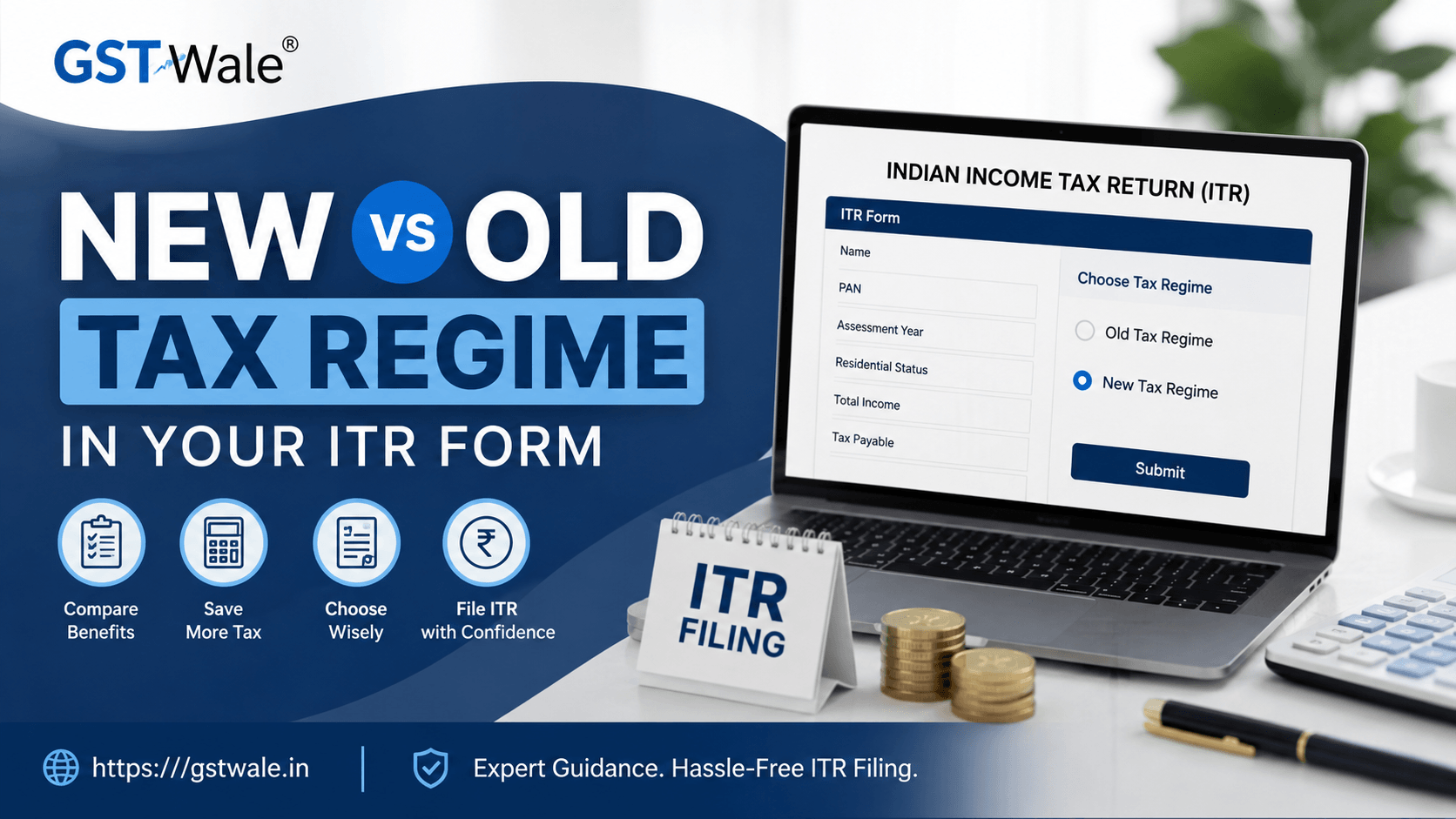
Filing taxes in India used to be a fairly predictable annual ritual, but the introduction of parallel tax systems has changed the game completely. As you sit down to prepare your financial disclosures this year, the most critical decision on your radar revolves around selecting the correct tax path directly inside your itr form. Making a wrong move or missing a subtle check-box can lead to a surprisingly heavy tax bill or a rejected deduction claim. Today, the team at GST Wale is breaking down exactly how the new and old tax regimes interact with your itr form so you can approach your filings with absolute clarity and peace of mind.
Choosing the right structure is no longer just about calculating numbers on a notepad; it requires strategic alignment with the latest digital utilities provided by the Income Tax Department. Navigating the rules of the income tax return form requires a clear understanding of your income streams, especially since the modern e-filing ecosystem is completely automated. If you want to seamlessly submit your taxes, claim the right exemptions, and avoid unexpected compliance notices, scheduling your annual ITR Filing with seasoned professionals ensures your data aligns perfectly with the department’s expectations. Let’s dive deep into the essential rules, slab updates, and critical deadlines you must track to file income tax return online without a single hitch.
The Default Shift in the ITR Form
The absolute first thing you must realize when you open your itr form is that the ground rules have fundamentally shifted. The New Tax Regime is now the default tax regime across all forms (from ITR-1 to ITR-4).
What does a "default" system mean for a regular taxpayer?
The Automated Assumptions: If you log in to do your itr online and rapidly click through the pre-filled fields without actively modifying the regime selection checklist, the system will automatically compute your tax liability using the new regime’s lower slabs.
The Deduction Cleanout: Under this default state, the system will automatically remove common tax-saving mechanisms like Section 80C, Section 80D, and House Rent Allowance (HRA) from your calculation schedules.
The Salaried Switch: If you are a salaried individual without business income, you retain the luxury of changing your mind every single year. You can choose the old regime directly inside the personal information schedule of the itr form.
The Business Restriction: For freelancers, consultants, and business owners filing ITR-3 or ITR-4, the rules are far stricter. You cannot simply toggle between regimes inside the basic form; you have to file a separate declaration called Form 10-IEA before your final submission. Furthermore, you are only allowed to switch back to the old regime once in your lifetime if you carry business income.
Comparing the Tax Slabs: Old vs. New Regime
To make an informed decision when filling out your income tax return form, you need to know exactly how your income is sliced and taxed under both systems.
The following table provides a clear comparative overview of the tax slabs under both systems for individual taxpayers:
| Taxable Income Range | Old Tax Regime Rates | New Tax Regime Rates |
|---|---|---|
| Up to ₹2,50,000 | Nil | Nil |
| ₹2,50,001 to ₹4,00,000 | 5% | Nil |
| ₹4,00,001 to ₹5,00,000 | 5% | 5% |
| ₹5,00,001 to ₹8,00,000 | 20% | 5% |
| ₹8,00,001 to ₹10,00,000 | 20% | 10% |
| ₹10,00,001 to ₹12,00,000 | 30% | 10% |
| ₹12,00,001 to ₹16,00,000 | 30% | 15% |
| ₹16,00,001 to ₹20,00,000 | 30% | 20% |
| ₹20,00,001 to ₹24,00,000 | 30% | 25% |
| Above ₹24,00,000 | 30% | 30% |
Expert Insight from GST Wale: Thanks to the enhanced Section 87A rebate rules built into the new regime, resident individuals with a total taxable income up to ₹12 lakh effectively pay zero tax. For salaried employees, adding the standard deduction of ₹75,000 means an income up to ₹12.75 lakh escapes tax completely under the new system.
Step-by-Step Guide to Declaring Your Regime in the ITR Form
When you decide to file it returns online, the portal requires a methodical approach to ensure your regime choice matches your compiled data. Follow these operational steps:
Step 1: Navigate to Personal Information
Log into the income tax e-filing portal and open your respective itr form. Head straight into the 'Part A - General Information' or 'Personal Information' schedule.
Step 2: Locate the Regime Selection Question
Look for the specific question asking whether you wish to opt out of the default New Tax Regime.
Select No if you choose to remain in the simplified, lower-rate New Tax Regime.
Select Yes if your targeted investments and deductions make the Old Tax Regime more financially sound.
Step 3: Handle Form 10-IEA (For Business Income Only)
If you have business or professional earnings (filing ITR-3 or ITR-4) and selected 'Yes' to opt for the old regime, you must pause your itr form progress. Navigate to the 'Income Tax Forms' tab on the portal dashboard, fill out Form 10-IEA detailing your choice, submit it via EVC or Digital Signature, and copy the acknowledgment number back into your main tax return form.
Step 4: Verify Pre-Filled Data against AIS
Before confirming your schedules, check the pre-filled data pulled into your form against your Annual Information Statement (AIS). Ensure that any taxes deducted at source (TDS) match the regime logic you are executing.
Crucial Deadlines and the Belated Return Penalty
Timing is everything when navigating the regime switch. If you plan to file income tax return online under the Old Tax Regime, you must complete your submission before the official statutory due date—which is typically July 31st for individual non-audit cases.
If you miss this timeline and end up filing a belated return, the system enforces a strict penalty: you lose the right to choose the Old Tax Regime entirely. The portal will lock your belated return directly into the New Tax Regime default settings, which means all your actual investments in PPF, insurance, and home loans will be instantly disqualified. Therefore, starting your it filing process early is vital to retaining complete control over your tax strategy.
Frequently Asked Questions (FAQs)
Can I switch my tax regime choice if my employer already deducted TDS based on the new regime?
Yes. The choice you communicate to your corporate employer at the start of the year is only for monthly TDS purposes. When you log in to fill out your actual itr form, you have full authority to select whichever regime is most optimal for you, provided you complete the return before the standard July 31st deadline.
I am a freelancer filing ITR-3. Can I change my tax regime every year?
No. Taxpayers with business or professional income are only allowed one lifetime switch out of the default New Tax Regime and one subsequent entry back into it. Once you make a U-turn back to the default setup, you lose the option to return to the old structure in future years.
Which ITR form should I use if I want to report income from two houses under the old regime?
The portal features an upgraded framework where ITR-1 (Sahaj) can now accommodate individuals reporting income or interest schedules for up to two distinct house properties. If you own more than two properties or have capital gains, you must step up to ITR-2.
Is the standard deduction available if I stick to the Old Tax Regime?
Yes. The standard deduction of ₹50,000 remains applicable under the Old Tax Regime for salaried individuals and pensioners, while the New Tax Regime offers a standard deduction of ₹75,000.
Streamline Your ITR Filing with GST Wale
Choosing between the new and old regimes within an intricate itr form requires a perfect blend of calculation and legal foresight. A single clerical error or a delayed filing can cost you thousands in lost deductions or unexpected compliance penalties.
At GST Wale, our certified tax experts take the guesswork out of the entire process. We analyze your financial profile, run cross-regime simulations, file the necessary declarations like Form 10-IEA, and accurately submit your income tax return form well ahead of time. Avoid the tax-season stress and let the professionals guide your financial path. Reach out to GST Wale today to secure a smooth, optimized, and compliant return filing experience!
 Previous