


Why Salaried Individuals with Multiple Form 16s Must File ITR 2.0
Why Salaried Individuals with Multiple Form 16s Must File ITR 2.0
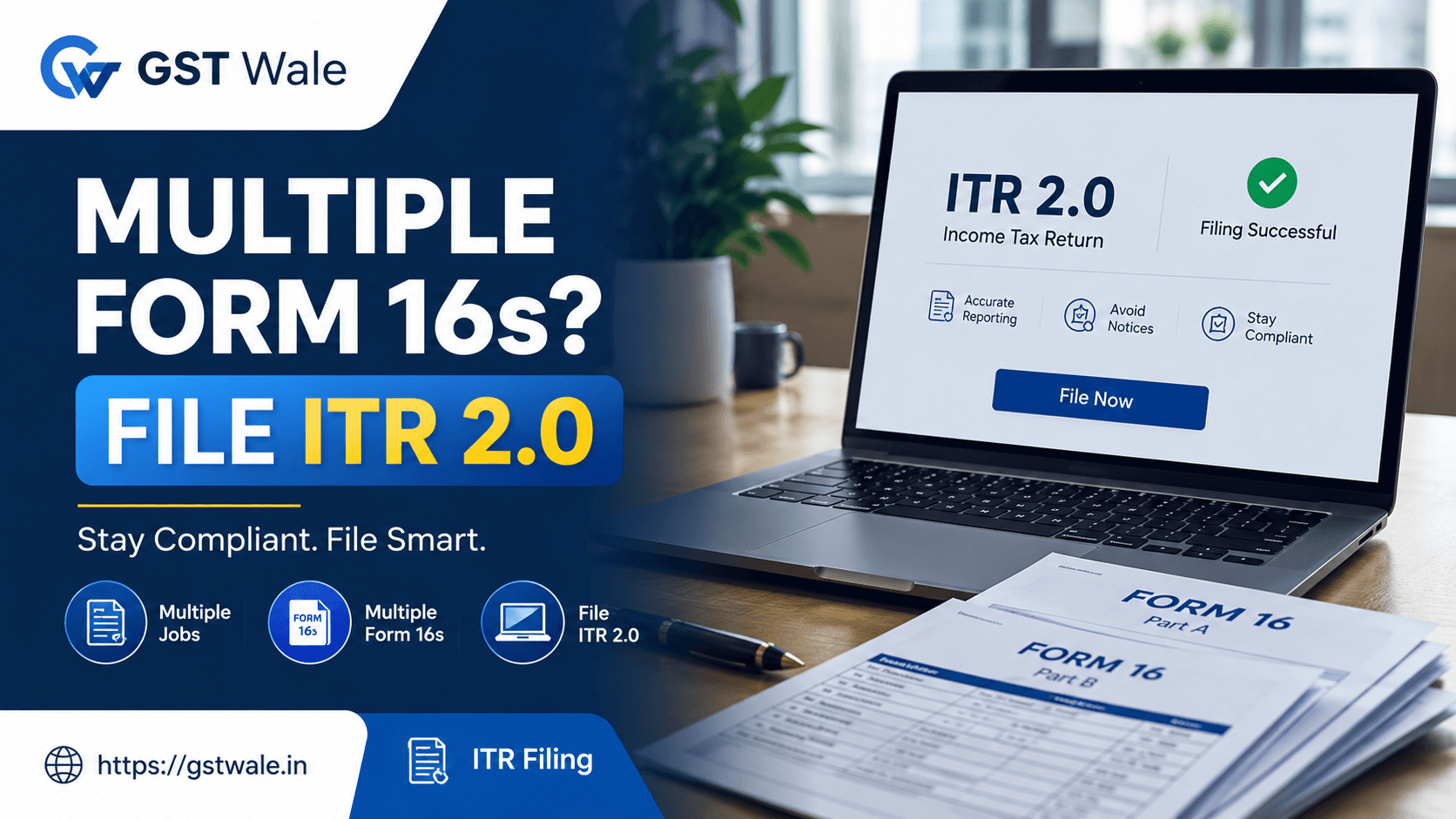
Every year around June and July, my cabin at GST Wale gets flooded with salaried professionals holding a common dilemma. The story usually goes like this: "Sir, I changed my job in October last year. My previous employer gave me a Form 16, and my current employer gave me another one. Can I just file the simple ITR 1 form online"
My answer is always a firm no. If you have changed jobs during the financial year and hold multiple Form 16 documents, navigating your ITR Filing requires extra care. While a single-salary individual easily sails through with ITR 1, having two or more employers changes the game. To report this accurately, avoid underpaying tax, and stay clear of the Income Tax Department's radar, you must use the correct income tax return form. In this comprehensive guide, we will break down exactly why you must pick ITR 2.0 this tax season and how to handle the transition smoothly.
The Hidden Trap of Multiple Form 16s
When you switch jobs mid-year, both your old and new employers calculate your Tax Deducted at Source (TDS) independently. This independent calculation creates a massive structural loophole that catches thousands of salaried individuals off guard every single year.
Why Your Current Employer Discounts Your Past Income
When you join a new company, you are supposed to declare your previous income via Form 12BB. However, many employees either forget to submit this or join at a time when the payroll cycle is already locked.
As a result, your new employer assumes you have zero income for the earlier months of the financial year. They calculate your taxes from scratch, applying the basic exemption limit (like the standard ₹3,00,000 or ₹7,00,000 exemptions depending on the tax regime) all over again.
The Double Standard Deduction Benefit
Both employers will also give you the standard deduction benefit of ₹50,000 on their respective systems. When you look at both Form 16s individually, they look perfectly legal. But when you aggregate them, you have accidentally claimed double exemptions and double standard deductions. The government only allows these benefits once per individual, not per job! When the tax department's computer matches these details, a demand notice is automatically triggered.
Why Choosing ITR 2.0 is Non-Negotiable
You might wonder why we stress using ITR 2.0 instead of the simpler ITR 1. Let's look at how the structural limitations of the wrong ITR form can land you in hot water.
1. Detailed Breakdown of Multiple Salaries
The standard ITR 1 form is highly simplified. It expects a single, clean input for salary components. When you try to compress two different employers' calculations—with different House Rent Allowances (HRA), Leave Travel Allowances (LTA), and provident fund contributions—into a single line item, the math breaks down. ITR 2.0 provides dedicated schedules where you can cleanly separate Income from Employer A and Employer B, ensuring every allowance is mapped to the right source.
2. Unreported Capital Gains or Investments
Often, switching jobs comes with other financial events. Did you liquidate a company stock option (ESOPs)? Did you withdraw your old EPF before completing five years of continuous service? Or maybe you sold some mutual funds to manage the transition period? If any of these apply, ITR 1 completely bars you from filing. The comprehensive ITR 2.0 structure seamlessly accommodates capital gains alongside your multi-salary calculations.
3. Rectifying the Double Tax Benefit
When you file using ITR 2.0, the online portal allows you to aggregate your total gross salary accurately. The system automatically applies the standard deduction exactly once and recalibrates your actual tax slab. If there is a shortfall in tax because both employers taxed you at lower slabs, this form calculates the exact self-assessment tax you need to pay before hitting the submit button.
Step-by-Step Guide to Consolidate Data for ITR 2.0
Filing your tax return with multiple salary inputs sounds intimidating, but breaking it down into an orderly process makes it highly manageable. Here is the exact workflow we use at GST Wale to file for our multi-Form 16 clients:
Step 1: Gather Your Complete Document Stack
Do not start your IT filing by looking only at your Form 16s. You need the complete picture. Gather:
Form 16 from Employer A (Previous)
Form 16 from Employer B (Current)
Your Annual Information Statement (AIS) and Taxpayer Information Summary (TIS)
Form 26AS (to verify actual TDS deposited by both companies)
Step 2: Recalculate Total Gross Salary
Add up the gross salary figures from Section 17(1), 17(2), and 17(3) of both forms. This gives you your true annual gross salary.
Step 3: Clean Up Exempt Allowances
Check if both employers gave you HRA exemptions. If you stayed in the same rented house, calculate your HRA exemption based on your total rent paid against your total salary factors. Enter the corrected, single HRA exemption value into the salary schedule of the ITR 2.0 portal.
Step 4: Pay Residual Tax Fees
Once the data is plugged into the ITR 2.0 system, you will likely see an amount under "Tax Payable." This is because your combined income pushed you into a higher tax bracket than what individual employers calculated. Pay this amount via net banking/UPI as Self-Assessment Tax, note down the BSR code and Challan number, and enter it into the tax payments schedule.
Common Mistakes to Avoid During Your IT Filing
When dealing with a complex ITR form, even minor errors can lead to system rejections or defective return notices. Keep an eye out for these frequent slip-ups:
Filing ITR 1 out of laziness: Trying to force-fit multi-employer data into a single employer template because it looks easier. The income tax backend will detect the variance between your uploaded data and the individual TDS entries filed by your employers.
Ignoring the AIS/TIS data: The government tracks every single penny. If your old employer deposited a final settlement amount that isn't on your Form 16 yet but shows up in your AIS, it must be reported in your ITR 2.0 filing.
Forgetting to declare previous income to the new employer: If you change jobs mid-year in the future, always submit Form 12BB to your new HR immediately to avoid massive tax shocks at the end of the year.
Frequently Asked Questions
Can I file ITR 1 if I have two Form 16s but my total income is below ₹7 Lakhs?
Even if your total combined income is low, if you hold multiple Form 16s representing different periods of employment during the same financial year, using ITR 2.0 is highly recommended. It allows you to break down the schedules properly so the tax department can clearly see that you are not claiming duplicate deductions.
What happens if I accidentally filed my return using the wrong ITR form?
If you have already submitted your return using ITR 1 and omitted your previous employer's income or mixed up the details, you can file a Revised Return under Section 139(5). Select ITR 2.0 as your revised income tax return form and correct the data before the deadline ends.
Why does the online portal show I owe tax when both my employers deducted TDS?
This happens due to the tax slab progression. For example, if both employers calculated your tax assuming you fall into the 5% slab, but their combined income pushes your true total into the 20% or 30% slab, a differential tax gap arises. ITR 2.0 helps you calculate and resolve this differential amount correctly.
Switching jobs is a great career move, but it brings added responsibilities when it comes to complying with the Income Tax Department. Attempting to hide a previous employer's income or misreporting data on a simpler form to avoid hassle will only lead to tax notices, penalties, and unnecessary stress down the road.
Choosing ITR 2.0 ensures complete transparency, accurate calculation of allowances, and absolute peace of mind. You don't have to figure out these complex schedules alone. At GST Wale, our team of seasoned tax professionals handles the heavy lifting for you—from consolidating multiple Form 16s to optimizing your deductions seamlessly. Let us take care of your online tax filing correctly this year. Reach out to GST Wale today, and let’s get your tax return processed perfectly!
 Previous