


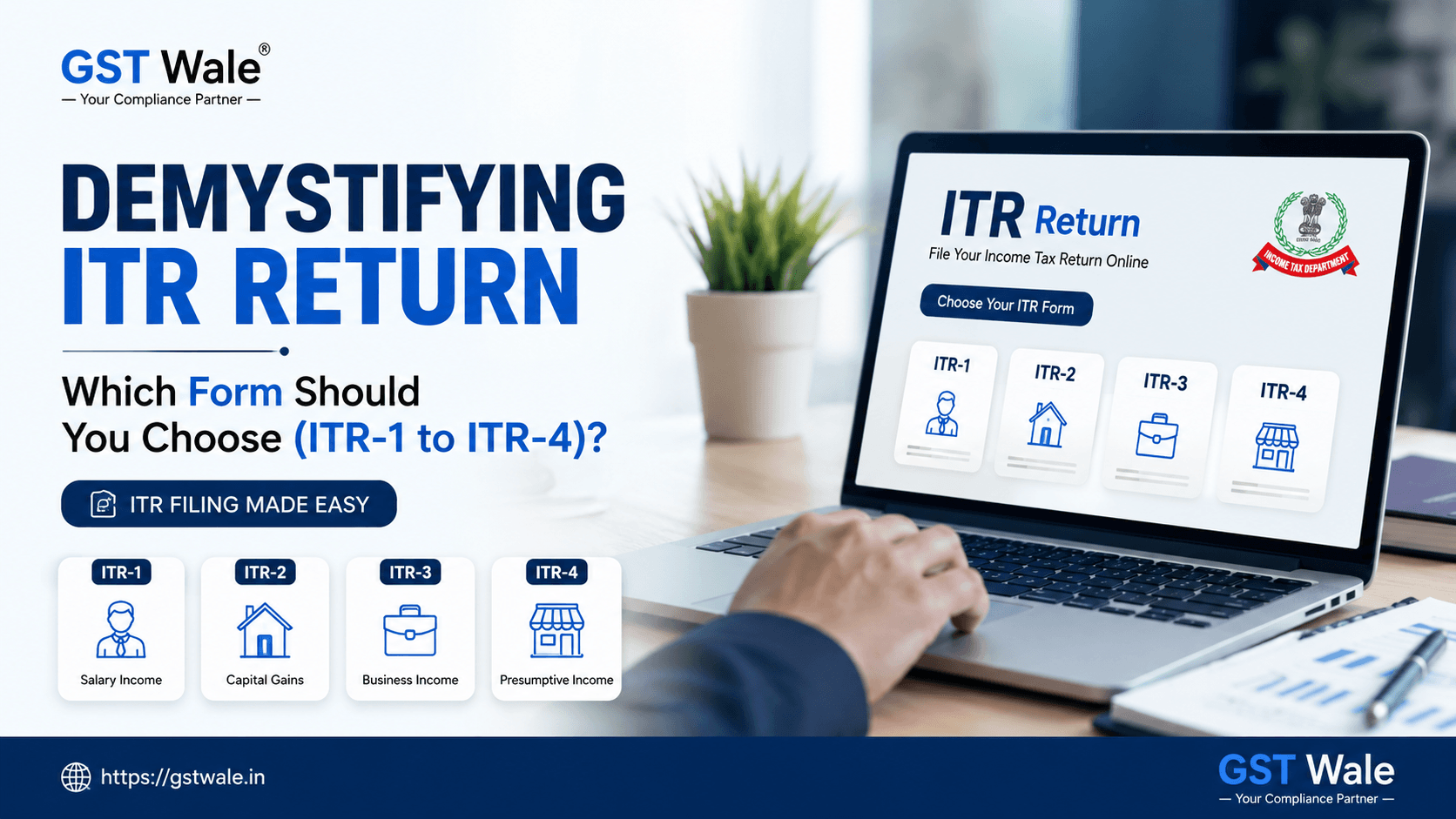
Demystifying ITR Return: Which Form Should You Choose (ITR-1 to ITR-4)?
Demystifying ITR Return: Which Form Should You Choose (ITR-1 to ITR-4)?
It is that time of the year again when your inbox fills up with investment proof reminders, Form 16 alerts, and messages from your HR department. Yes, income tax season is here. For many salaried professionals and small business owners, filing an ITR return feels like decrypting a complex code. The process often triggers anxiety, not because people want to evade taxes, but because they are terrified of making a mistake and receiving a notice from the Income Tax Department.
At GST Wale, we believe that managing your taxes should be straightforward, not stressful. The absolute first step to a smooth tax filing experience is accurate tax form selection. If you pick the wrong form, your filing can be treated as defective, forcing you to rectify it all over again. To help you steer clear of these compliance headaches, we have created this comprehensive guide to simplify the process. If you want to skip the confusion entirely and ensure a flawless submission, you can easily secure expert assistance through our professional ITR Filing service.
Let us demystify the different types of ITR forms from ITR-1 to ITR-4 so you can confidently choose the right one for your financial profile.
Understanding Income Tax Categories in India
Before diving into the specific forms, it helps to understand why the Income Tax Department has created multiple variants. The government divides taxpayers into distinct income tax categories based on how they earn their livelihood.
An individual earning a fixed monthly salary has vastly different financial disclosures than a freelance software engineer, a retail shop owner, or a corporate director. The forms are designed to scale in complexity based on these income streams. Let us break down each form step-by-step.
ITR-1: The "Sahaj" Form for Salaried Individuals
The word Sahaj translates to simple, and that is exactly what this form is meant to be. It is designed for straightforward financial profiles with limited revenue streams.
ITR 1 Eligibility Criteria
You can use ITR-1 if you meet all of the following conditions:
You are a resident individual (not applicable for Non-Resident Indians or Not Ordinarily Residents).
Your total income for the financial year does not exceed ₹50 Lakhs.
Your income comes from a single house property, salary/pension, or other sources (like bank interest or family pension).
You have agricultural income up to ₹5,000.
Who Cannot File ITR-1?
Even if your income is under ₹50 Lakhs, you cannot use this form if you own multiple houses, have brought-forward business losses, hold unlisted equity shares, or are a director in a company.
ITR-2: For Individuals with Capital Gains and Multiple Properties
If your financial profile has grown beyond a basic salary structure—perhaps you started investing in the stock market or bought a second home—you graduate to ITR-2.
Who is ITR-2 Meant For?
This form is applicable for individuals and Hindu Undivided Families (HUFs) who do not have any income from a business or profession but have:
Income exceeding ₹50 Lakhs.
Capital gains from selling shares, mutual funds, or real estate property.
Income from more than one house property.
Foreign assets or foreign source income.
A status of Non-Resident (NRI) or Resident Not Ordinarily Resident (RNOR).
Real-World Example: Meet Priya, a senior software architect earning ₹55 Lakhs a year. She also sold some ancestral land this year. Because her salary crosses the ₹50 Lakh threshold and she has capital gains, she must use ITR-2 to file her ITR return.
ITR-3: For Individuals with Business or Professional Income
If you run a registered business, operate as a partner in a firm, or practice a profession independently without opting for flat-rate taxation schemes, ITR-3 is your designated form.
Key Classifications for ITR-3
This form is tailored for individuals and HUFs earning income from:
A proprietary business or profession.
Acting as a partner in a partnership firm.
Cryptocurrencies or Virtual Digital Assets (VDAs).
Being a director in an unlisted company.
Because business expenses, balance sheets, and depreciation schedules need to be filled out here, ITR-3 is inherently detailed and requires thorough bookkeeping.
ITR-4: The "Sugam" Form for Small Businesses and Freelancers
If ITR-3 sounds too intimidating with its balance sheets and profit-and-loss accounts, the government offers a simplified relief route called ITR-4 (Sugam).
ITR 4 Presumptive Taxation Scheme
This form is specially designed for individuals, HUFs, and partnership firms (excluding LLPs) who opt for the ITR 4 presumptive taxation scheme under sections 44AD, 44ADA, or 44AE.
Expert Insight: Presumptive taxation is a brilliant government initiative. It allows small businesses and professionals to declare their income at a fixed, predetermined percentage of their total turnover, completely exempting them from the tedious chore of maintaining elaborate accounting books.
For Businesses (Section 44AD): You can declare a minimum profit of 6% (for digital transactions) or 8% (for cash transactions) of your gross turnover up to ₹2 Crores (or ₹3 Crores if cash receipts are under 5%).
For Professionals (Section 44ADA): Freelancers, doctors, consultants, and architects with a gross receipt of up to ₹50 Lakhs (or ₹75 Lakhs if cash receipts are minimal) can declare 50% of their gross receipts as pure profit and pay tax on that amount.
Summary Table: Quick Tax Form Selection Guide
| Form Type | Target Audience | Key Income Limits & Conditions |
|---|---|---|
| ITR-1 (Sahaj) | Residents with simple income streams | Income up to ₹50 Lakhs; Salary, 1 House, Interest Income. |
| ITR-2 | Investors and High Net-Worth Individuals | Income over ₹50 Lakhs; Capital Gains, Multiple Houses, Crypto, NRI status. |
| ITR-3 | Full-scale Business Owners & Partners | Audited/Unaudited businesses keeping regular books of accounts; Company Directors. |
| ITR-4 (Sugam) | Small Traders, Freelancers, & Consultants | Presumptive taxation; Turnover limits apply; No need for complex accounting books. |
Frequently Asked Questions (FAQs)
What happens if I choose the wrong ITR form?
Filing your taxes with the incorrect form makes your filing invalid. The Income Tax Department will likely issue a notice under Section 139(9) labeling your return as "defective." You will then have a strict window of 15 days to refile using the correct form.
I am a salaried employee but I also trade in intraday stocks. Which form do I use?
Intraday trading is legally treated as a speculative business income. Therefore, you cannot file ITR-1 or ITR-2. You will need to file your ITR return using ITR-3.
Can a salaried professional use the ITR-4 presumptive taxation scheme for freelance side gigs?
Yes. If you have a regular salary but also earn side income from freelancing (e.g., content writing, software consulting), you can combine your salary income with your presumptive professional income (Section 44ADA) and file using ITR-4, provided your overall income satisfies the basic eligibility criteria.
Let GST Wale Simplify Your Tax Season
Filing your annual ITR return does not have to be a painful exercise in guesswork. Identifying your correct financial bucket among the various income tax categories and choosing the right form ensures you stay fully compliant while avoiding unnecessary structural penalties.
However, as your investments grow, your asset portfolios diversify, or your businesses expand, tax filing rules can become tricky to navigate alone. Don't risk data mismatches or overlooked deductions. Let our expert team at GST Wale handle your compliance workload. We will analyze your income streams, choose the ideal form, maximize your legal tax savings, and submit a flawless return on your behalf. Reach out to GST Wale today, and let us take the stress out of your tax season!
 Previous