


Capital Gains on Property Sale: How to Report it in income tax return itr
Capital Gains on Property Sale: How to Report it in income tax return itr
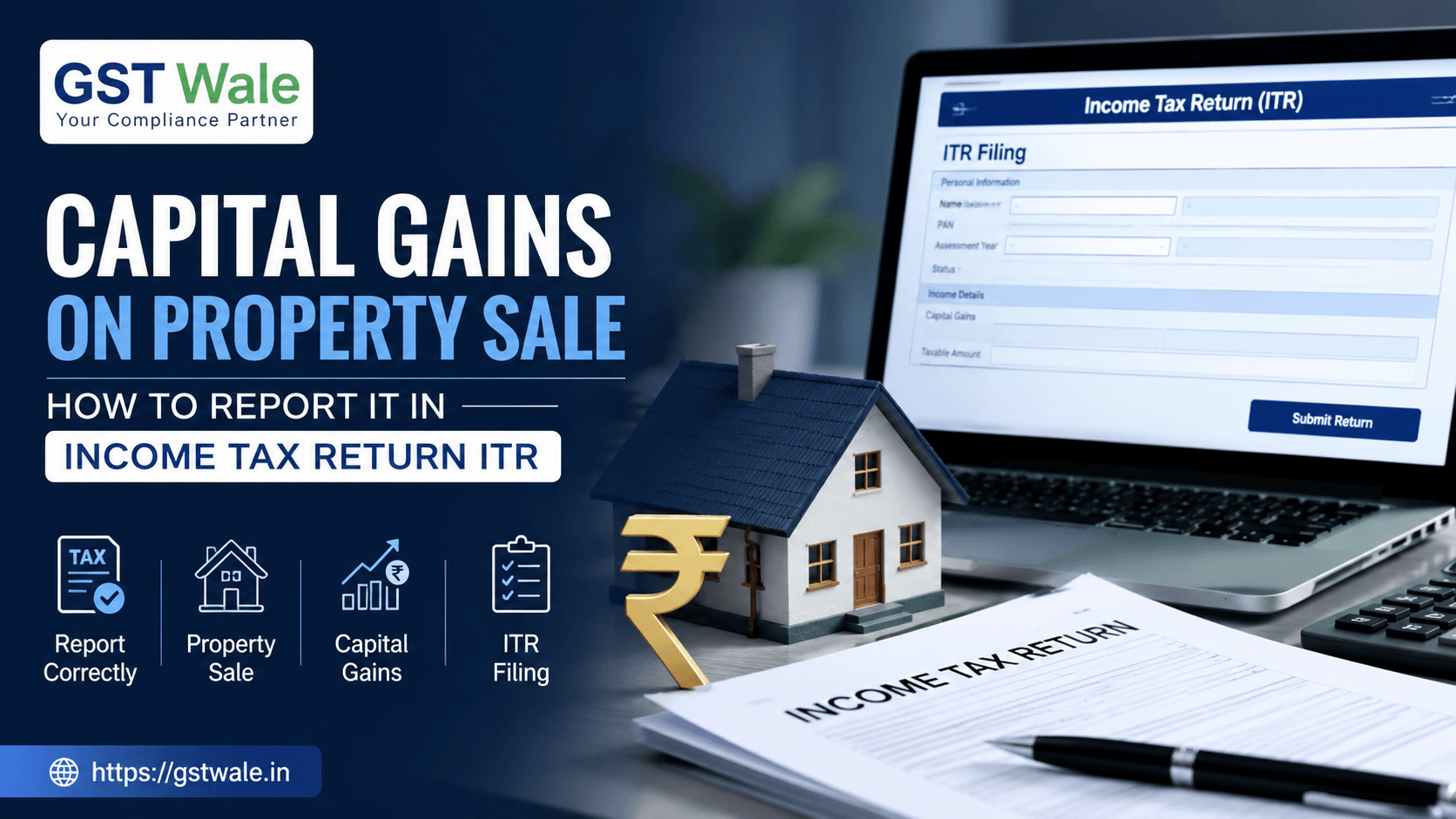
Selling a property can bring a substantial profit, but it can also create a tax liability if not reported correctly in your income tax return itr. Many taxpayers in India are unaware of how capital gains are calculated, which exemptions are available, and how to disclose the transaction properly while filing returns.
At GST Wale, we regularly help property owners, investors, and salaried individuals manage their property sale taxation smoothly through professional ITR Filing services. Whether you sold a residential house, plot, or commercial property, understanding the tax implications is essential to avoid notices and penalties.
In this article, we will explain everything you need to know about reporting capital gains from property sale in your income tax return itr in a simple and practical manner.
What Are Capital Gains on Property Sale?
Capital gains arise when you sell a capital asset such as:
- Residential property
- Commercial property
- Land or plot
- Inherited property
- Gifted property
The profit earned from the sale is taxable under the head “Capital Gains” in your income tax return itr.
The gain is calculated as:
Sale Price – Purchase Cost – Expenses = Capital Gain
However, taxation depends on how long the property was held before selling.
Types of Capital Gains in Real Estate
Short-Term Capital Gains (STCG)
If the property is sold within 24 months from the purchase date, the gain is treated as short-term capital gain.
- Taxed as per your income tax slab
- No benefit of indexation
- No section 54 exemptions available in most cases
Long-Term Capital Gains (LTCG)
If the property is sold after 24 months, it is considered long term gains real estate income.
- Taxed at 20% with indexation benefit
- Eligible for exemptions
- Lower tax burden compared to short-term gains
This distinction is very important while preparing your income tax return itr.
How to Calculate Long-Term Capital Gains
Formula for LTCG
Long-term capital gains are calculated using indexed cost of acquisition.
Calculation Formula
Long-Term Capital Gain =
Sale Consideration – Indexed Cost of Acquisition – Indexed Improvement Cost – Transfer Expenses
What Is Indexed Cost of Acquisition?
The indexed cost of acquisition adjusts the purchase price based on inflation using the cost inflation index table issued by the Income Tax Department.
This helps reduce taxable gains significantly.
Example
Suppose:
- Property purchased in 2010 for ₹20 lakh
- Sold in 2025 for ₹70 lakh
- Indexed purchase cost becomes ₹38 lakh
- Brokerage and legal expenses = ₹2 lakh
Taxable LTCG:
₹70 lakh – ₹38 lakh – ₹2 lakh = ₹30 lakh
This ₹30 lakh must be reported in your income tax return itr.
Understanding the Cost Inflation Index Table
The cost inflation index table helps calculate inflation-adjusted purchase costs.
For example:
| Financial Year | CII |
|---|---|
| 2010-11 | 167 |
| 2020-21 | 301 |
| 2024-25 | 363 |
Indexed Cost Formula
Indexed Cost = Purchase Price × CII of Sale Year ÷ CII of Purchase Year
Using the correct cost inflation index table is crucial to avoid incorrect tax calculations in your income tax return itr.
Expenses Allowed While Calculating Capital Gains
You can deduct several legitimate expenses from the sale value:
- Brokerage paid to agents
- Legal fees
- Stamp duty
- Registration charges
- Cost of renovation or improvement
- Transfer expenses
Maintaining proper invoices and proofs is important while filing your income tax return itr.
Section 54 Exemptions on Property Sale
One of the biggest advantages available to taxpayers is claiming section 54 exemptions.
When Can You Claim Section 54?
You can claim exemption if:
- You sold a residential property
- Capital gains are invested in another residential property
Time Limit for Reinvestment
- Purchase new property within 1 year before or 2 years after sale
- Construct property within 3 years
This is one of the most common reinvestment tax relief options used by taxpayers.
Example
Mr. Sharma sold a flat and earned LTCG of ₹25 lakh. He purchased another residential house for ₹30 lakh within one year.
Result:
- Entire ₹25 lakh gain becomes exempt
- No LTCG tax payable
- Proper disclosure still required in income tax return itr
Section 54EC and Capital Gains Bonds
If you do not want to purchase another property, you can invest in capital gains bonds.
Eligible Bonds
- REC Bonds
- NHAI Bonds
- PFC Bonds
Important Conditions
- Investment must be made within 6 months
- Maximum investment allowed: ₹50 lakh
- Lock-in period applies
These capital gains bonds help save tax legally while keeping funds secure.
Capital Gains Account Scheme (CGAS)
Sometimes taxpayers cannot reinvest before the due date of filing returns.
In such cases, the unutilized amount can be deposited in a Capital Gains Account Scheme.
This allows temporary protection from taxation until the investment is completed.
Failure to use CGAS properly can lead to tax complications in your income tax return itr.
Which ITR Form Should You Use?
For reporting capital gains from property sale:
Use ITR-2 If
- You have salary income
- Capital gains from property sale
- No business income
Use ITR-3 If
- You have business or professional income along with capital gains
Choosing the wrong form may lead to defective filing notices.
Step-by-Step Process to Report Capital Gains in Income Tax Return ITR
Step 1: Gather Documents
Keep ready:
- Sale deed
- Purchase deed
- Improvement bills
- Brokerage receipts
- TDS certificate (Form 16B)
- Capital gains investment proofs
Step 2: Compute Capital Gains
Calculate:
- Sale consideration
- Indexed cost of acquisition
- Deductions and exemptions
Step 3: Fill Schedule CG
In your income tax return itr, capital gains are reported under:
- Schedule CG
- Details of buyer
- PAN of buyer
- Property address
- Exemption details
Step 4: Verify TDS
Usually, buyers deduct 1% TDS under Section 194IA.
Check Form 26AS before filing.
Step 5: Claim Exemptions
Mention:
- section 54 exemptions
- capital gains bonds investments
- CGAS deposits
Step 6: Submit and Verify Return
After filing the income tax return itr:
- E-verify using Aadhaar OTP
- Or send signed ITR-V to CPC Bengaluru
Common Mistakes Taxpayers Should Avoid
Ignoring Stamp Duty Value
The government may consider stamp duty valuation instead of actual sale price in some cases.
Wrong Indexation Calculation
Incorrect use of cost inflation index table can increase tax liability.
Missing Exemption Claims
Many taxpayers forget to claim reinvestment tax relief.
Using Incorrect ITR Form
Wrong forms often trigger notices.
Not Reporting Exempt Capital Gains
Even if gains are exempt, they must still appear in your income tax return itr.
Practical Tips from GST Wale
Maintain Property Records
Keep all old purchase documents safely.
Plan Reinvestment Early
Do not wait till the last moment to claim section 54 exemptions.
Consult Experts Before Selling
Proper tax planning can save lakhs legally.
Check AIS and Form 26AS
Property transactions now reflect automatically in tax records.
FAQs on Capital Gains and Income Tax Return ITR
Is property sale mandatory to report in income tax return itr?
Yes. Every property sale transaction must be reported, even if no tax is payable.
Can I save tax completely on long-term capital gains?
Yes, through section 54 exemptions or investment in capital gains bonds.
What happens if I do not disclose property sale?
The Income Tax Department may issue notices, penalties, and interest demands.
Can inherited property also attract capital gains tax?
Yes. Capital gains are calculated based on the original owner's acquisition cost.
Is indexation benefit available for short-term gains?
No. Indexed cost of acquisition applies only to long-term capital gains.
Reporting property sale correctly in your income tax return itr is extremely important to avoid future tax disputes and unnecessary penalties. Understanding long term gains real estate taxation, using the cost inflation index table properly, and claiming eligible reinvestment tax relief can significantly reduce your tax burden.
At GST Wale, we help taxpayers file accurate returns, calculate capital gains correctly, and maximize section 54 exemptions with complete compliance support. If you have recently sold a property and need professional assistance, our experts are ready to guide you through every step of your income tax return itr filing process.
 Previous