


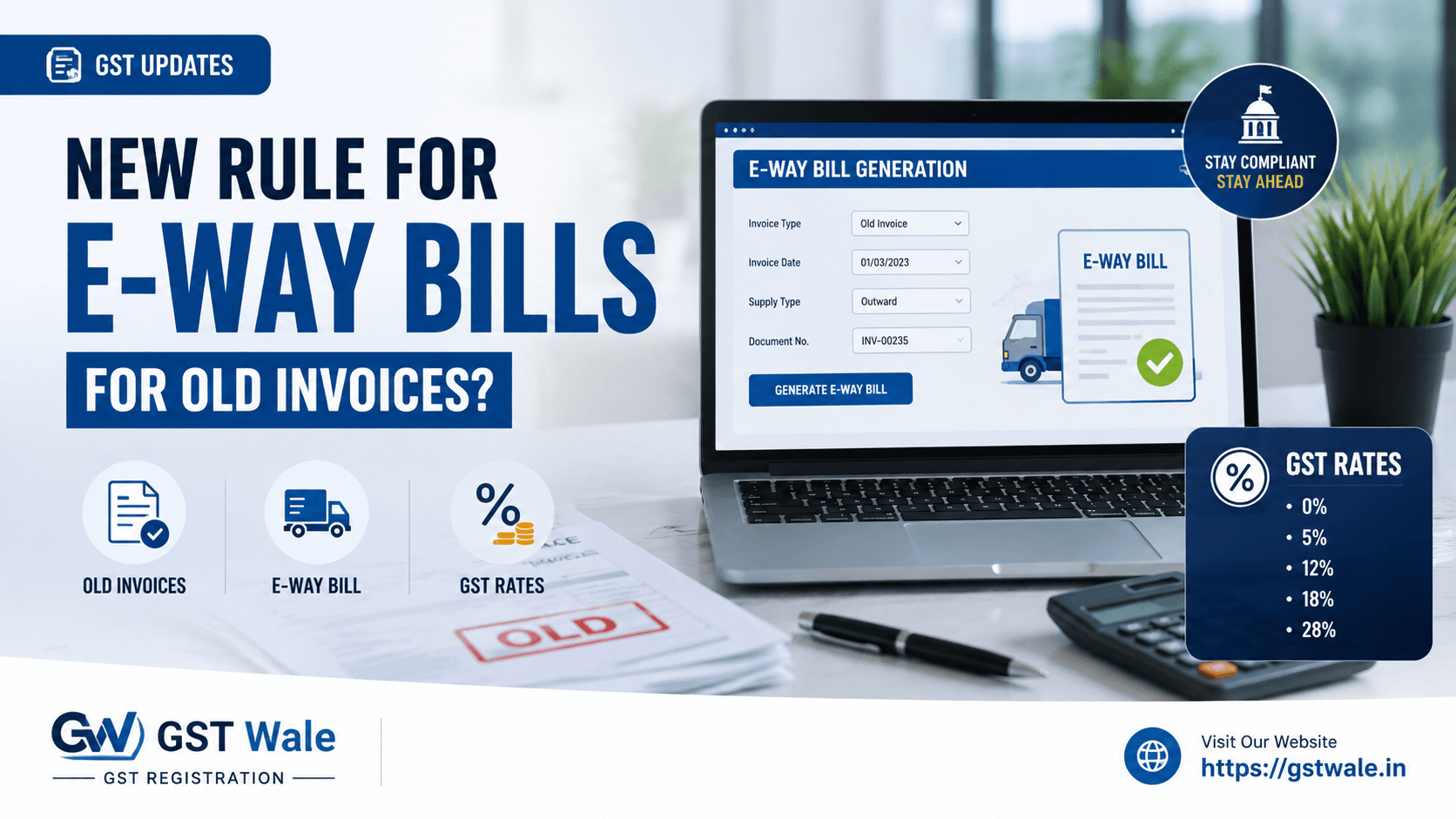
What is the New Rule for Generating E-Way Bills for Old Invoices?
What is the New Rule for Generating E-Way Bills for Old Invoices?
Running a business in India means staying on your toes constantly. Just when you think you have mastered your compliance routine, the GST Council introduces a tweak to keep the system airtight. If you are a manufacturer, trader, or logistics provider transporting commercial goods, there is a major update you cannot afford to miss. The government has introduced a strict time-barring rule for generating Electronic Way (E-Way) Bills against old tax invoices. At GST Wale, we have been flooded with frantic calls from clients asking: "Can we still clear backlogged shipments" or "Will this change our calculated gst rates on older transactions" Let’s break this down in plain, simple language so you can protect your business from unnecessary penalties while complying with the latest gst rates.
Before diving deep into the compliance mechanics, it is important to remember that smooth logistics start with a flawless tax foundation. If you are establishing a new venture or expanding your operations across state lines, ensuring your GST Registration is fully compliant and updated is your very first step toward trouble-free shipping and maintaining the accurate application of various gst rates on your products.
The New 30-Day Restriction: Impact on Invoices and GST Rates
Until recently, the GST portal was quite lenient. If you raised a tax invoice, you could theoretically generate an E-Way Bill for it weeks or even months later. This leniency, however, opened up loopholes for tax evasion—such as recycling old invoices to move multiple consignments under a single bill. To plug this leak, the National Informatics Centre (NIC) introduced a hard stop: taxpayers cannot generate E-Way Bills for invoices older than 30 days. This system lock ensures that transactions matching specific gst rates are documented and moved in real time.
Initially, this rule applied strictly to large taxpayers with an aggregate turnover exceeding ₹100 Crores. However, the mechanism is progressively expanding across smaller sectors regardless of their product gst rates. Many business owners confuse this with the old 180 day e-way bill rule discussed in previous council meets regarding input tax credit reversals. Make no mistake: this new update specifically restricts the generation window of the transport document to exactly 30 days from the invoice date, standardizing compliance across all applicable gst rates.
Impact on Transporting Commercial Goods and Logistics
When you are transporting commercial goods, timing is everything. Imagine your factory prepares an invoice on the 1st of the month, but due to production delays or vehicle unavailability, the cargo sits in the warehouse for 32 days. Under the new regime, if you attempt to log into the portal on day 32, the system will flatly reject your request. You cannot move those goods legally, even if you have prepaid the full tax amount according to the correct gst rates.
This directly impacts how businesses manage their supply chains and inventory valuations. If you are intercepted by a GST officer without a valid E-Way Bill, the consequences are severe: a penalty equal to 100% of the tax payable based on your item's specific gst rates or ₹20,000, whichever is higher. Moreover, your goods and vehicle can be detained, costing you heavily beyond the basic statutory gst rates.
How This Aligns with E-Invoicing and GST Rates Balance
The government is rapidly moving toward an interconnected, real-time ecosystem. The E-Way Bill portal is now deeply integrated with the E-Invoicing system. When an invoice is generated, the data automatically populates the E-Way bill fields. This integration ensures that the applicable gst rates (whether 5%, 12%, 18%, or 28%) match perfectly across your outward returns (GSTR-1), your e-invoices, and your transit documents. You cannot manipulate dates or alter values down the line without triggering an immediate system red flag regarding your tax brackets and gst rates.
Key E-Way Bill Validity Rules Under Current GST Rates Framework
To avoid transit disruptions, business owners and dispatch managers must keep a firm grip on the baseline parameters governing e-way bill document validity. Generating the document within 30 days is only half the battle; ensuring it remains active during transit is where the real operational challenge lies, especially for high-value items subject to peak gst rates.
Distance-Based Validity: For regular cargo, an E-Way Bill is valid for 1 day for every 200 km of distance. For Over Dimensional Cargo (ODC), it is 1 day for every 20 km. The distance matrix remains independent of your commercial gst rates.
Tracking Interstate Shipments: When tracking interstate shipments, the validity period begins the moment the vehicle number is entered in Part B. If your truck breaks down across state lines, you must update the vehicle details immediately to keep the document alive and protect goods tied to statutory gst rates.
The Extension Window: If a shipment is delayed due to an exceptional circumstance (like a natural calamity, strike, or major breakdown), you can extend the validity. This extension can only be requested inside the window starting 8 hours before the expiry time and ending 8 hours after the expiry time.
Understanding the Eway Bill Extension Cap: Be aware that there is an eway bill extension cap built into the system logic. You cannot endlessly extend a document to keep a shipment in limbo; extensions require valid justification and are monitored closely by jurisdictional officers overseeing compliance with various gst rates.
Practical Steps for Businesses to Adapt to New GST Rates Rules
As your trusted partners at GST Wale, we advise implementing these operational changes immediately to ensure your logistics remain bulletproof and fully aligned with standard gst rates protocols:
1. Synchronize Invoice and Dispatch Dates
Never raise an invoice prematurely. Only generate the tax invoice when the goods are physically ready to clear the factory gates or warehouse loading docks. If delays occur, consider canceling the invoice within the permitted 24-hour window and regenerating it when logistics are aligned, maintaining accurate mapping of your gst rates.
2. Standardize Your Master Data & GST Rates
Ensure that your billing software correctly maps the HSN codes and matching gst rates. Discrepancies between the invoice rate and the E-Way Bill entries will cause systemic failures, wasting precious days of your 30-day eligibility window and confusing your calculations of effective gst rates.
3. Audit Your Pending Invoices Weekly
Set up an internal alert system. Any invoice crossing the 20-day mark without an associated E-Way Bill should be flagged immediately for review by your finance and logistics teams to avoid tax disputes based on current gst rates.
Frequently Asked Questions (FAQs) Regarding Invoice Timelines and GST Rates
Q1: Does this 30-day restriction apply to both interstate and intrastate supplies?
Yes. The restriction on generating E-Way Bills for invoices older than 30 days applies uniformly across the portal, whether you are moving goods across the street or across the country, regardless of the slab of gst rates applied.
Q2: If my invoice expires after 30 days, can I change the GST rates to bypass the rule?
Absolutely not. Altering your standard gst rates or modifying invoice values to force a new document generation is illegal and constitutes tax non-compliance. The system links your HSN, invoice history, and GSTR-1, making anomalies instantly visible to tax authorities who track statutory gst rates.
Q3: What should I do if my invoice is 35 days old and the goods desperately need to be moved?
Legally, you cannot generate an E-Way Bill for that specific invoice. You will need to consult a professional to look at your specific transactional framework and relevant gst rates—whether a credit note needs to be issued, or if a delivery challan applies under specific rules. Do not attempt to move the vehicle without a valid portal document.
Q4: How does the new rule affect the gst new rate changes announced by the ministry?
When the government introduces a gst new rate for specific commodities, it applies from a designated effective date. If you are generating an E-Way bill for an older invoice within its valid 30-day window, you must apply the historical gst rates that were legally active on the invoice date, not the transport date.
Q5: Can an expired E-Way Bill be renewed automatically?
No, there is no automatic renewal. You must manually log into the portal within the specified 8-hour window around the expiry time and apply for an extension, subject to the built-in system limitations irrespective of your business's applicable gst rates.
Stay Ahead of the Compliance Curve and GST Rates with GST Wale
The tightening of the E-Way Bill timeline is a clear indicator that the Indian tax administration is moving toward a zero-tolerance policy for delayed reporting. Trying to manage fluctuating gst rates, complex transport timelines, and sudden portal restrictions all on your own can take your focus away from growing your business and tracking your optimal gst rates structure.
Don't let compliance roadblocks stall your trucks or disrupt your understanding of statutory gst rates. Let the team of expert Chartered Accountants at GST Wale handle your tax structuring, filing, and logistical advisory seamlessly. Reach out to us today, and let's keep your business moving forward smoothly, legally, and always in sync with correct gst rates!
 Previous