


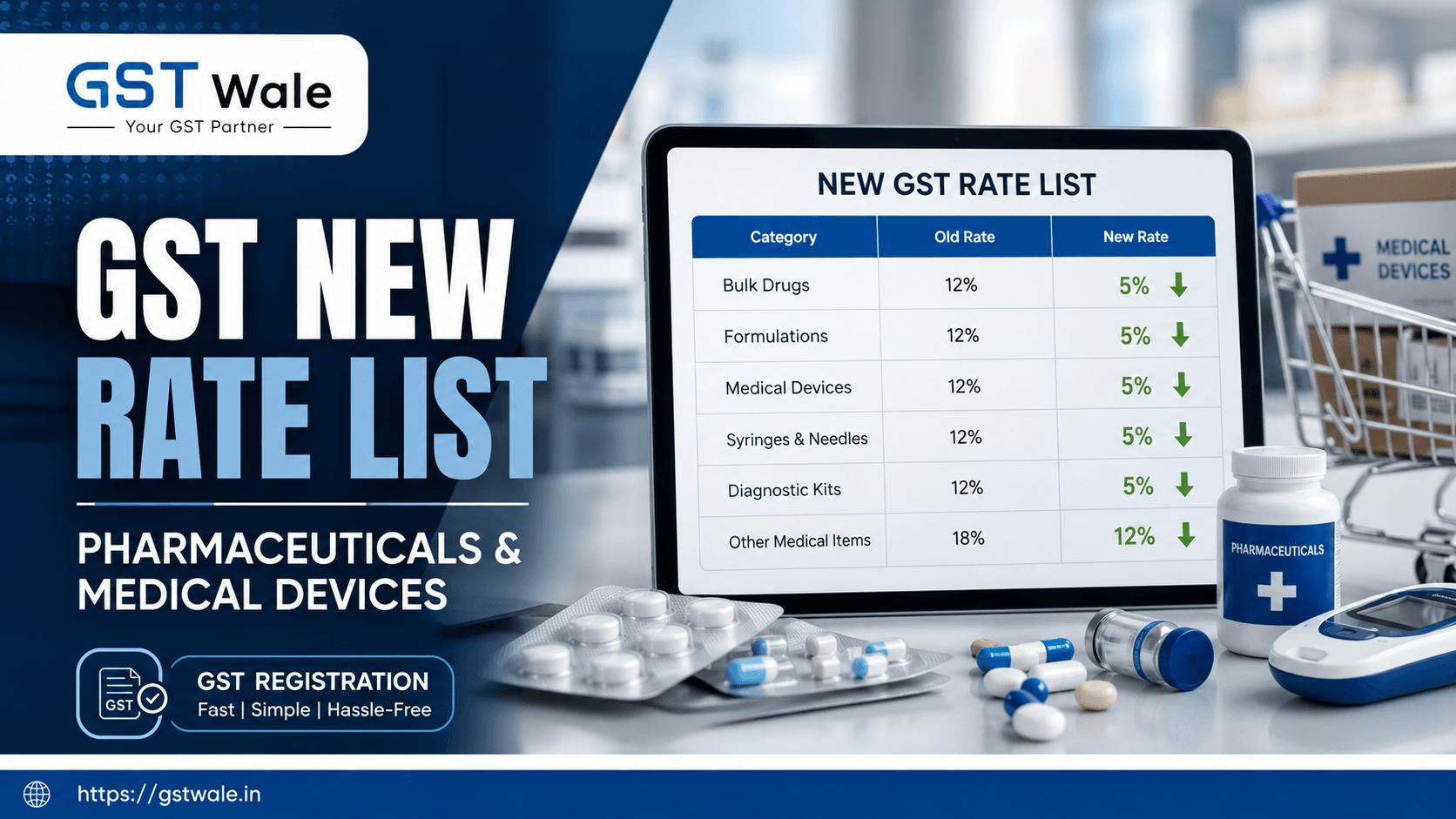
Complete Pricing Chart: The New GST Rate List for Pharmaceuticals and Medical Devices
Complete Pricing Chart: The New GST Rate List for Pharmaceuticals and Medical Devices
Navigating the landscape of indirect taxes in India can often feel like reading a complex medical report. For pharmaceutical manufacturers, chemists, hospital administrators, and medical device distributors, staying updated with tax changes is critical to keeping a business healthy. Recently, the GST Council rolled out its landmark GST 2.0 reforms, bringing massive structural changes to the healthcare sector. The primary objective here is healthcare affordability—ensuring that everyday citizens do not face a financial crisis due to essential medical bills.
At "GST Wale", we continuously help business owners decode these complex notifications into actionable business insights. If you are operating a pharma retail shop, distributing surgical equipment, or starting a healthcare venture, your first step toward absolute compliance is securing a valid GST Registration to seamlessly pass on input tax benefits. In this detailed guide, we break down the gst new rate list for pharmaceuticals and medical devices, outlining exactly how these revised slabs affect your pricing charts, billing software, and overall profit margins.
Decoding the Healthcare Tax Shift: The gst new rate list
The recent rationalization by the GST Council completely restructured the old multi-tier brackets. The complex puzzle of 5%, 12%, 18%, and 28% slabs has been streamlined into a highly simplified, three-tier framework. For the medical sector, this means most items have migrated down to either a zero-tax bracket or a concessional 5% "Merit" slab.
The primary goal of this gst new rate list is to eliminate classification disputes. Historically, companies and tax officers frequently argued over whether a specific product should be classified as a "medicament" (taxed lower) or a "food supplement" (taxed higher). By slashing the rates and uniforming the categories, the government has cleared up this grey area, creating a highly transparent pricing environment.
Complete Pricing Chart for Pharmaceuticals and Medical Devices
To help your accounting team update your billing ERP software immediately, here is the official category-wise breakdown of the gst new rate list as mandated under the latest council guidelines.
1. Lifesaving and Critical Drugs (0% GST Slab)
In a major humanitarian move, the government has designated specific lifesaving medicines zero tax. This means highly expensive treatments that previously strained family savings are now completely exempt from GST.
Cancer Treatment Drugs: Medications like Trastuzumab, Osimertinib, Rituximab, and Pembrolizumab (previously taxed at 5% or 12%) are now at 0%.
Rare Diseases & Chronic Conditions: 33 specifically notified drugs for rare medical disorders, including Agalsidase Beta and Imiglucerase, have been shifted to the Nil rate.
Public Health Essentials: Insulin, specific HIV/AIDS antiretroviral drugs, tuberculosis medications (like Bedaquiline), and polio vaccines provided under national immunization programs attract 0% GST.
2. General Formulations and Everyday Medicines (5% GST Slab)
Almost all other standard pharmaceutical products have dropped from the old 12% slab down to a uniform 5% gst new slab.
Allopathic Medicines: Regular prescription tablets, capsules, syrups, and antibiotics.
Alternative Medicine: Pure Ayurvedic, Unani, Siddha, and Homeopathic formulations.
Medical Consumables: Bandages, sterile gauze, surgical dressings, and clinical diapers.
3. Medical Devices and Diagnostic Equipment (5% GST Slab)
To make advanced diagnostic tools accessible to small clinics and laboratories, a major diagnostic kits tax cut was implemented, dropping their rates from 12% or 18% down to 5%.
Home Monitoring Devices: Blood glucose monitors (glucometers), test strips, digital thermometers, and pulse oximeters.
Imaging & Heavy Machinery: X-ray machines, MRI scanners, CT scan systems, and ultrasound equipment (HSN 9022 / 9018).
Surgical & ICU Equipment: Ventilators, anesthesia machines, defibrillators, disposable sterilized syringes, and hypodermic needles.
Vision and Mobility Aids: Corrective spectacles, contact lenses, wheelchairs, artificial limbs, and crutches.
4. Hospital Infrastructure and Specialized Furniture (18% GST Slab)
While clinical and diagnostic instruments enjoy the lower 5% rate, items classified under hospital infrastructure or general medical furniture still attract the standard 18% gst rates.
Medical Furniture: Hospital beds with mechanical fittings, stretchers, operating tables, and dental chairs (HSN 9402).
Advanced Laboratory Glassware: Non-clinical specialized laboratory equipment.
Expert Note from GST Wale: The government has strictly mandated that all pharmaceutical companies reduce their Maximum Retail Price (MRP) to pass the 7% tax savings directly to patients. Profiteering from these reduced tax rates can attract severe penalties from the National Anti-Profiteering Authority.
How to Calculate the New GST on Medicines: A Practical Example
With the implementation of the revised gst new rate list, computing your tax liability has become relatively straightforward. Let us look at a real-world example to see how the gst new rate directly lowers the final medical instruments bill or pharmaceutical invoice.
Imagine a distributor sells a batch of medical diagnostic kits to a local laboratory.
$$ \text{Base Price of Diagnostic Kits} = ₹20,000 $$
$$ \text{Old GST Rate (12%)} = ₹2,400 \implies \text{Old Invoice Total} = ₹22,400 $$
Under the new 5% merit rate for medical devices:
$$ \text{New GST Amount} = ₹20,000 \times \left(\frac{5}{100}\right) = ₹1,000 $$
$$ \text{New Invoice Total} = ₹20,000 + ₹1,000 = ₹21,000 $$
By switching to the updated slab, the lab saves a clean ₹1,400 on a single transaction, showing how the reform directly drives down operational costs.
The Inverted Duty Structure (IDS) Challenge for Pharma Businesses
While the gst new rate list is an incredible win for consumers, it brings a tactical accounting challenge for manufacturers, known as the Inverted Duty Structure (IDS).
An Inverted Duty Structure occurs when the tax rate on raw materials (Inputs) is higher than the tax rate on the finished product (Outputs). In the pharmaceutical industry, many Active Pharmaceutical Ingredients (APIs) and raw chemicals are still taxed at 18% GST. However, when a manufacturer converts those APIs into finished tablets or syrups, the output tax rate drops to 5%.
This leaves manufacturers with a massive balance of unutilized Input Tax Credit (ITC) sitting in their electronic credit ledgers. To manage this liquidity bottleneck, the government has introduced automated IDS refunds, allowing pharmaceutical businesses to claim their blocked cash flow within 90 days. Keeping your monthly filings perfectly reconciled is vital to ensuring these refunds clear without hitches.
Frequently Asked Questions (FAQs)
Q1. What is the current GST rate on standard allopathic tablets and syrups?
Under the revised gst new rate list, general allopathic medicines, antibiotics, and daily syrups are taxed at a uniform rate of 5%. Previously, most of these formulations were taxed at 12%.
Q2. Are health supplements and vitamins also covered under the 5% medicine slab?
Pure therapeutic medicines and formulations are kept at 5%. However, stand-alone food supplements, nutraceuticals, and protein powders that are classified as food preparations generally attract the higher 18% standard rate. It is important to look closely at the product's HSN code classification.
Q3. How has the new GST list impacted medical insurance premiums?
In a massive relief to individual taxpayers, individual health and life insurance premiums have been fully exempted from GST (0%), down from the previous 18% bracket. This is a huge milestone for nationwide healthcare affordability.
Q4. Can a pharmacy sell old stock at the previous higher MRP?
The government provided a 3-month transitional window for businesses to clear or relabel old inventory. For fresh stocks or stocks sold after the transition period, manufacturers and distributors must stick stickers with the revised, lowered MRP reflecting the 5% or 0% GST rate.
Trust GST Wale for Seamless Healthcare Compliance
The transition into the Next-Gen GST 2.0 framework requires meticulous attention to detail. Upgrading your inventory databases with the precise HSN codes, recalculating your product margins against the Inverted Duty Structure, and filing timely refund applications are tasks that demand expert oversight.
At GST Wale, we act as your dedicated financial partners. From setting up your primary corporate structure to handling complex monthly tax reconciliations, our team of experienced Chartered Accountants handles the compliance heavy lifting so you can focus on scaling your business. Get in touch with "GST Wale" today to secure your medical business and streamline your tax reporting perfectly.
 Previous