


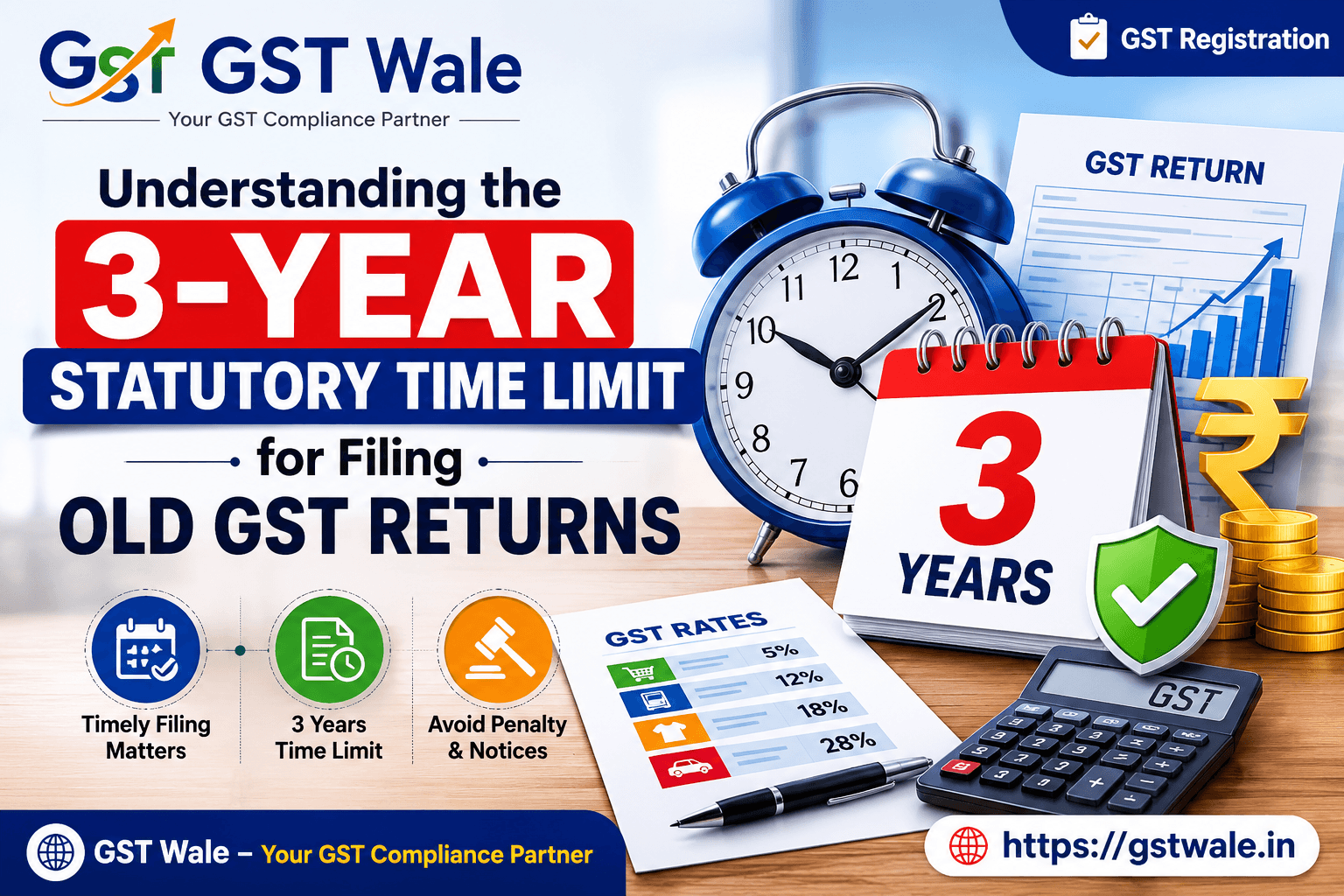
Understanding the 3-Year Statutory Time Limit for Filing Old GST Returns
Understanding the 3-Year Statutory Time Limit for Filing Old GST Returns
Running a business in India comes with its fair share of challenges, and keeping up with the ever-evolving Goods and Services Tax (Tax) compliance is definitely near the top of that list. At GST Wale, we interact with hundreds of entrepreneurs who often ask us, "Can I file a return that I missed two or three years ago"
The short answer is yes, but there is a major catch. The government has introduced a strict 3-year statutory time limit for filing old GST returns. Whether you are dealing with regular transactions or tracking changes in gst rates, staying compliant is no longer optional—it is a matter of business survival. If you are a new business owner or looking to regularize your old tax records, getting your GST Registration done correctly is the very first step toward building a clean compliance track record.
In this comprehensive guide, we will break down what this 3-year time limit means for your business, how missed return deadlines can disrupt your operations, and how the underlying tax slabs affect your outstanding liabilities.
What is the 3-Year Statutory Time Limit?
In the initial years of the GST rollout, taxpayers enjoyed considerable flexibility. The government frequently extended deadlines, waived late fees, and allowed businesses to catch up on their backlogs. However, as the system matured, the tax department shifted its focus toward strict enforcement.
Under Section 62 of the CGST Act, a hard ceiling has been placed on belated returns. Taxpayers are now barred from filing their GST returns—such as GSTR-1, GSTR-3B, GSTR-4, or GSTR-9—after a period of three years from the original due date of that specific return.
Why the 3-Year Cap Matters
Once this three-year window slams shut, the GST portal automatically blocks you from uploading that specific period's return. This means if you suddenly realize you forgot to file a return from mid-2022, you might find yourself completely locked out from doing so today. This restriction is fundamentally designed to clean up the portal's database and force businesses into real-time compliance.
Understanding the GSTR 3B Time Bar and Its Consequences
The monthly or quarterly summary return, GSTR-3B, is the most critical return because it is where you declare your outward supplies, claim Input Tax Credit (ITC), and pay your tax liability. The gstr 3b time bar creates a double-whammy effect for defaulting businesses.
Permanent Loss of Input Tax Credit (ITC): Under Section 16(4) of the CGST Act, you cannot claim ITC for a financial year after November 30 of the subsequent financial year. So, even if you attempt to file a two-year-old return within the 3-year limit, your ability to claim credit for the taxes you paid to your suppliers is already legally dead.
Outward Liabilities Remain Active: While you lose the right to claim input credit, your liability to pay tax on your sales does not disappear. You must pay the outward tax based on the applicable gst rates for those items, entirely out of your own pocket.
Suo Moto Registration Cancellation: If a regular taxpayer fails to file returns for a continuous period of six months (or three quarters for composition dealers), the proper officer has the power to cancel your GSTIN altogether.
Portal Blocking Rules and Operational Paralysis
The financial hit is only one part of the problem; the operational friction can completely freeze your day-to-day business. The government uses automated portal blocking rules to ensure taxpayers do not ignore their filings.
If you violate the missed return deadlines, the system triggers sequential blocking:
E-Way Bill Generation Blocked: If you fail to file your GSTR-3B or GSTR-1 for two consecutive months/quarters, the portal blocks your ability to generate E-Way bills. If you cannot generate an E-Way bill, you cannot legally transport goods worth more than ₹50,000, effectively halting your supply chain.
GSTR-1 Blocking: You cannot file your current month's GSTR-1 if your previous period's GSTR-3B is outstanding. This means your buyers will not see the credit in their GSTR-2B, leading them to withhold your payments.
Calculating the Financial Cost: Late Fees and Compliance Penalty
Filing old returns is an expensive affair. The longer you wait, the more the financial burden compounds. Let’s look at how the costs accumulate.
1. The Late Fee Calculator Mechanics
The standard late fee for delaying GSTR-3B or GSTR-1 is ₹50 per day (₹25 CGST + ₹25 SGST) for a regular return with tax liability. For a 'NIL' return, it is capped at ₹20 per day. However, these fees have maximum caps per return period depending on your total turnover. Even with caps, accumulating months of missed returns across GSTR-1 and GSTR-3B can easily run into tens of thousands of rupees in pure late fees.
2. High Interest on Delayed Tax Payments
A late fee is just for the delay in filing. If you have an actual tax liability, you must pay interest at the rate of 18% per annum. This interest is calculated from the day following the original due date up to the actual date of payment.
3. The Compliance Penalty
If the tax department detects that you deliberately suppressed sales or failed to file returns to evade taxes, they can issue a show-cause notice. The compliance penalty under Section 122 can match 100% of the tax evaded or ₹10,000, whichever is higher.
How Your "GST Rates" and Slabs Impact Old Outstanding Liabilities
When regularizing old returns, you cannot simply apply a uniform tax rate. You must carefully map your historical sales to the exact gst rates that were legally active during that specific past period.
The Indian tax framework operates under a multi-tier system. Over the last three years, the GST Council has frequently shifted items across different brackets. For instance, a product that sits comfortably under a gst new rate slab of 18% today might have been taxed at 12% or 28% two years ago. Conversely, certain essential items might have been moved into a gst new slab to ease the consumer burden.
When GST Wale assists businesses in reconstructing old accounts, we meticulously audit the historical dates of transactions. Applying an incorrect tax rate on an old return can trigger system mismatches, resulting in automated audit notices and additional interest burdens.
Frequently Asked Questions (FAQs)
Q1. Can I file a GST return that is older than 3 years?
No. The GST portal completely blocks the filing of any return once a period of three years has lapsed from its original due date.
Q2. What happens if my GST registration is canceled due to missed returns?
You must first apply for the revocation of cancellation. However, the portal will require you to file all pending returns up to the date of cancellation, paying all accumulated late fees, interest, and taxes based on the historical gst rates applicable at that time.
Q3. Is there any way to waive the interest on old tax liabilities?
While the government occasionally introduces amnesty schemes to waive or reduce late fees, interest charges (18% per annum) are statutory and are rarely waived because they are considered compensatory for the delay in tax payment to the exchequer.
Q4. How do changes like a gst new rate affect my old pending returns?
Any gst new rate or gst new slab announced by the GST Council applies prospectively from its notification date. For old pending returns, you must apply the historical tax rates that were active during the exact month the supply took place.
Don't Wait Until It's Too Late – Let GST Wale Help You
Navigating old accounts, calculating interest, tracking past gst rates, and beating the 3-year statutory clock can be an overwhelming task for any business owner. One single error can lead to a blocked portal, canceled registrations, or expensive tax notices.
At GST Wale, we act as your dedicated compliance partners. Our team of experienced professionals will audit your pending records, compute the exact liabilities using a precise late fee calculator approach, ensure you don't fall foul of the gstr 3b time bar, and regularize your status seamlessly.
 Previous