


The Shift from 12% to 18%: The History of GST on Mobile Phones
The Shift from 12% to 18%: The History of GST on Mobile Phones
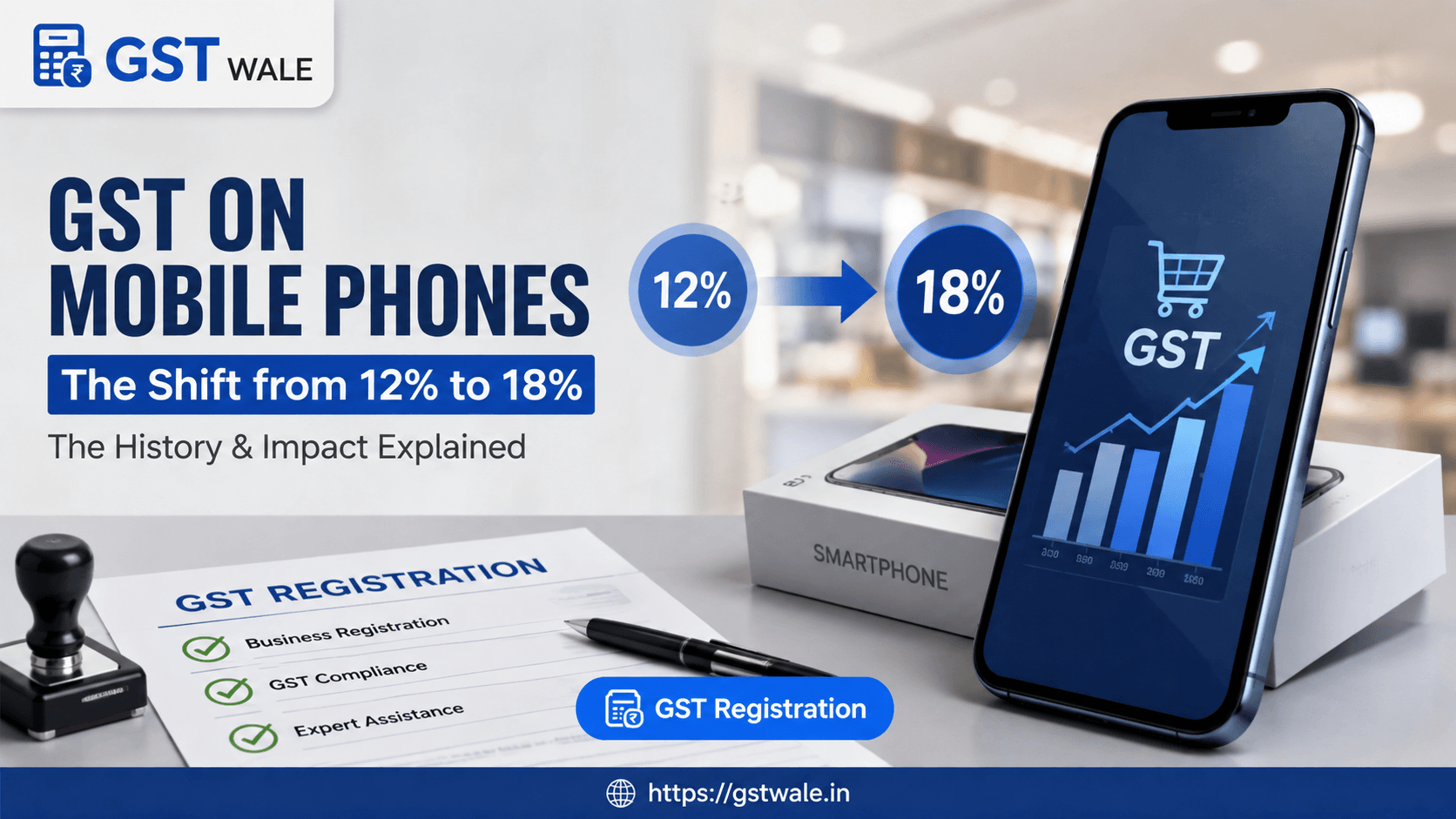
The gst on mobile phones has been one of the most discussed tax changes since the introduction of the Goods and Services Tax (GST) in India. Whether you are a consumer buying a new smartphone, a retailer selling mobile devices, or a business dealing in electronics, understanding this tax change is important. Over the years, the GST rate on mobile phones has evolved due to government policy decisions aimed at strengthening domestic manufacturing and correcting tax-related challenges.
If you are planning to start a business dealing in mobile phones or other taxable goods, obtaining a proper <a href="https://gstwale.in/services/gst/gst-registration">GST Registration</a> is the first step towards compliance and smooth business operations. At GST Wale, we help businesses complete the registration process quickly and accurately while ensuring they meet all GST requirements.
In this article, GST Wale explains the complete history behind the shift in gst on mobile phones from 12% to 18%, the reasons behind the increase, its effect on consumers and manufacturers, and what businesses should know today.
Understanding GST on Mobile Phones
The gst on mobile phones refers to the Goods and Services Tax applicable on the sale of mobile handsets in India. GST replaced multiple indirect taxes like VAT, excise duty, and entry tax in July 2017, creating a unified taxation system across the country.
Initially, mobile phones were taxed at 12% under GST. However, this rate did not remain unchanged for long because of challenges affecting manufacturers and the overall electronics industry.
Today, the gst on mobile phones is 18%, making it one of the standard GST rates applicable to electronic products.
GST Rate Revision Timeline for Mobile Phones
Understanding the gst rate revision timeline helps explain why the tax rate changed.
July 2017 – GST Introduced
When GST was first implemented:
- Mobile phones attracted 12% GST.
- Many mobile parts attracted GST at rates of 18% or even higher.
- Manufacturers faced difficulties in claiming seamless input tax credits.
Although consumers initially benefited from the lower GST rate, manufacturers encountered significant operational issues.
April 2020 – GST Increased to 18%
Based on recommendations from the GST Council, the gst on mobile phones increased from 12% to 18%.
This revision aimed to address several taxation challenges within the electronics manufacturing sector while encouraging domestic production.
Since April 1, 2020, the GST rate has remained at 18%.
Why Was GST on Mobile Phones Increased?
Many consumers wondered why the government increased the gst on mobile phones despite smartphones becoming an everyday necessity.
Several important reasons influenced this decision.
Correcting the Inverted Duty Structure Electronics
One of the biggest reasons was the inverted duty structure electronics problem.
An inverted duty structure occurs when:
- Raw materials and components attract higher GST.
- Finished products attract lower GST.
Before April 2020:
- Mobile phones were taxed at 12%.
- Several components attracted 18% GST.
This created difficulties because manufacturers accumulated unused Input Tax Credit (ITC), leading to blocked working capital and delayed refunds.
By increasing the gst on mobile phones to 18%, the tax rates became more aligned across the supply chain.
Simplifying Input Tax Credit
Higher GST on finished products meant manufacturers could effectively utilize their input tax credits instead of waiting for refunds.
This improved:
- Cash flow
- Compliance
- Manufacturing efficiency
For businesses, this was a major relief despite the higher tax rate.
Mobile Components Tax and Its Role
Another major factor behind the revision was the mobile components tax.
Mobile phones consist of numerous parts, including:
- Display panels
- Batteries
- Printed circuit boards
- Chargers
- Cameras
- Connectors
- Microprocessors
Many of these components were already taxed at 18%.
When finished mobile phones were taxed at only 12%, manufacturers paid more GST on inputs than they collected on sales.
The revised gst on mobile phones helped reduce this mismatch significantly.
Impact on Local Manufacturing
One of the government's long-term goals has been strengthening India's electronics manufacturing ecosystem.
The revised gst on mobile phones supported the impact on local manufacturing by making tax structures more balanced.
Some positive outcomes include:
- Better utilization of Input Tax Credit.
- Reduced refund dependency.
- Improved manufacturing competitiveness.
- Increased investments in electronics production.
The change aligned well with initiatives such as Make in India and Production Linked Incentive (PLI) schemes.
Growth of Mobile Assembly Plants India
The increase in the gst on mobile phones also coincided with rapid expansion in mobile assembly plants india.
Today, India has become one of the world's largest smartphone manufacturing hubs.
Leading companies such as:
- Samsung
- Apple manufacturing partners
- Xiaomi
- Vivo
- Oppo
- Realme
have significantly expanded their manufacturing operations within India.
As more phones are assembled locally, the government expects long-term benefits including:
- Job creation
- Export growth
- Reduced imports
- Stronger electronics supply chains
How Did Consumers Get Affected?
Naturally, many buyers feared that increasing the gst on mobile phones would immediately make smartphones much more expensive.
In reality, the effect varied.
Price Impact
For premium smartphones:
- Prices increased moderately.
For budget smartphones:
- Companies often absorbed part of the additional tax to remain competitive.
Several manufacturers adjusted pricing strategies instead of passing the entire tax burden to customers.
Increased Transparency
GST also brought several advantages for consumers:
- Uniform taxation across India.
- Better invoice transparency.
- Easier warranty claims.
- Simplified tax compliance for retailers.
What Does GST Mean for Mobile Retailers?
Retailers selling smartphones must properly charge the applicable gst on mobile phones.
They should ensure:
- Correct GST classification.
- Proper tax invoices.
- Timely GST return filing.
- Accurate Input Tax Credit claims.
- Updated accounting records.
Failure to comply may result in notices, interest, or penalties.
Example: Understanding the Tax Difference
Suppose a smartphone has a base value of ₹20,000.
At 12% GST:
- GST = ₹2,400
- Total Price = ₹22,400
At 18% GST:
- GST = ₹3,600
- Total Price = ₹23,600
Although the difference appears significant, manufacturers also benefit from better input tax credit utilization, which can partially offset production costs.
Key Benefits of the GST Revision
The revised gst on mobile phones has offered several long-term advantages.
For Manufacturers
- Better Input Tax Credit utilization.
- Reduced refund accumulation.
- Improved cash flow.
- Easier tax compliance.
For the Government
- Stronger tax administration.
- Higher GST collections.
- Encouragement for domestic manufacturing.
For the Industry
- Balanced taxation.
- Better investment climate.
- Support for India's electronics ecosystem.
Common Misconceptions About GST on Mobile Phones
Higher GST Always Means Higher Prices
Not necessarily.
Many brands adjust pricing through promotions, supply chain efficiencies, and cost optimization.
GST Is Paid Only by Manufacturers
Incorrect.
The gst on mobile phones is collected throughout the supply chain and ultimately borne by the end consumer.
Imported Phones Are Taxed Differently
GST generally applies at the same rate, although customs duties may differ for imported products.
FAQs
1. What is the current GST on mobile phones?
The current gst on mobile phones is 18%.
2. When did GST on mobile phones increase from 12% to 18%?
The GST rate increased on 1 April 2020 following the recommendations of the GST Council.
3. Why was GST on mobile phones increased?
The increase primarily addressed the inverted duty structure electronics issue, improved input tax credit utilization, and supported domestic manufacturing.
4. Does 18% GST apply to all smartphones?
Yes. Most mobile phones sold in India are currently subject to 18% GST under the applicable GST provisions.
5. Does the GST increase help Indian manufacturing?
Yes. The revised tax structure has positively influenced the impact on local manufacturing, supported investments, and encouraged the expansion of mobile assembly plants india.
The journey of gst on mobile phones from 12% to 18% reflects more than just a tax increase. It represents a policy decision aimed at correcting structural tax issues, improving input tax credit efficiency, supporting the mobile components tax framework, resolving the inverted duty structure electronics challenge, and strengthening the impact on local manufacturing. While consumers experienced a moderate increase in prices, the long-term objective has been to create a stronger and more competitive electronics manufacturing ecosystem in India.
If you are a mobile retailer, distributor, manufacturer, or entrepreneur looking to stay GST-compliant, GST Wale is here to help. From GST registration and return filing to advisory and compliance support, our experienced professionals provide practical, reliable solutions tailored to your business. Get in touch with GST Wale today and let us simplify your GST journey with expert guidance every step of the way.
 Previous