


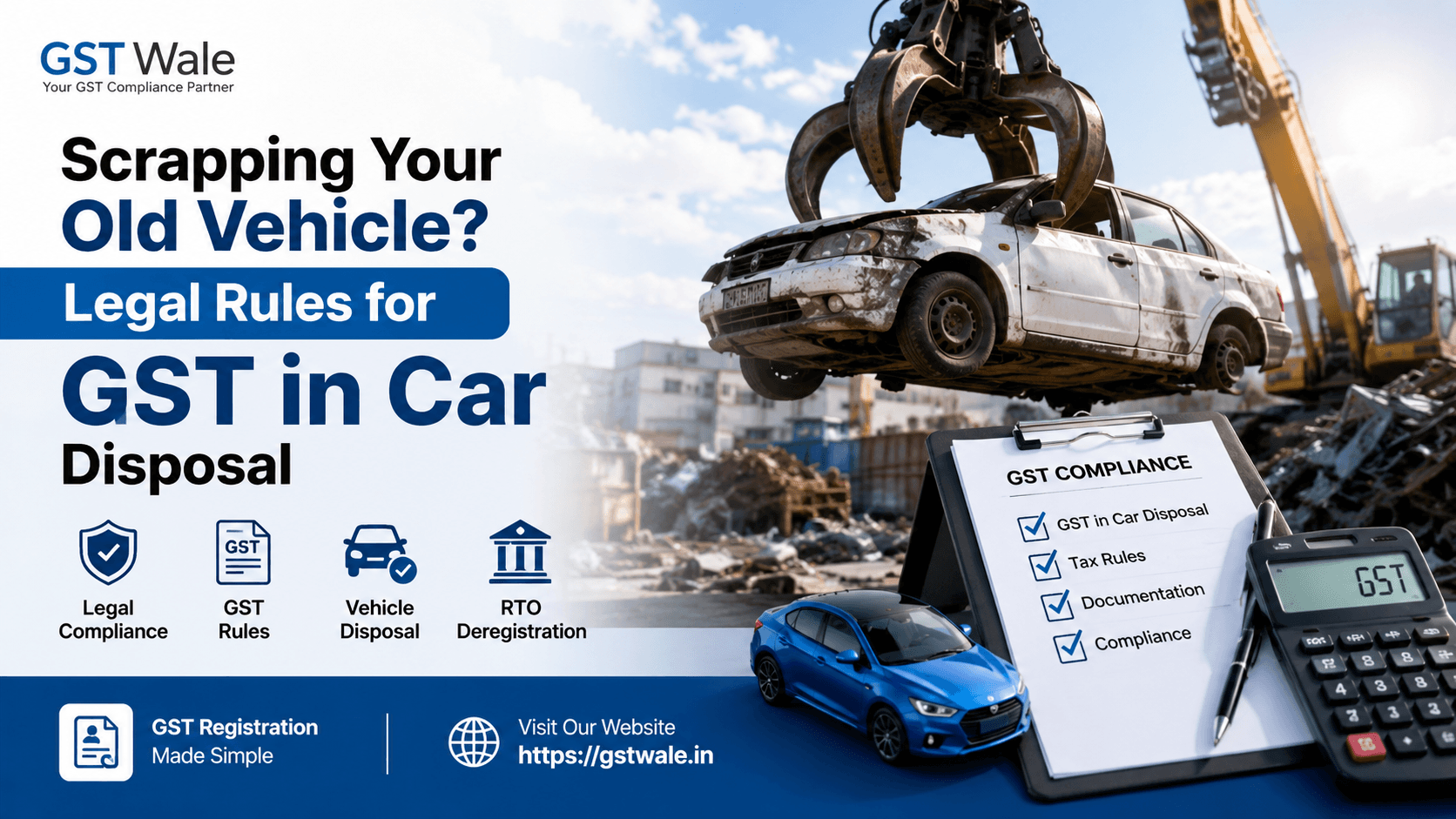
Scrapping Your Old Vehicle? Legal Rules for GST in Car Disposal
Scrapping Your Old Vehicle? Legal Rules for GST in Car Disposal
Disposing of an old vehicle is no longer as simple as selling it to a local scrap dealer. With updated government policies, environmental regulations, and GST compliance requirements, vehicle owners and businesses must understand the legal process before scrapping a car. One of the most common questions we receive at GST Wale is about gst in car disposal and whether GST applies when an old vehicle is sold for scrap.
If you are a business owner, transporter, company, or even an individual disposing of an old commercial vehicle, understanding gst in car transactions can help you avoid unnecessary tax disputes and remain compliant with Indian tax laws. If your business is expanding or you are purchasing and disposing of vehicles regularly, obtaining proper GST Registration is equally important for smooth compliance and record keeping.
In this guide, we will explain the legal rules, GST implications, documentation requirements, and practical considerations involved in vehicle disposal.
H2: Understanding GST in Car Disposal
The concept of gst in car disposal depends largely on who is selling the vehicle and the purpose for which the vehicle was used.
If the vehicle forms part of business assets and is sold during its useful life or after becoming unusable, GST implications may arise depending on the eligibility of input tax credit, nature of supply, and applicable GST provisions.
For private individuals selling their personal vehicles, GST generally does not apply because such transactions are usually outside the scope of business.
However, businesses disposing of company-owned vehicles should carefully evaluate the GST treatment before completing the sale.
H2: When Does GST Apply on Vehicle Scrapping?
The applicability of gst in car disposal depends on several factors, including:
- Whether the seller is GST registered.
- Whether the vehicle was used for business purposes.
- Whether Input Tax Credit (ITC) was claimed.
- Nature of disposal.
- Buyer of the scrap vehicle.
If the sale qualifies as a taxable supply under GST, the transaction may attract GST according to applicable rules.
Businesses should maintain proper tax invoices and accounting records while disposing of old vehicles.
H2: GST in Car Used for Business Purposes
When a vehicle is part of business operations, disposal becomes a taxable transaction in many situations.
Examples include:
- Company cars
- Delivery vans
- Commercial taxis
- Logistics vehicles
- Employee transport vehicles
Since these vehicles form part of business assets, gst in car disposal should be examined carefully before sale.
H3: Business Asset Retirement
One important concept is business asset retirement.
When a company removes an old vehicle from its fixed assets and sells it to a scrap dealer, accounting entries and GST treatment should both be properly documented.
Businesses should maintain:
- Asset disposal records
- Sale invoice
- Vehicle deregistration documents
- Accounting adjustments
- GST return disclosures
Proper documentation helps avoid future notices from tax authorities.
H2: Legal Process Before Scrapping an Old Vehicle
Vehicle disposal is governed not only by GST law but also by transport regulations.
Before scrapping your vehicle:
- Clear pending challans.
- Remove hypothecation if applicable.
- Obtain required NOC where necessary.
- Complete ownership verification.
- Sell only through authorised vehicle scrapping facilities.
Following these steps ensures legal disposal and smoother GST compliance.
H3: Deregistration Rules RTO
One important legal requirement involves deregistration rules RTO.
Before permanently scrapping a vehicle, the owner should complete deregistration formalities with the Regional Transport Office wherever required.
Proper deregistration helps:
- Prevent misuse of vehicle identity.
- Avoid future liabilities.
- Maintain legal ownership records.
- Support tax documentation.
Businesses should retain copies of deregistration certificates for future reference.
H2: GST in Car Scrap Sales
After a vehicle reaches the end of its life, it is often sold as metal scrap.
Here, the transaction may attract GST depending on the applicable classification and tax rules.
The invoice should clearly mention:
- Vehicle details
- Registration number
- Sale value
- GST details
- Buyer information
Maintaining accurate documentation simplifies audits and return filing.
H3: Vehicle Salvage Tax Rate
Many businesses ask about the vehicle salvage tax rate.
The applicable GST depends on the nature of the goods being supplied after disposal. If the vehicle is sold as scrap, GST treatment may differ from selling a used vehicle in working condition.
The classification of the material being sold plays an important role in determining tax liability.
Professional advice is recommended whenever high-value commercial vehicles are involved.
H3: Metal Scrap HSN Code
Businesses selling dismantled vehicle parts or scrap should also identify the appropriate metal scrap hsn code.
Correct HSN classification ensures:
- Accurate GST invoices
- Proper GST return filing
- Reduced compliance risks
- Better audit preparedness
Incorrect HSN reporting can lead to unnecessary notices or tax mismatches.
H2: Insurance Total Loss GST – What Happens?
Sometimes a vehicle is declared beyond repair after an accident.
This situation is commonly referred to as insurance total loss gst treatment.
If an insurance company declares the vehicle a total loss, GST implications may vary depending on:
- Insurance settlement structure
- Ownership transfer
- Salvage value
- Business use of the vehicle
Businesses should carefully review insurance documents before accounting for the transaction.
Professional tax advice is useful when handling high-value insurance claims involving commercial vehicles.
H2: Example of GST in Car Disposal
Consider a logistics company that owns a delivery van purchased several years ago.
The van becomes unusable after years of service.
The company:
- Removes the vehicle from fixed assets.
- Completes deregistration formalities.
- Sells the vehicle to an authorised scrap dealer.
- Issues a proper tax invoice.
- Reports the transaction in GST returns.
This is a practical example where gst in car disposal becomes part of overall business compliance.
H2: Documents Required During Vehicle Scrapping
Keep the following records safely:
- Registration Certificate (RC)
- PAN and Aadhaar (where applicable)
- GST invoice
- Sale agreement
- Asset disposal register
- Scrapping certificate
- Deregistration documents
- Accounting records
- Insurance documents
- Payment proof
Good documentation reduces future compliance issues.
H2: Common Mistakes Businesses Should Avoid
Many taxpayers unknowingly make errors while disposing of old vehicles.
Avoid these common mistakes:
- Ignoring GST applicability.
- Selling vehicles without invoices.
- Failing to complete RTO formalities.
- Incorrect HSN classification.
- Improper accounting treatment.
- Missing documentation.
- Wrong reporting in GST returns.
Proper planning makes gst in car compliance much easier.
H2: Expert Tips from GST Wale
As Chartered Accountants, we recommend the following:
- Evaluate GST before finalising the sale.
- Verify whether the vehicle formed part of business assets.
- Maintain complete documentation.
- Use authorised scrapping centres.
- Reconcile GST returns with accounting records.
- Preserve invoices and certificates for future assessments.
Professional compliance today can prevent expensive disputes tomorrow.
H2: Frequently Asked Questions
H3: Is GST applicable when selling an old personal car?
Generally, selling a personal vehicle by an individual is not considered a business transaction, so GST usually does not apply. However, business-owned vehicles require separate evaluation.
H3: Does GST apply if I scrap a commercial vehicle?
Yes, gst in car disposal may apply when a GST-registered business disposes of a commercial vehicle used in business activities. The exact tax treatment depends on the facts of the transaction.
H3: Why are deregistration formalities important?
Following deregistration rules RTO helps legally close vehicle ownership, prevents future liabilities, and supports proper tax documentation.
H3: What records should businesses maintain after vehicle disposal?
Businesses should retain invoices, accounting entries, scrapping certificates, deregistration documents, insurance records, and payment proofs for future compliance.
H3: Should I consult a GST professional before scrapping a vehicle?
Yes. Every business transaction has unique tax implications. Professional advice ensures correct compliance, proper documentation, and accurate GST reporting.
Understanding gst in car disposal is essential for every business that owns vehicles. Whether you are retiring an ageing commercial vehicle, handling insurance total loss gst situations, determining the correct vehicle salvage tax rate, identifying the appropriate metal scrap hsn code, or completing deregistration rules rto, proper compliance can save both time and money.
At GST Wale, our experienced Chartered Accountants help businesses manage GST compliance with confidence. From registrations and return filing to advisory services and transaction-specific guidance, we ensure every aspect of your GST obligations is handled professionally. Contact GST Wale today for reliable expert support and stay fully compliant with every stage of your business journey.
 Previous