


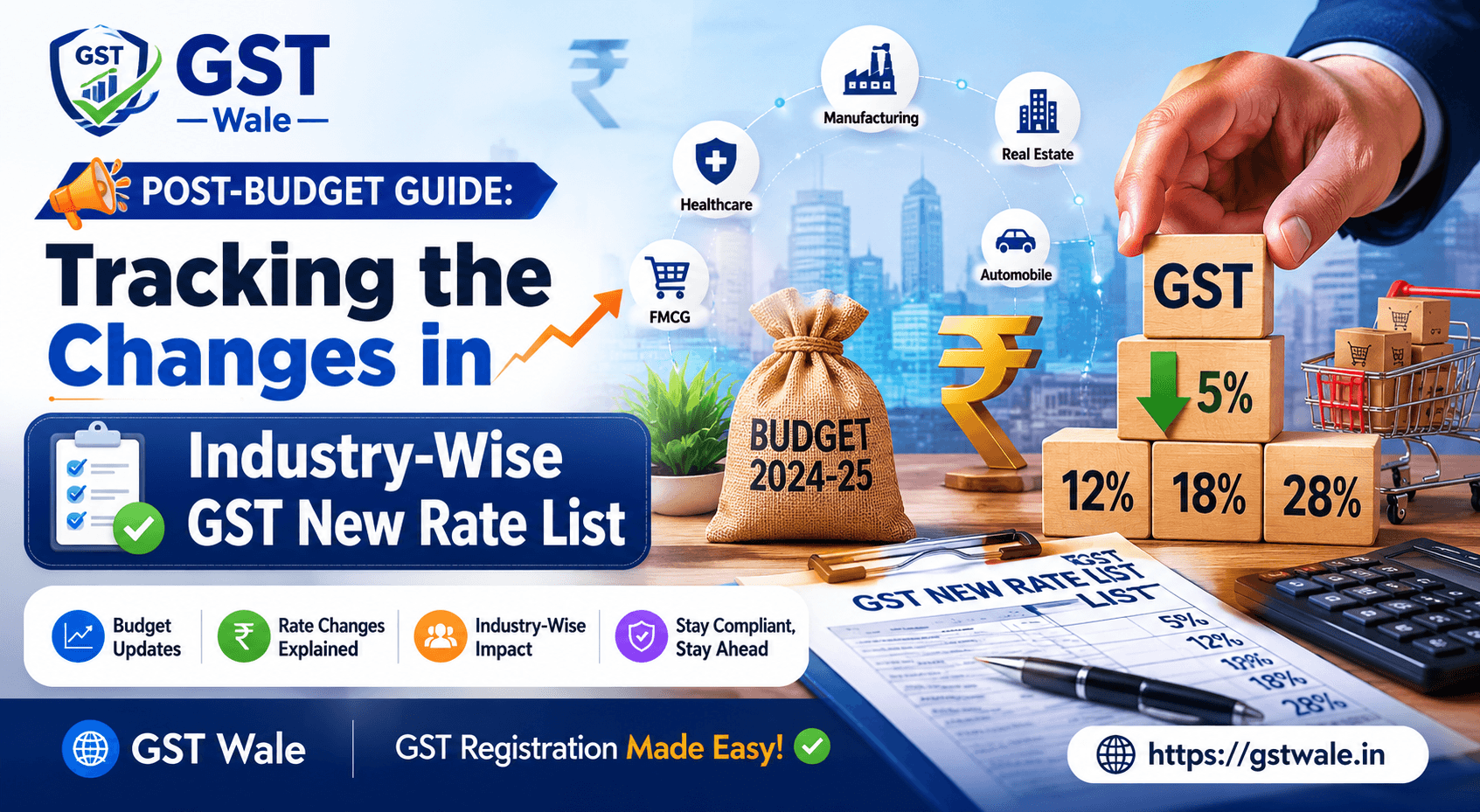
Post-Budget Guide: Tracking the Changes in the Industry-Wise GST New Rate List
Post-Budget Guide: Tracking the Changes in the Industry-Wise GST New Rate List
Every time the Union Budget drops, business owners across India hold their breath. As Chartered Accountants, our phones at GST Wale start ringing off the hook. Everyone has the exact same question: "Sir, did the tax on my product go up or down"
Navigating the post-budget landscape can feel like trying to decode a complex legal puzzle. The updates introduced in the latest budget have reshaped the gst new rate list, bringing significant changes across multiple sectors. Whether you are a manufacturing titan, a tech startup, or a local distributor, staying on top of these changes is non-negotiable for price compliance and claiming the right Input Tax Credit (ITC). If you are setting up a new venture in this post-budget era, securing your GST Registration under the correct category is your absolute first step to avoiding compliance penalties.
Let’s break down the industry-wise tax updates, explore the new slabs, and analyze what these changes mean for your bottom line.
Decoding the Budget Tax Notification: The New Slabs
The latest budget tax notification hasn't completely rewritten the GST law, but it has strategically recalibrated where certain items sit. India continues to stick to its multi-tier gst new slab structure (primarily 5%, 12%, 18%, and 28%). However, the shuffling of goods between these brackets means your accounting software needs an immediate invoice template update.
When the government revises the gst rates, the primary goal is usually twofold: lowering common-man essentials to curb inflation and streamlining raw material taxes to fix inverted duty structures. Let's look at how specific industries are panning out under the revised gst new rate list.
Industry-Wise Tax Blueprint and Sector Impact Analysis
A proper sector impact analysis reveals that the government is heavily focusing on domestic manufacturing and green energy. Here is how the key industries stand today:
1. Electronics and Consumer Tech
To boost the 'Make in India' initiative, the government has rationalized taxes on mobile phone components and certain consumer electronics.
What changed: Select inputs for smartphone manufacturing have been moved to a lower bracket.
The Impact: While the core gst new rate for finished smartphones remains stable, the cost of production for domestic assemblers is expected to drop, making Indian electronics more competitive.
2. Automobiles and Green Mobility
The push toward sustainability heavily reflects in the current gst rates structure.
Electric Vehicles (EVs): EVs continue to enjoy the lowest gst new slab of 5%, keeping them highly attractive.
Hybrid & IC Engines: Traditional internal combustion engines and luxury segments face the highest 28% bracket plus applicable cess.
Lithium-ion Cells: The budget hints at long-term relief on battery components, aligning with parallel custom duty updates that reduce import costs for critical minerals.
3. Textiles and Apparel
The textile industry has historically struggled with an inverted duty structure (where raw materials are taxed higher than finished goods).
The Correction: Adjustments in the gst new rate list aim to harmonize the tax on man-made fibers and fabrics. Ready-made garments below a specific price threshold continue to protect small-scale retailers, keeping affordable clothing accessible.
4. Fast-Moving Consumer Goods (FMCG)
For the everyday consumer, there is relatively stable ground. Essential food items, unbranded grains, and dairy products remain largely exempt or under the minimal 5% slab. Packed and branded commodities face a standard 12% or 18% levy, ensuring no massive shock to household budgets.
Expert CA Insight: Always cross-verify your HSN (Harmonized System of Nomenclature) codes immediately after a budget. A minor description change in the law can shift your product from an 12% bracket to an 18% bracket, leading to massive shortfalls during audits if ignored.
The Intersection of Custom Duty Updates and GST
A common mistake many importers make is looking at the gst new rate list in isolation. You cannot talk about the domestic gst new rate without analyzing import tariffs.
When the budget rolls out custom duty updates, it directly changes the Countervailing Duty (CVD) equivalents and the calculation matrix for Integrated GST (IGST) paid at the time of import. For example, if the basic customs duty on an imported component drops, the total assessable value on which IGST is levied decreases. This creates a cascading benefit, freeing up working capital for businesses relying on international supply chains.
How Business Owners Should Adapt to the GST New Rate List
Don't wait for your annual audit to fix tax discrepancies. Here is a step-by-step action plan from our desk at GST Wale to ensure your business remains fully compliant:
Audit Your Inventory Matrix: Run your entire inventory list against the newly released gst new rate list. Update the tax master in your ERP or accounting software.
Re-evaluate Vendor Invoices: Ensure your suppliers are charging the corrected gst new rate. If they overcharge you based on outdated rates, your ITC matching on the GST portal will face severe mismatches.
Revise Price Lists: If your product’s tax slab has dropped, anti-profiteering clauses require you to pass that benefit to consumers. Conversely, if taxes have risen, your profit margins will take a hit unless you consciously revise your market pricing.
Frequently Asked Questions (FAQs)
Q1. Where can I officially download the latest gst new rate list?
The official, finalized gst new rate list and accurate tax charts can be accessed via the Central Board of Indirect Taxes and Customs (CBIC) portal or through official circulars issued following the budget tax notification.
Q2. What happens if I accidentally clear old stock using outdated gst rates?
If you short-pay tax due to an outdated rate, you will be liable to pay the differential tax amount along with interest under Section 50 of the GST Act. It is critical to issue debit notes or supplementary invoices to rectify this quickly.
Q3. How does a change in the gst new slab affect my pending Input Tax Credit (ITC)?
A change in the forward tax rate does not retroactively change the ITC you already legally earned on past purchases. However, going forward, your ITC accumulation will mirror the updated industry-wise tax structures.
Q4. Do these post-budget updates apply to all states simultaneously?
Yes. Because GST is a dual tax structure, any rate changes recommended by the GST Council and cleared via the budget notifications apply uniformly across both Central GST (CGST) and State GST (SGST) structures nationwide.
Let GST Wale Handle Your Compliance Burden
Keeping up with evolving tax slabs, shifting custom duties, and structural compliance can quickly overwhelm a business owner. At GST Wale, we take the guesswork out of taxation. From securing your initial setup to handling complex post-budget transitional credits, our experienced team of professionals ensures your business never misses a compliance beat.
 Previous