


How to Read a Hotel Bill Correctly: Decoding Room Tariffs and the GST New Rate
How to Read a Hotel Bill Correctly: Decoding Room Tariffs and the GST New Rate
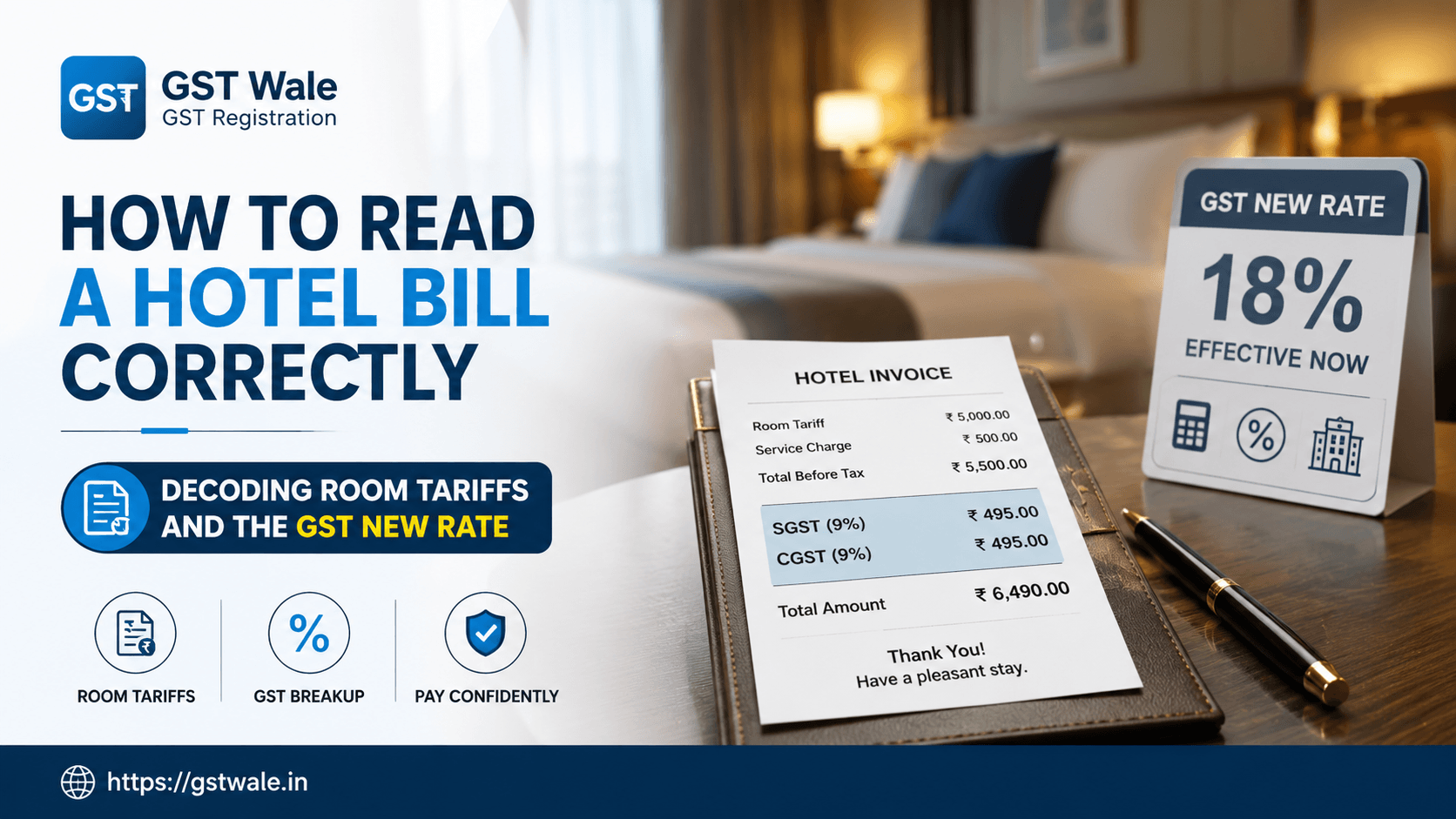
Ever checked out of a beautiful hotel after a relaxing weekend, looked at the final invoice, and felt your head spin? Between the base room tariff, the in-room dining charges, and a maze of different tax percentages, reading a hospitality invoice can feel like decoding a cryptic puzzle.
As business owners or frequent travelers, understanding these charges is crucial. At GST Wale, we meet corporate clients every week who accidentally overpay or fail to claim the correct Input Tax Credit (ITC) simply because they don’t know how to verify their hospitality bills against the current regulations. If you are running a business and booking hotels frequently for your team, getting your GST Registration in order is the first step toward seamlessly claiming these tax credits. Once that is sorted, the next step is knowing exactly how the gst new rate applies to your stay so you can spot errors instantly.
Let’s break down exactly how to read your hotel bill like a seasoned auditor.
Decoding the Anatomy of a Hotel Invoice
Before we dive into the specific tax percentages, it helps to understand that a standard hotel invoice is divided into two distinct operating categories:
The Room Tariff: The core charge for your lodging.
Food and Beverage (F&B): Covers room service, the in-house restaurant, and mini-bar items.
Hotels are legally required to separate these charges because they attract entirely different tax treatments. You cannot have a single blanket tax applied to the entire bill if you ordered a club sandwich to your room. The room tariff follows the lodging rules, while your dinner follows the restaurant rules.
How the GST New Rate Applies to Room Tariffs
The hospitality sector has seen several structural shifts over the years. Gone are the days of confusing luxury taxes and service taxes. Today, the tax structure is purely based on the declared tariff of the room per night.
To ensure you aren’t being overcharged, check your invoice against the official gst new rate list for accommodation:
Rooms Priced up to ₹7,500 per Night
If your actual room tariff (the value of supply) is between ₹1,001 and ₹7,500 per night, it attracts a gst new rate of 12%. This is split equally as 6% Central GST (CGST) and 6% State GST (SGST) for intra-state bookings. Note that rooms priced below ₹1,000 per night, which were previously exempt, also fall into tax brackets under recent fiscal revisions, so keep an eye out for a clean 12% on budget stays.
Luxury Hotel GST: Rooms Priced Above ₹7,500 per Night
For premium stays, villas, and suites where the room tariff exceeds ₹7,500 per night, a higher gst new rate of 18% applies (9% CGST + 9% SGST). This is often referred to as the luxury hotel gst bracket.
CA Insight on Declared vs. Transaction Value: Always check which value the hotel used to calculate the tax. In the early days of GST, taxes were levied on the declared tariff (the rack rate printed on the door). Under the updated rules, the tax is calculated strictly on the transaction value—the actual discounted price you paid. If the rack rate is ₹9,000 but you booked it on a discount for ₹6,500, the applicable tax bracket should be 12% (based on ₹6,500), not 18%. If a hotel charges you 18% on a discounted room that fell below the ₹7,500 threshold, challenge it immediately.
Food and Beverage Tax Billing: What About the Restaurant?
When you order food to your room or eat at the hotel’s buffet, you are dealing with a different set of hospitality tax slabs. This is where many hotel accounting systems accidentally miscalculate charges.
Standard In-Hotel Restaurants
For most standard hotels where the room tariff is under ₹7,500, the restaurant service tax component under GST is set at a flat 5% without Input Tax Credit. This means the hotel cannot claim credits on their raw ingredients, but they can only charge you 5% on your food bill.
Restaurants inside Luxury Hotels
If the restaurant is located inside a hotel premises where any room tariff exceeds ₹7,500 per night, the food and beverage tax billing changes. In these premium properties, the food automatically attracts a gst new rate of 18% with full Input Tax Credit allowed to the hotel.
So, do not be surprised if a cup of coffee at a luxury resort has an 18% tax attached to it, while the exact same coffee at a mid-tier business hotel charges only 5%. It is entirely legal and dictated by the property's highest room tier.
Step-by-Step: How to Audit Your Own Hotel Bill
The next time you are standing at the reception desk waiting to check out, perform this quick 4-step audit:
Step 1: Verify the Base Rate: Ensure the room rate matches your booking voucher or corporate contract exactly before any taxes are added.
Step 2: Check the Tax Split: Look at the CGST and SGST columns. If you are staying in a hotel within your home state, you will see CGST and SGST. If you are traveling out-of-state for business, it will likely still be CGST/SGST of that specific state, meaning you need to be careful about how you claim corporate ITC depending on your state registrations.
Step 3: Separate Food from Lodging: Ensure that your room service food items are billed at either 5% or 18% depending on the property type, and not clubbed into the room's tax percentage if they differ.
Step 4: Check for Forbidden Charges: Ensure the hotel hasn't added a "Service Charge" under the guise of a government tax. A service charge is an optional tip collected by the hotel, not a statutory tax. You have the right to ask for its removal if you were unsatisfied with the service.
Frequently Asked Questions
1. What is the current gst new rate for a hotel room priced at ₹8,000?
A hotel room priced above ₹7,500 per night attracts a tax rate of 18%. This is split into 9% CGST and 9% SGST.
2. Can I claim Input Tax Credit (ITC) on out-of-state hotel stays?
This is a common headache for businesses. Because hotels apply CGST and SGST of the state where the immovable property (the hotel) is located, a business registered in Maharashtra generally cannot claim ITC for an SGST component charged by a hotel in Delhi. However, IGST can occasionally be applied if specific corporate billing setups are handled correctly.
3. Is the tax calculated on the extra bed charges?
Yes. If you pay an extra ₹1,500 for an additional bed in the room, that amount is clubbed with the base room tariff. If the combined total pushes the night's cost over the ₹7,500 threshold, the entire amount moves into the higher gst new slab.
4. What is the difference between the gst new rate list for banquet halls vs. standard rooms?
Banquets and outdoor catering services bundled with a hotel stay are typically treated as a composite supply or specific catering service, which generally attracts an 18% tax rate, different from the standalone 5% standalone restaurant rate.
Wrap Up: Let GST Wale Simplify Your Taxes
Reading a hotel bill correctly doesn’t just save you a few hundred rupees on a weekend getaway—it protects your business from compliance errors and inflated operational costs. Keeping track of the shifting gst rates can feel like a full-time job, but it doesn't have to be yours.
Whether you need help setting up a clean framework for your corporate travel claims, managing your monthly returns, or executing a fresh GST Registration for a expanding business, GST Wale is here to act as your virtual corporate legal department. We take the stress out of compliance so you can focus entirely on growing your business.
 Previous