


Demystifying the GST New Slab Structure: What Falls Under 5%, 18%, and 40%?
Demystifying the GST New Slab Structure: What Falls Under 5%, 18%, and 40%?
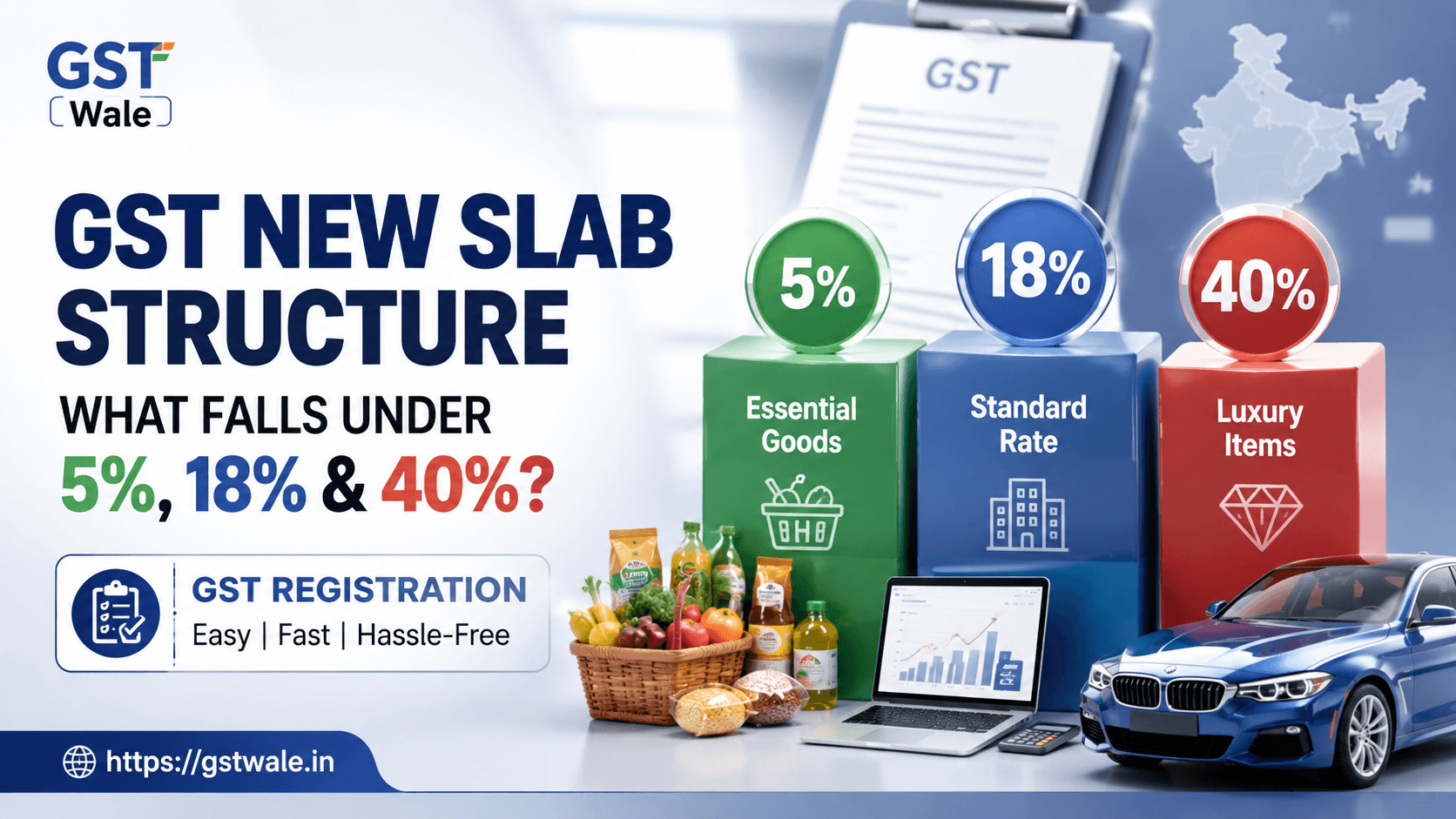
The discussion around the gst new slab structure has become one of the most important topics for businesses, traders, and consumers across India. Whenever the government reviews tax policies, business owners naturally want to understand how changes in GST can affect pricing, compliance, and profitability.
At GST Wale, we regularly interact with businesses that ask practical questions like: “Will my products become costlier?” or “Do I need to change my billing process?” Understanding the gst new slab system is important because even a small change in tax rates can affect your cash flow and customer pricing strategy.
If you are starting a business or expanding operations, proper tax compliance starts with timely GST Registration, ensuring your business stays compliant from day one.
In this guide, we will simplify the proposed tax structure, explain what products and services may come under various categories, and discuss what these changes could mean for businesses and consumers.
Understanding the GST New Slab Structure
GST in India was originally designed with multiple tax rates to balance the needs of different categories of goods and services. The idea was straightforward:
- Lower tax on essential items
- Moderate tax on commonly used products
- Higher tax on luxury or non-essential products
The proposed gst new slab discussions mainly focus on improving efficiency through tax rate rationalization and reducing confusion in classifications.
The commonly discussed slabs include:
- 5% GST
- 18% GST
- 40% GST for selected categories
Each tax category serves a different purpose in the GST ecosystem.
GST New Slab at 5%: Essential Goods and Common Products
The lower tax bracket primarily aims to keep daily necessities affordable for the public.
What generally falls under the 5% category?
Products and services commonly associated with lower GST rates may include:
- Packaged food items
- Household essentials
- Public transport services
- Certain medicines
- Basic utility products
The purpose of this slab is to support affordability and maintain access to necessary products.
Understanding essential goods exemption
Many people confuse a lower tax rate with an essential goods exemption. These are two different things.
For example:
- Fresh fruits and vegetables may be exempt
- Unprocessed food products may be exempt
- Certain educational materials may be exempt
However:
- Processed or packaged products can attract GST
Business owners should carefully verify classifications before invoicing customers.
Practical example
Suppose a grocery wholesaler sells packaged food products worth ₹1,00,000.
If the applicable tax falls under the 5% slab:
- Product value: ₹1,00,000
- GST @5%: ₹5,000
- Invoice total: ₹1,05,000
Even small changes in rates can impact pricing and purchasing behavior.
GST New Slab at 18%: The Standard Tax Rate
The 18% category is often considered the standard tax rate under GST and covers a large number of products and services.
Products and services commonly under 18%
Examples may include:
- Business consultancy services
- IT services
- Restaurant services in specific categories
- Industrial products
- Electronic items
- Financial services
For many businesses, this slab represents the most common tax category used in everyday operations.
Why is 18% considered important?
The government designed this slab to create a balance between revenue generation and affordability.
For example:
A digital marketing company issues an invoice worth ₹50,000.
Calculation:
- Service amount: ₹50,000
- GST @18%: ₹9,000
- Total invoice: ₹59,000
Businesses registered under GST may claim Input Tax Credit (ITC), reducing their effective tax burden.
This is one reason why maintaining accurate records becomes extremely important.
GST New Slab at 40%: Understanding the Luxury Tax Slab
One of the major discussions in tax reforms has involved introducing a higher luxury tax slab for selected products.
The objective is straightforward:
- Increase tax collection from luxury consumption
- Keep essential products affordable
- Improve tax balance across sectors
What products could potentially fall under a 40% slab?
Examples often discussed include:
- Premium luxury cars
- High-end imported products
- Certain luxury goods
- Non-essential premium items
Why impose higher taxes on luxury items?
The concept follows a progressive taxation approach.
If someone purchases a premium luxury vehicle worth ₹30 lakh:
- Product value: ₹30,00,000
- GST @40%: ₹12,00,000
- Total cost impact becomes significant
Such taxation primarily targets discretionary spending rather than essential consumption.
How GST Rate Rationalization Affects Businesses
The idea behind tax rate rationalization is not simply increasing or decreasing taxes.
The broader goals include:
- Reducing classification disputes
- Simplifying tax administration
- Improving compliance
- Creating uniformity across industries
Businesses often face challenges where similar products fall under different tax categories.
For example:
One food item may attract:
- 5% GST in one category
- 12% GST in another category
Such differences create confusion during audits and assessments.
A more streamlined gst new slab structure could reduce these practical issues.
Understanding GST New Rate and GST New Rate List
Many business owners search online for the latest gst new rate and gst new rate list expecting a single updated chart.
However, businesses should remember an important point:
GST rates are revised periodically based on recommendations and notifications.
Before updating pricing or invoices:
- Verify official notifications
- Review HSN classifications
- Check applicable circulars
- Consult GST experts when necessary
Depending solely on assumptions can create compliance risks.
What Businesses Should Do if GST Rates Change
Whenever a gst new slab update is announced, businesses should act quickly.
Step 1: Update accounting software
Ensure GST percentages reflect revised rates.
Step 2: Review pricing strategy
Decide whether to absorb the tax increase or pass it to customers.
Step 3: Train finance teams
Employees handling billing should understand new tax classifications.
Step 4: Review vendor invoices
Incorrect tax rates from suppliers can affect Input Tax Credit claims.
Step 5: Seek professional guidance
Early consultation prevents costly compliance mistakes.
FAQs
1. What is the gst new slab structure?
The gst new slab structure refers to revised or proposed GST tax categories designed to simplify taxation and improve compliance.
2. What is considered the standard tax rate under GST?
The 18% category is generally considered the standard tax rate for many products and services.
3. What is a luxury tax slab?
A luxury tax slab is a higher GST category applied to premium and non-essential goods.
4. Are essential items exempt from GST?
Certain products fall under essential goods exemption, while others may attract lower GST rates.
5. Where can businesses check the gst new rate list?
Businesses should refer to official GST notifications and professional guidance instead of relying on unofficial sources.
Understanding the gst new slab structure is no longer optional for businesses operating in India. Whether it involves lower tax on essentials, the 18% standard category, or higher taxation on luxury products, every change directly affects pricing, compliance, and business planning.
At GST Wale, we help businesses understand changing gst rates, ensure proper compliance, and avoid costly mistakes. If you need assistance with GST registration, return filing, or expert GST consultation, connect with GST Wale and let experienced professionals simplify taxation for your business journey.
 Previous