


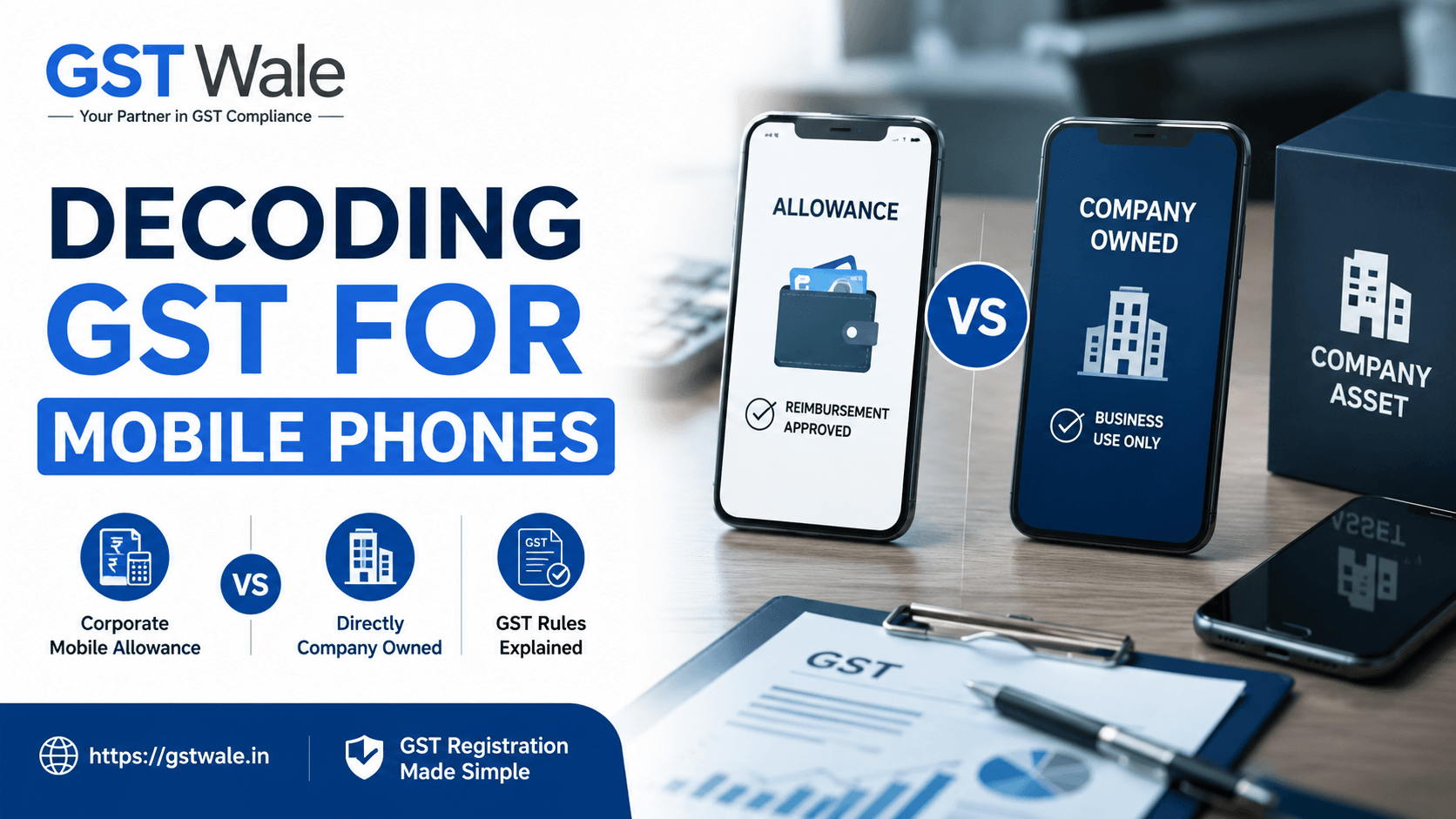
Corporate Mobile Allowance vs Directly Company Owned: Decoding GST for Mobile Phones
Corporate Mobile Allowance vs Directly Company Owned: Decoding GST for Mobile Phones
In today's business environment, mobile phones are no longer a luxury—they are an essential business tool. Whether it is speaking with clients, coordinating with employees, attending virtual meetings, or managing operations on the move, smartphones have become an integral part of business communication costs. However, when employers decide to support employee mobile usage, an important question arises: should the company provide a mobile allowance or purchase and own the device directly? Understanding **gst for mobile phones** is essential before making this decision. Businesses planning to formalize their compliance should also ensure proper GST Registration to claim eligible tax benefits and maintain accurate records.
Many organisations focus only on employee convenience while overlooking the GST implications. As experienced professionals at GST Wale, we regularly help businesses understand how different ownership structures affect taxation, input tax credit, documentation, and compliance. This article explains the practical differences between mobile allowances and company-owned phones, helping you make an informed decision.
Why Understanding GST for Mobile Phones Matters
Every business aims to reduce operational expenses while remaining compliant with tax laws. The treatment of **gst for mobile phones** depends on whether the mobile phone is owned by the company or the employee. The ownership model influences tax benefits, accounting treatment, documentation requirements, and eligibility for Input Tax Credit (ITC).
A wrong approach can lead to unnecessary tax costs, denial of ITC, or compliance issues during departmental assessments.
Two Common Models Adopted by Businesses
1. Corporate Mobile Allowance
In this model, the employee owns the mobile phone and usually pays the monthly bills. The employer reimburses either:
- A fixed monthly mobile allowance.
- Actual expenses based on submitted bills.
- A combination of allowance and reimbursement.
This method is widely used because it reduces asset management responsibilities for employers.
2. Company-Owned Mobile Phones
Under this arrangement, the company purchases the handset in its own name and provides it to employees strictly for official work. Monthly recharge or postpaid bills are also paid directly by the organisation.
This model generally offers better compliance and stronger documentation when claiming benefits under **gst for mobile phones**.
GST for Mobile Phones in Company-Owned Devices
When a business purchases mobile phones for official use, GST paid on the purchase may qualify for Input Tax Credit, provided all legal conditions are satisfied.
Eligibility for Input Tax Credit
A company can generally claim ITC when:
- The invoice is issued in the company's name.
- The supplier has correctly charged GST.
- The mobile phone is used for business purposes.
- The purchase is properly recorded in accounting records.
- GST returns are filed within prescribed timelines.
This is where proper **input credit mapping** becomes extremely important. Businesses should maintain accurate documentation showing which devices are allotted to specific employees and how they are used for official work.
Practical Example
Suppose a consulting company purchases twenty smartphones for its sales team. The invoices are issued in the company's name, payments are made through the business bank account, and employees use the phones exclusively for client communication.
In such cases, the business may generally claim ITC under applicable GST provisions, making the company-owned approach financially beneficial.
GST for Mobile Phones Under Employee Reimbursement
The treatment of **gst for mobile phones** becomes more complex when employees own the devices.
If employees purchase their own phones and later receive reimbursement, the employer may not automatically become eligible to claim ITC because the tax invoice is usually issued in the employee's name instead of the company's name.
This distinction is one of the biggest reasons many businesses prefer company-owned devices for employees whose work heavily depends on mobile communication.
Understanding Phone Bill Reimbursement Tax
The concept of **phone bill reimbursement tax** often creates confusion.
If reimbursement is made strictly against actual official expenses and supported by valid documentation, the tax implications may differ from a fixed allowance paid as part of salary. Businesses should clearly define reimbursement rules and preserve all supporting records.
Each case should be examined based on employment terms, reimbursement policy, accounting treatment, and applicable GST provisions.
Corporate Ownership Perks Beyond GST
Apart from better compliance under **gst for mobile phones**, businesses enjoy several additional advantages through direct ownership.
Key Corporate Ownership Perks
- Better control over company assets.
- Simplified ITC documentation.
- Uniform security policies across devices.
- Easier employee onboarding and exit management.
- Improved monitoring of official business communication costs.
- Centralised procurement often reduces purchase costs.
These **corporate ownership perks** often outweigh the administrative convenience of reimbursements.
Role of HR Policy Taxation in Mobile Benefits
A strong **hr policy taxation** framework is essential when companies provide communication benefits.
Your HR policy should clearly specify:
- Who is eligible for company-issued devices.
- Maximum reimbursement limits.
- Business-only usage expectations.
- Documentation required for reimbursements.
- Ownership of devices after resignation.
- Replacement and damage policies.
Well-documented policies reduce future disputes and improve compliance during audits.
Managing Business Communication Costs Efficiently
Every organisation wants to optimise **business communication costs** without creating unnecessary tax exposure.
Consider these practical strategies:
- Issue company-owned phones for client-facing employees.
- Maintain a proper asset register.
- Use corporate telecom plans wherever possible.
- Keep invoices in the company's legal name.
- Review mobile usage periodically.
- Ensure accounting and HR teams coordinate documentation.
These simple practices support better compliance under **gst for mobile phones** while improving financial control.
Step-by-Step Decision Guide
If Your Business Has Fewer Employees
- Estimate monthly communication expenses.
- Compare reimbursement costs with device ownership.
- Review ITC eligibility.
- Implement a written policy.
If Your Business Has Large Teams
- Purchase devices centrally.
- Allocate phones department-wise.
- Maintain proper input credit mapping.
- Conduct periodic internal reviews.
- Track employee handovers during exits.
Common Mistakes Businesses Should Avoid
- Claiming ITC on employee invoices.
- Paying fixed allowances without proper documentation.
- Ignoring written HR policies.
- Maintaining incomplete purchase records.
- Failing to reconcile telecom bills with accounting records.
- Ignoring regular compliance reviews.
Frequently Asked Questions
Can a company claim GST credit on employee-owned mobile phones?
Generally, claiming ITC becomes difficult when the purchase invoice is issued in the employee's name instead of the company's name. Proper ownership and documentation play a crucial role in determining eligibility.
Is a company-owned phone better than providing a mobile allowance?
From a GST and documentation perspective, company-owned devices often provide better compliance, stronger record keeping, and improved control over business assets and communication expenses.
Does reimbursement always qualify for GST benefits?
No. The tax treatment depends on documentation, ownership, invoice details, employment terms, and the nature of reimbursement. Every situation should be evaluated carefully.
Why is input credit mapping important?
Input credit mapping helps businesses establish a clear link between purchased devices, business usage, employee allocation, and accounting records. It strengthens compliance and supports ITC claims during audits.
How can businesses improve compliance for mobile expenses?
Maintain invoices in the company's name, implement clear HR policies, preserve supporting records, monitor usage, and conduct regular internal reviews of communication-related expenses.
Choosing between a corporate mobile allowance and a company-owned device involves much more than employee convenience. Proper evaluation of **gst for mobile phones**, ownership structure, documentation, ITC eligibility, reimbursement policies, and compliance requirements can significantly impact business costs. For organisations seeking long-term efficiency, company-owned devices often provide stronger tax advantages, better governance, and simplified compliance.
Need Expert GST Guidance?
At GST Wale, we help businesses understand complex GST provisions through practical advice tailored to real business situations. Whether you need assistance with **gst for mobile phones**, Input Tax Credit planning, compliance reviews, registrations, or ongoing GST support, our experienced professionals are here to help. Connect with GST Wale today and ensure your business remains compliant while maximising every legitimate tax benefit available.
 Previous