


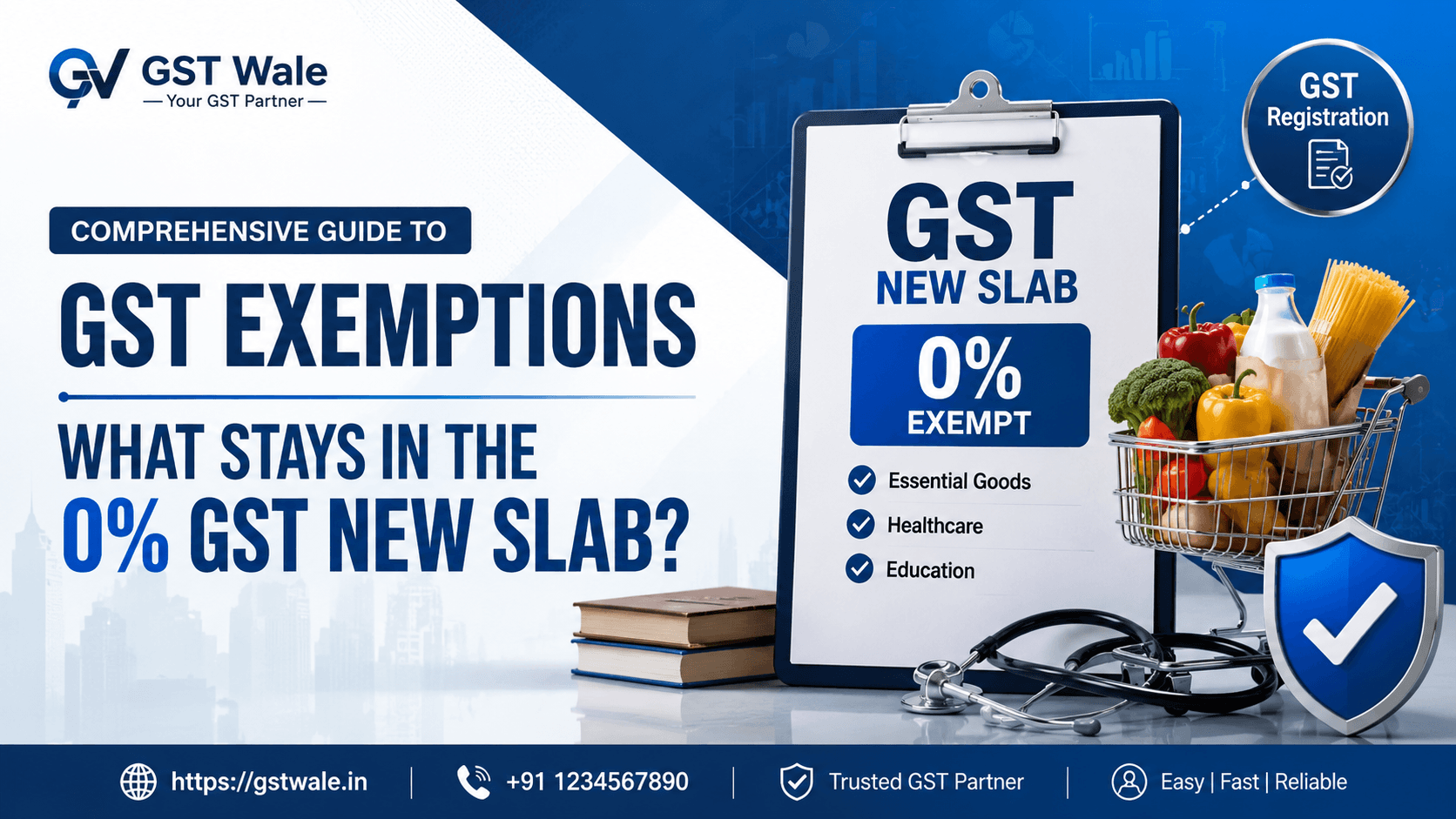
Comprehensive Guide to GST Exemptions: What Stays in the 0% GST New Slab?
Comprehensive Guide to GST Exemptions: What Stays in the 0% GST New Slab?
Every year, as business dynamics evolve, the Government of India fine-tunes the Indirect Tax landscape. As Chartered Accountants, the most frequent question we handle at GST Wale revolves around how these shifts impact the pocket of a common man and the balance sheet of an SME. With recent notifications rolling out, everyone is trying to decode the gst new slab structure, particularly the zero-percent bracket. Understanding what falls under this exemption is critical because even a minor misclassification within the gst new slab framework can result in unexpected department notices. If you are setting up a new venture or expanding your operations, securing an accurate GST Registration is your very first step to navigating these tax brackets legally and smoothly.
In this comprehensive handbook, we will break down the entire mechanism of the 0% gst new slab, separate the myths from facts, and give you a clean, updated view of what stays completely tax-free under this regime today.
Decoding the 0% GST New Slab vs Zero-Rated Items
First, let us clear up a massive technical point that trips up many entrepreneurs when studying the rules. In our daily CA practice, we see people mixing up "exempted goods" under the 0% gst new slab with zero rated items.
While both mean you pay 0% tax at the point of sale, their structural accounting under gst rates rules inside the tax framework is vastly different:
Exempted Goods (0% Slab): These are goods or services on which the gst new rate is set to 0% within the gst new slab. However, businesses selling these items cannot claim Input Tax Credit (ITC) on the raw materials or administrative services used.
Zero Rated Items: This specific tag applies primarily to exports and supplies made to Special Economic Zones (SEZs). Here, the entire supply chain is tax-free, and the exporter can actively claim refunds on input taxes, unlike standard items in the 0% gst new slab.
Knowing this distinction within the gst new slab system helps you manage your pricing matrix correctly without eating into your bottom-line profit margins.
The Essential Food Tax Free Category: What Stays Untouched?
The philosophy of the Indian GST structure has always been social equity—keeping the common man's kitchen budget stable and predictable. Under the updated gst new rate list, the government has meticulously maintained a wide range of essential food tax free items inside the 0% gst new slab to prevent inflationary pressure on daily households.
Here is a quick breakdown of daily household consumables that enjoy a 0% gst new rate under the law:
Unbranded and Loose Agro Products: Fresh vegetables, local fruits, fresh milk, unpasteurized curd, lassi, loose paneer, natural honey, and fresh meat or fish stay protected in this gst new slab.
Flours and Grains: Loose or unbranded rice, wheat, rye, oats, and maize are also part of the 0% gst new slab collection.
Daily Essentials: Common salt, loose jaggery (gur), and organic manure are completely tax-free here.
Expert Insights from GST Wale: A major point of friction in the application is the packaging rule. If these same items are pre-packaged and labeled under the Legal Metrology Act, they generally attract a 5% tax and leave the 0% gst new slab. If you sell loose grains, you sit safely in the 0% gst new slab; the moment you pre-pack and seal them with weight labels, the dynamic changes.
Crucial Pillars: Educational Service Exemption and Healthcare
Beyond food, the government classifies mind and body wellness as basic constitutional necessities. Hence, these two sectors hold massive protective relief within the overall gst rates architecture and the 0% gst new slab specifically.
Understanding the Educational Service Exemption
The educational service exemption remains highly robust under the current framework. The absolute 0% gst new slab applies directly to:
Core services provided by an educational institution to its students, faculty, and staff members.
Conduct of examinations, admissions, and standard curriculum delivery under the gst new slab guidelines.
Mid-day meal catering, security, and cleaning services specifically provided to a pre-school or higher secondary school.
However, note that commercial coaching centers, private skill development institutes, and corporate training programs do not qualify for this shield—they attract the standard 18% slab rather than the 0% gst new slab.
Healthcare Framework and the Health Insurance Zero Tax Reality
Medical consultations, hospital room stays (below a specified daily limit), and diagnostics by authorized clinics remain tax-free under this bracket. But what about insurance?
There is a growing demand across trade bodies regarding a comprehensive health insurance zero tax structural push into the tax-free tier. Currently, standard health insurance policies attract an 18% levy. However, specific government-backed schemes designed for the economically weaker sections—such as the Rashtriya Swasthya Bima Yojana or Ayushman Bharat—enjoy a full health insurance zero tax status within the 0% gst new slab to make healthcare affordable at the grassroots level.
Services That Safely Sit in the 0% GST New Slab
Apart from tangible goods, a variety of everyday public utilities and financial transactions are sheltered within the 0% gst new slab to keep basic living costs predictable:
Public Transport & Commute: Traveling via metro, local monorails, auto-rickshaws, cycle rickshaws, and non-AC metered cabs is kept in the 0% gst new slab.
Financial Utilities: Interest charged on loans, advances, or deposits (since taxing interest would cripple standard banking flows) remains clear of any tax in this bracket.
Residential Living: Renting out a residential dwelling unit for use as a private home or residence qualifies for the 0% gst new slab.
Practical Steps for Businesses to Align with the GST New Slab
If your business deals in a mix of taxable and exempted items under the revised gst new rate list, compliance inside the gst new slab must be absolute. Here is a step-by-step checklist recommended by our advisory team at GST Wale:
HSN Code Mapping: Review your item master list. Ensure the Harmonized System of Nomenclature (HSN) codes accurately reflect whether the item belongs to the 0% gst new slab or a higher tier.
Proportionate ITC Reversal: If you use common inputs to sell both 18% taxable goods and 0% items under the gst new slab, you must reverse your Input Tax Credit proportionately under Rules 42 and 43.
Bill of Supply vs. Tax Invoice: For zero-tax sales falling under the gst new slab, never issue a standard Tax Invoice showing separate tax lines. You must legally issue a "Bill of Supply."
Frequently Asked Questions (FAQs)
1. Does the gst new slab mean everything unbranded is 0%?
Not necessarily. While most unbranded food grains are at 0%, many unbranded non-food items still attract standard tax rates outside the gst new slab. Always check the specific HSN code description under the official gst rates directory.
2. Can I claim Input Tax Credit on expenses if my sales are under the 0% gst new rate?
No. If your outward supplies are completely exempt under the 0% gst new slab, you cannot utilize or claim Input Tax Credit on your business purchases.
3. Are all types of books tax-free under the gst new rate list?
Yes, printed books, newspapers, journals, and maps are fundamentally categorized under the 0% gst new slab to support literacy. Electronic books (e-books), however, carry an 18% tax rate.
4. What happens if I accidentally charge GST on an exempted 0% item?
If you collect tax on a zero-tax item from the gst new slab, you cannot pocket it. Legally, you are mandated to deposit that collected amount with the government.
Staying Compliant with GST Wale
Navigating the complexities of the gst new slab updates requires a proactive approach. While the 0% tier offers massive relief to end consumers and specific industries, it demands rigorous accounting from business owners—particularly around tracking your brand status and managing proportionate Input Tax Credit reversals within the gst new slab framework.
At GST Wale, we simplify your entire indirect tax journey so you can focus completely on scaling your business. Whether you need help navigating a gst new slab category, initial compliance setup, or end-to-end monthly return filing, our expert team ensures your business remains perfectly aligned with the latest gst rates updates. Get in touch with GST Wale today, and let us build a bulletproof compliance framework for your enterprise!
 Previous